
Reverse osmosis
Key facts
- Installs at
- Whole house or single tap
- Removes
- PFAS, Lead, Arsenic, Nitrate, Fluoride, Copper, Uranium
- Does not remove
- Bacteria, Hydrogen sulfide
- Certifications
- NSF/ANSI 58, NSF/ANSI 53, NSF/ANSI 42, NSF/ANSI 401 what these mean
- Needs
- a drain
- Typical cost
- $300 to $950 installed under a sink; $200 to $450 for a countertop unit; $4,800 to $8,000 for whole-house
- Upkeep
- prefilters every 6 to 12 months, membrane every 2 to 3 years
Reverse osmosis (RO) removes the widest range of dissolved contaminants of any common home treatment, which is why it is the usual answer for PFAS, arsenic, nitrate and fluoride in drinking water. EPA says RO is “typically more than 90 percent effective at removing a wide range of PFAS, including shorter chain PFAS.”
It is slow and sends water down the drain, so it is almost always installed at one tap rather than for the whole house; the Minnesota Department of Health calls RO “more practical as a point-of-use treatment option.” For most homes, a certified under-sink or countertop unit is cheaper than any whole-house system that claims similar results.
How it works
Household water pressure pushes water through a semi-permeable membrane with pores the CDC puts at about 0.0001 micron. Dissolved salts, metals and many other contaminants stay on the feed side and are flushed to the drain as reject water.
A typical system has several stages:
- Pre-filters (sediment and carbon) remove particles and chlorine, which Nebraska Extension says extends membrane life.
- The RO membrane does the main work.
- A carbon post-filter polishes taste and catches chemicals the membrane lets through.
- A storage tank, or a pump in tankless designs, supplies a dedicated faucet.
Only part of the incoming water becomes drinking water. EPA says a typical point-of-use system sends five gallons or more to the drain per gallon treated.
What it removes and what it does not
The CDC says RO removes lead, copper, chromium and sodium, and may reduce arsenic, fluoride, radium, nitrate and sulfate. EPA lists RO as removing many inorganics, dissolved solids, radionuclides such as uranium and synthetic organic chemicals. For home buyers:
- PFAS: including shorter-chain PFAS that carbon handles poorly.
- Lead and copper.
- Arsenic: certified claims under NSF/ANSI 58 cover pentavalent arsenic (arsenic V) only. Wells with arsenic III may need an oxidation step first.
- Nitrate: Penn State puts rejection at 83 to 92 percent, depending on pressure, temperature and membrane.
- Fluoride.
What it does not handle well:
- Dissolved gases such as hydrogen sulfide, and some pesticides, solvents and VOCs, which Nebraska Extension says can pass the membrane. The carbon stages cover many VOCs.
- Bacteria. The membrane can hold them back, but Nebraska Extension says RO “is not recommended” for microorganisms because bacteria damage the membrane. Feed it only coliform-free water.
Certifications to look for
- NSF/ANSI 58: the RO standard. Every certified system must reduce total dissolved solids by at least 75 percent. Other claims, such as arsenic, nitrate/nitrite, lead, fluoride, cysts and PFOA/PFOS, are optional and must be named on the listing.
- NSF/ANSI 53 and 42: for the carbon stages, covering claims such as VOCs, PFOA/PFOS and chlorine.
- NSF/ANSI 401: emerging compounds such as some pharmaceuticals.
- EPA WaterSense: the efficiency label, introduced in November 2024. Labeled systems send 2.3 gallons or less to the drain per gallon treated and have a membrane rated to last at least a year.
Read the listing, not the box. IAPMO certifies the AquaTru Classic to NSF/ANSI 58 for a long list including arsenic V, nitrate/nitrite, fluoride, copper and lead, and to NSF/ANSI 53 for PFOA and PFOS. The Waterdrop G3P800’s PFAS certification covers PFOA and PFOS only, and the Waterdrop X16’s PFAS figures are lab test data, not a certification. EPA notes current PFAS certifications do not yet show removal to its 4 ppt limits.
Installation and upkeep
- Countertop units such as the AquaTru need no plumbing, only an outlet. The AquaTru lists a feed-water hardness limit of 10 grains per gallon.
- Under-sink units need a cold-water feed valve, a drain saddle and a faucet or countertop hole. Waterdrop describes the G3P800 as a DIY job of about 30 minutes.
- Whole-house RO needs a large storage tank, a repressurizing pump and professional installation.
HomeGuide puts prefilter changes at every 6 to 12 months and membranes at every 2 to 3 years. Maker schedules match: AquaTru’s pre-filter every 6 months, VOC filter every 12 and membrane every 24; Waterdrop’s membrane every 24 months.
Costs
HomeGuide puts under-sink RO at $300 to $950 installed, countertop units at $200 to $450, and whole-house RO at $4,800 to $8,000. Prices checked September 2026:
| System | Type | Price | Filters |
|---|---|---|---|
| AquaTru Classic | Countertop | $475 | About $130 a year |
| Waterdrop G3P800 | Under-sink, tankless | $999 list | About $160 a year |
Over 10 years the AquaTru comes to about $1,773 ($475 plus 10 years of filters). For a comparison with whole-house systems, see whole-house filter vs reverse osmosis, our AquaTru Classic review, how to remove PFAS from water and the product finder.
Pros and limits
Pros
- Broadest removal of any common home treatment, including short-chain PFAS, arsenic, nitrate and fluoride.
- Certified models are easy to find and verify.
- Cheap at one tap compared with whole-house treatment.
Limits
- Sends several gallons to the drain per gallon treated, unless WaterSense-labeled.
- Slow; sized for drinking and cooking, not the whole house.
- Not a disinfection method; needs coliform-free feed water.
- Hard water and chlorine shorten membrane life without pre-treatment.
Systems in our database that use reverse osmosis
| System | Grade | Price | Certified to | |
|---|---|---|---|---|
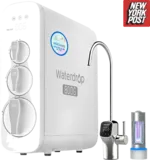 Waterdrop G3P800 (WD-G3P800-W) Waterdrop G3P800 (WD-G3P800-W) |
B | $999 | NSF/ANSI 58, NSF/ANSI 53, NSF/ANSI 42, NSF/ANSI 372 | Check price |
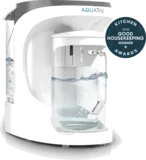 AquaTru Carafe (AT100 series) AquaTru Carafe (AT100 series) |
B | $375 | NSF/ANSI 42, NSF/ANSI 53, NSF/ANSI 58, NSF/ANSI 401, NSF/ANSI 372 | Check price |
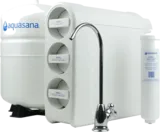 Aquasana SmartFlow Reverse Osmosis (AQ-SFRO2) Aquasana SmartFlow Reverse Osmosis (AQ-SFRO2) |
B | $190 | NSF/ANSI 42, NSF/ANSI 53, NSF/ANSI 58, NSF/ANSI 401, CSA B483.1, NSF/ANSI 372 | Check price |
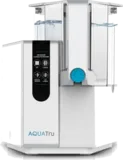 AquaTru Classic (AT2000 series) AquaTru Classic (AT2000 series) |
B | $475 | NSF/ANSI 42, NSF/ANSI 53, NSF/ANSI 58, NSF/ANSI 401, NSF/ANSI 372 | Check price |
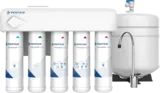 Pentair FreshPoint GRO-575B (161112) Pentair FreshPoint GRO-575B (161112) |
B | $722 | NSF/ANSI 58, NSF/ANSI 53, NSF/ANSI 42, NSF/ANSI 401, CSA B483.1, NSF/ANSI 53, NSF/ANSI 372 | Check price |
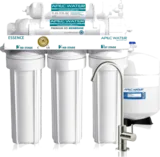 APEC ROES-50 APEC ROES-50 |
B | $231 | NSF/ANSI 58, NSF/ANSI 372 | Check price |
| Home Master TMAFC | B | $330 | None | Check price |
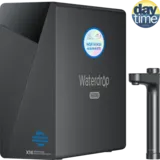 Waterdrop X16 (WD-X16) Waterdrop X16 (WD-X16) |
C | $1,999 | NSF/ANSI 58, NSF/ANSI 42, NSF/ANSI 372 | Check price |
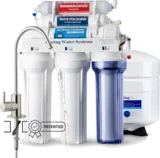 iSpring RCC7AK iSpring RCC7AK |
C | $242 | NSF/ANSI 58 | Check price |
 AquaTru Freestanding Model 1 (ATFS-1-W) AquaTru Freestanding Model 1 (ATFS-1-W) |
C | $1,699 | NSF/ANSI 42, NSF/ANSI 53, NSF/ANSI 58, NSF/ANSI 401 | Check price |
Open these in the system finder
Common questions
How much water does reverse osmosis waste?
EPA says a typical point-of-use RO system sends five gallons or more down the drain for every gallon of treated water. WaterSense-labeled systems, a label EPA introduced in November 2024, send 2.3 gallons or less.
Does reverse osmosis remove bacteria?
The membrane can hold back bacteria and viruses, but Nebraska Extension says RO is not recommended for that job because bacteria damage the membrane, and only coliform-free water should be fed to it. Disinfect well water with UV or chlorination first.
Should I get whole-house reverse osmosis?
Rarely. HomeGuide puts it at $4,800 to $8,000 installed with a large storage tank and pump, and health agencies say drinking and cooking are the main exposure routes for contaminants like PFAS. An under-sink or countertop unit covers those for a few hundred dollars.
Does RO remove minerals like calcium?
Yes. The CDC says RO may reduce calcium, magnesium and potassium along with sodium and other dissolved solids. Some systems add minerals back in a post-filter.
Sources
- EPA: Reducing PFAS in drinking water with treatment technologies
- EPA: Overview of drinking water treatment technologies
- EPA WaterSense: Point-of-use reverse osmosis systems
- EPA: Identifying drinking water filters certified to reduce PFAS
- CDC: About home water treatment systems
- University of Nebraska-Lincoln Extension: Drinking water treatment, reverse osmosis (G1490)
- Penn State Extension: Nitrates in drinking water
- Minnesota Department of Health: PFAS and home treatment of water
- New Jersey Department of Health: PFAS in drinking water fact sheet (April 2024)
- WC&P: Contaminant reduction testing of POU RO systems under NSF/ANSI 58 (Rick Andrew, 2006)
- IAPMO R&T file W-10194: AquaTru (NSF/ANSI 58)
- IAPMO R&T file WC-14805: Waterdrop G3P800 (NSF/ANSI 53, PFOA/PFOS)
- AquaTru Classic product page
- Waterdrop G3P800 product page
- Waterdrop X16 product page
- HomeGuide: Reverse osmosis system cost
- HomeGuide: Water softener cost (RO filter and membrane intervals)