
Salt-free conditioning
Key facts
- Installs at
- Point of entry (whole house)
- Does not remove
- Hardness, Iron, Chlorine, Bacteria, PFAS
- Certifications
- DVGW W 512, IAPMO/ANSI Z601 what these mean
- Needs
- no drain or power
- Typical cost
- $1,500 to $4,500 installed
- Upkeep
- media every 4 to 10 years depending on the system, plus sediment or carbon pre-filters
A salt-free conditioner reduces scale without removing hardness. Most use template-assisted crystallization (TAC), which turns some dissolved calcium into microscopic crystals that stay suspended in the water, so less of it sticks to pipes and water heaters.
It is a reasonable choice if you are on moderately hard city water and mainly want to protect a water heater, with no drain, power or salt. It is the wrong choice if you want soft water: spots on glass, soap scum and the feel of hard water all remain.
How it works
TAC media is a bed of polymer beads with tiny nucleation sites. According to the WateReuse Research Foundation’s study of these devices, calcium carbonate crystals form on the beads as water flows through, break off and stay suspended. Scale-forming reactions then happen on those floating crystals rather than on a heating element.
The hardness is still in the water. Watts, which makes the OneFlow TAC line, states on its spec sheet: “OneFlow is not a water softener.” The Water Quality Association says these devices “do not provide a reduction of total calcium or magnesium content of the treated stream nor are they proven to achieve soft water.”
Because a hardness test cannot show whether a conditioner works, the only way to judge one is to measure scale in a controlled test.
What it removes and what it does not
A salt-free conditioner removes nothing from the water. What it does is reduce scale: over 88% in the WateReuse study’s test rig for TAC, against about 50% for magnetic and electronic descalers.
It does not remove or reduce:
- Hardness: calcium and magnesium stay in the water.
- Iron and manganese. Worse, metals coat the media. Watts and US Water Systems cap iron at 0.3 mg/L and manganese at 0.05 mg/L; SpringWell requires none.
- Chlorine. Chlorine limits range from 0.05 mg/L (US Water Systems GreenWave) to under 2 or 3 ppm (Watts, SpringWell), so city water often needs a carbon filter first.
- Bacteria, PFAS or any other contaminant.
Hardness caps also apply. Watts recommends 30 grains per gallon as a maximum for OneFlow, and Aquasana says its conditioner works best below 15.
Certifications to look for
There is no NSF/ANSI standard for scale reduction. Two test standards exist:
- DVGW W 512 (Germany): hard water runs through the device into a small water heater at an accelerated 80 °C for about three weeks, beside untreated controls. The device must cut scale formation by 80%.
- IAPMO/ANSI Z601 (US, 2018): requires at least a 70% scale reduction against untreated controls. The Water Quality Association argued for keeping the German 80% pass mark.
None of the salt-free systems we track (SpringWell FutureSoft, US Water Systems GreenWave, Aquasana’s salt-free conditioner) lists a DVGW or Z601 certification for the system you buy. Independent data on TAC as a technology is not a certificate for a specific product.
Installation and upkeep
Salt-free tanks need no drain, no power and no backwash, so installation is a plumbing job on the main line with a bypass. On city water, a carbon filter usually goes in front to meet chlorine limits. US Water Systems also advises draining the water heater 30 to 60 days after installation and again at one year, and warns against phosphate anti-scalants and filters after the tank.
Media life by maker: 4 to 6 years for the GreenWave, 10 years for Aquasana’s tank, and “5+ years” on SpringWell’s FutureSoft page.
Costs
HomeGuide puts salt-free systems at $1,500 to $4,500 installed, against $1,200 to $3,800 for a salt softener. Prices checked September 2026:
| System | Price | Upkeep |
|---|---|---|
| Aquasana salt-free conditioner (7 gpm) | $879 | About $148 a year in pre- and post-filters; $774 tank at 10 years |
| US Water Systems GreenWave (10 gpm) | $1,361 | $379.95 rebed every 4 to 6 years |
| SpringWell FutureSoft FS1 (12 gpm) | $1,785 | Sediment pre-filter; media price not published |
Salt-free is not automatically cheaper to own. Compare the full picture in salt-free vs salt water softener, our best salt-free softeners and the product finder.
Pros and limits
Pros
- No salt, drain, power or wastewater.
- Adds no sodium.
- Reduces scale in water heaters and pipes on suitable water.
Limits
- Does not soften: spots and soap scum remain.
- Strict limits on iron, manganese, chlorine and sulfur rule out many wells.
- No system we track holds a DVGW or Z601 certification.
- Upkeep is not zero: media and pre-filters still need replacing.
Systems in our database that use salt-free conditioning
| System | Grade | Price | Certified to | |
|---|---|---|---|---|
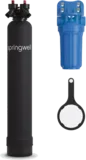 SpringWell FS1 SpringWell FS1 |
B | $1,785 | None | Check price |
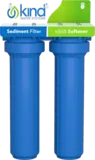 Kind Water Systems E-2000 Kind Water Systems E-2000 |
C | $1,353 | None | Check price |
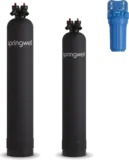 SpringWell CSF1 SpringWell CSF1 |
C | $2,321 | None | Check price |
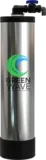 US Water Systems GreenWave 2.0 (385-GW) US Water Systems GreenWave 2.0 (385-GW) |
C | $1,361 | None | Check price |
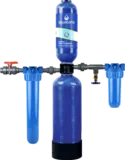 Aquasana Salt-Free Water Conditioner WH-SFWC-S Aquasana Salt-Free Water Conditioner WH-SFWC-S |
C | $879 | None | Check price |
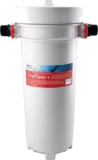 Watts OneFlow+ OFPSYS Watts OneFlow+ OFPSYS |
C | $829 | NSF/ANSI 372 (lead-free materials only) | Check price |
Open these in the system finder
Common questions
Is a salt-free softener really a softener?
No. It does not remove calcium or magnesium, so a hardness test reads the same before and after. Watts, which makes the OneFlow TAC line, says plainly that it is not a water softener. It reduces scale formation instead.
Will a salt-free conditioner work on well water?
Often not without pre-treatment. Makers cap iron at 0.3 mg/L or require none at all, cap manganese at 0.05 mg/L or none, and require hydrogen sulfide to be removed first. Many wells exceed those limits.
How long does TAC media last?
It depends on the maker: US Water Systems lists 4 to 6 years for its GreenWave media, and Aquasana replaces its conditioner tank at 10 years. Chlorine, iron and sulfur shorten media life or void the warranty.
Do magnetic descalers work the same way?
No. In the WateReuse Research Foundation study, magnetic and electronic devices reduced scale by only about 50%, compared with over 88% for TAC in the same test rig.
Sources
- WateReuse Research Foundation: Evaluation of alternatives to domestic ion exchange water softeners (Fox et al., 2014)
- Full report (California State Water Resources Control Board copy)
- Water Quality Association: Scale deposits
- Watts OneFlow engineering specification (feed water limits)
- DVGW twin No. 07: Water treatment in drinking water installations (W 510 and W 512)
- WC&P: A new standard for evaluation of scale control equipment (Rick Andrew, 2014)
- IAPMO/ANSI Z601 scale reduction devices standard announcement (2018)
- WQA position on IAPMO Z601 (80% pass criterion)
- USGS: Hardness of water
- HomeGuide: Water softener cost (salt-free systems)
- US Water Systems GreenWave product page
- SpringWell FutureSoft salt-free conditioner product page
- Aquasana salt-free water conditioner product page