
Air injection oxidation (AIO)
Key facts
- Installs at
- Point of entry (whole house)
- Removes
- Iron, Manganese, Hydrogen sulfide
- Does not remove
- Bacteria, Hardness, PFAS, Nitrate
- Certifications
- NSF/ANSI 42, NSF/ANSI/CAN 61 what these mean
- Needs
- a drain and power
- Typical cost
- $2,231 for the air injection system we track, before installation; HomeGuide puts well water filtration at $800 to $4,000 installed
- Upkeep
- automatic backwash with no chemicals to buy; media eventually needs replacing (interval not published for the system we track)
An air injection oxidation (AIO) filter uses a pocket of air at the top of a tank to oxidize dissolved iron, manganese and hydrogen sulfide, then catches the resulting particles in a media bed that backwashes on a timer. It is the standard chemical-free fix for well water with moderate iron and sulfur.
Penn State Extension assigns oxidizing filters to roughly 3 to 10 mg/L of iron. Below that, a softener or cartridge may be enough; above it, or with iron bacteria, you usually need chemical injection.
How it works
- Water enters the tank and passes through the air pocket, where oxygen converts dissolved iron, manganese and hydrogen sulfide into solid particles.
- The media bed below traps those particles. SpringWell’s WS1, for example, uses a greensand-type medium it calls Greensand Fusion.
- On a schedule (nightly, for the WS1), the control valve backwashes the bed to a drain, flushing out the trapped particles and refreshing the air pocket.
Backwashing needs a drain, an outlet for the control valve and enough water flow. SpringWell’s manual lists 5 gpm for the WS1 backwash and 7 gpm for the larger WS4. A well pump that cannot supply that leaves the media dirty.
What it removes and what it does not
- Iron: EPA’s secondary standard is 0.3 mg/L, where orange staining starts. The Minnesota Department of Health puts greensand filters at up to 10 to 15 mg/L.
- Manganese: EPA’s secondary standard is 0.05 mg/L, and Penn State notes EPA also has a health advisory at 0.3 mg/L.
- Hydrogen sulfide: the Minnesota Department of Health puts oxidizing media at up to about 6 mg/L.
Manufacturer ratings are the practical ceiling. SpringWell rates the WS1 for iron up to 7 ppm, hydrogen sulfide up to 8 ppm and manganese up to 1 ppm, within a pH range of 6.5 to 10.
The Minnesota Department of Health lists oxidation filtration among the methods that can reduce arsenic, but no AIO system we track claims it. If arsenic is on your test, retest after treatment.
AIO does not remove:
- Bacteria, including iron and sulfur bacteria, which foul the media. Shock chlorinate first.
- Hardness, PFAS or nitrate.
- Organic (tannin-bound) iron, which is harder to treat and usually needs chemical oxidation or point-of-use reverse osmosis.
Certifications to look for
NSF/ANSI 42 includes iron and manganese reduction claims, and NSF/ANSI/CAN 61 covers the safety of materials. In practice, none of the air injection systems we track holds an NSF, IAPMO or WQA system certification, which is normal for this category.
That makes three other things matter more: a lab water test before you buy, the maker’s stated limits for iron, manganese, sulfur and pH, and the return terms. SpringWell requires a $134.25 water test before it ships the WS1. Our well testing guide covers what to order.
Installation and upkeep
Install the equipment in this order: sediment filter, iron filter, softener, then UV last. A plumber is the usual choice because the system needs a drain connection and power. HomeGuide puts a new drain line at $300 to $800 and a new outlet at $150 to $350 if you do not have them.
Upkeep is light. The tank backwashes itself and there are no chemicals or cartridges to buy for the WS1. The media will eventually wear out, but SpringWell does not publish a replacement interval or price.
Costs
HomeGuide puts a whole-house well water filtration system at $800 to $4,000 installed. Prices checked September 2026:
| System | Rated for | Price |
|---|---|---|
| iSpring WGB32BM (cartridges, not AIO) | Iron up to 3.0 ppm | $536, plus $160 a year in filters |
| SpringWell WS1 (AIO) | Iron up to 7 ppm, H2S up to 8 ppm | $2,231, plus $134.25 test and $58.79 bypass |
| US Water Systems Matrixx InFusion (peroxide, not AIO) | Iron up to 20 ppm, H2S up to 30 ppm | $2,983, plus peroxide and a $499 rebed every 3 to 5 years |
At low iron, the cheaper cartridge route may be enough. At high iron, the peroxide system costs more but covers more. See iron in well water, sulfur smell in well water, our SpringWell WS1 review and the product finder.
Pros and limits
Pros
- Handles iron, manganese and hydrogen sulfide in one tank.
- No chemicals to buy or store.
- Self-cleaning by backwash.
Limits
- Needs a drain, power and enough well flow to backwash.
- Tops out around 7 to 10 mg/L of iron; beyond that, use chemical injection.
- Does not treat iron or sulfur bacteria, organic iron, hardness or PFAS.
- No system certifications in this category.
Systems in our database that use air injection oxidation (aio)
| System | Grade | Price | Certified to | |
|---|---|---|---|---|
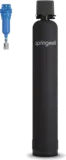 SpringWell WS1 SpringWell WS1 |
C | $2,231 | None | Check price |
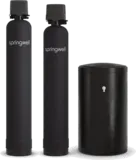 SpringWell WSSS1 SpringWell WSSS1 |
C | $3,124 | None | Check price |
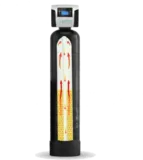 SoftPro Iron Master AIO SoftPro Iron Master AIO |
C | $1,517 | None | Check price |
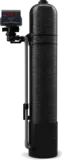 US Water Systems Flexx Oxi-Gen (081-FX) US Water Systems Flexx Oxi-Gen (081-FX) |
C | $2,230 | None | Check price |
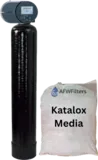 AFWFilters Air Injection Titanium 10 (AIT10-25SXT) AFWFilters Air Injection Titanium 10 (AIT10-25SXT) |
C | $1,289 | None | Check price |
Open these in the system finder
Common questions
How much iron can an air injection filter handle?
Penn State assigns oxidizing filters to roughly 3 to 10 mg/L of iron. Each system has its own rating: SpringWell's WS1 is rated for iron up to 7 ppm, hydrogen sulfide up to 8 ppm and manganese up to 1 ppm. Above that, chemical injection is the usual step up.
Does an air injection filter use chemicals?
No. Air from the pocket at the top of the tank does the oxidizing, and backwashing cleans the media. You need a drain and an outlet, but nothing to refill.
Will air injection fix iron bacteria?
No. The Minnesota Department of Health recommends shock chlorination for iron bacteria, repeated if needed. If the slime keeps coming back, continuous chlorine or hydrogen peroxide injection is the long-term fix.
Do I still need a softener?
Only if your water is hard. An AIO filter does not remove calcium or magnesium. If you need both, the iron filter goes first and the softener after it.
Sources
- Penn State Extension: Iron and manganese in private water systems
- Penn State Extension: Hydrogen sulfide (rotten egg odor) in water wells
- Minnesota Department of Health: Iron in well water
- Minnesota Department of Health: Iron bacteria in well water
- Minnesota Department of Health: Hydrogen sulfide and sulfur bacteria in well water
- Minnesota Department of Health: Arsenic in well water
- EPA: Secondary drinking water standards
- NSF: NSF/ANSI 42, 53 and 401 filtration systems standards
- SpringWell WS1 product page
- SpringWell WS1/WS4 manual
- iSpring WGB32BM product page
- HomeGuide: Home water filtration system cost (2026)