How to remove PFAS from your water
We earn a commission if you buy through links on this page. It never changes which systems we recommend. Details.
Short answerFor drinking and cooking water, a reverse osmosis unit certified to NSF/ANSI 58 and to NSF/ANSI 53 for PFOA/PFOS is the cheapest dependable fix, from about $475. Whole-house carbon treats every tap, but only one whole-house system we track is certified for more than PFOA and PFOS, and it costs about $1,000 a year to run.
Reverse osmosis and activated carbon both remove PFAS from drinking water, and a third option, PFAS-selective ion exchange resin, is starting to appear in home systems. Boiling does not work, and neither does a water softener, a sediment filter or a UV lamp.
For most homes the cheapest reliable answer is a reverse osmosis (RO) unit at the kitchen sink, certified to NSF/ANSI 58 and to NSF/ANSI 53 for PFOA and PFOS. Whole-house treatment is possible, but it costs several times more and protects routes of exposure that health agencies say matter little.
First, check whether you need to
Start with your water supply’s numbers. EPA’s April 2024 rule set limits of 4 parts per trillion (ppt) for PFOA and PFOS and 10 ppt for PFHxS, PFNA and GenX, plus a hazard index for mixtures, with compliance due by 2029. In May 2026 EPA proposed dropping all but the PFOA and PFOS limits and pushing their deadline to 2031. Until that is finalized, the 2024 limits stand.
EPA’s UCMR 5 sampling, with final data released in August 2026, covered 10,313 water systems. About 35% had at least one PFAS detected, and 1,165 averaged above an EPA limit at a sampling point, which covers roughly 55 million people. You can look up your own system on our PFAS lookup by ZIP code or browse results by state.
If you are on a private well, nobody has sampled it for you. A certified lab PFAS test typically costs $300 or more per sample, according to Connecticut’s environmental agency, which recommends it mainly if your well is near a suspected source such as a fire training area, landfill or factory. Our well testing guide covers how to order one.
What removes PFAS
Reverse osmosis
RO forces water through a membrane fine enough to hold back most dissolved contaminants. EPA’s research summary says high-pressure membranes such as RO are “typically more than 90 percent effective at removing a wide range of PFAS, including shorter chain PFAS.”
That breadth is RO’s main advantage. The trade-offs are a slow flow that suits a kitchen tap rather than a whole house, reject water that goes down the drain, and filters on a fixed schedule. The Minnesota Department of Health calls RO “more practical as a point-of-use treatment option.”
Activated carbon
Granular activated carbon (GAC) and carbon block filters trap PFAS as water passes through. EPA says GAC “can be 100 percent effective for a period of time,” with performance depending on the carbon type, bed depth, flow rate, which PFAS are present, and other organic matter in the water.
Carbon is what most whole-house PFAS systems use, because it can handle household flow rates without wasting water. Its weakness is short-chain PFAS, covered below.
Ion exchange resin
PFAS-selective anion exchange resin grabs PFAS molecules and holds them. EPA says this resin “has shown to have a high capacity for many PFAS” but is “typically more expensive than GAC.” NSF added anion exchange media to its PFOA and PFOS reduction testing in its 2019 edition of NSF/ANSI 53.
Do not confuse this with a water softener. Softeners use cation exchange resin, and the Minnesota Department of Health says softeners and iron filters “are not likely to remove PFAS.”
What does not work
- Boiling. Minnesota’s health department says plainly that “boiling water will not remove PFAS,” and New Jersey’s says the same. Boiling concentrates what is left.
- Softeners, iron filters, sediment filters and UV. None of these is designed for PFAS.
- An uncertified carbon filter you hope works. Carbon type and contact time decide the result, so a generic “carbon filter” claim tells you little.
The short-chain problem with carbon
PFAS come in long-chain forms such as PFOA and PFOS and short-chain forms such as PFBS and PFBA. EPA’s summary is direct: “GAC works well on longer-chain PFAS like PFOA and PFOS, but shorter chain PFAS like Perfluorobutanesulfonic acid (PFBS) and Perfluorobutyrate (PFBA) do not adsorb as well.”
In practice, short chains break through a carbon bed sooner, so a carbon filter’s rated life for PFOA may overstate its life for PFBS. If your utility report or well test shows short-chain PFAS, choose RO for drinking water, or at minimum replace carbon earlier than the label says.
Read the compound list
The PFAS lookup shows which compounds were detected, not just a total. PFBS and PFBA are the short-chain compounds EPA singles out as harder for carbon. PFOA and PFOS are long-chain and respond well to it.
What NSF/ANSI 53, 58 and P473 actually certify
Certification is where marketing gets slippery, so it helps to know what each standard covers.
| Standard | Applies to | PFAS claim | Pass level |
|---|---|---|---|
| NSF P473 (2016 protocol) | Carbon and other filters | PFOA and PFOS | Challenge of 1,000 ppt PFOS plus 500 ppt PFOA, reduced to 70 ppt combined |
| NSF/ANSI 53 | Carbon and anion exchange filters, point-of-use and whole-house | PFOA/PFOS; the 2022 edition added a “total PFAS” claim covering PFOA, PFOS, PFHxS, PFNA, PFHpA, PFBS and PFDA | 20 ppt combined in current editions |
| NSF/ANSI 58 | Reverse osmosis systems | PFOA/PFOS | 20 ppt combined in current editions |
P473 was folded into NSF/ANSI 53 and 58 in 2019, so a brand advertising “P473 certified” today is either quoting an older listing or out of date. The US Water Systems Pioneer, for example, still holds an IAPMO listing to both NSF/ANSI 53 and P473, but for PFOA and PFOS only.
Two cautions matter more than the standard numbers:
- The pass level is above EPA’s limit. A certified filter must hit 20 ppt combined PFOA and PFOS (70 ppt under P473). EPA’s limit is 4 ppt each. Minnesota’s health department notes that current certifications do not yet guarantee removal to the new EPA standards. Some certified units report far lower results (Aquasana’s HealthShield data sheet shows more than 99.9% reduction for each certified PFAS), so read the performance data sheet for the actual effluent values.
- “Tested to” is not “certified.” A certificate comes from NSF, IAPMO or WQA and is listed in their public database. “Tested to NSF/ANSI 53” or “SGS tested” means the brand paid a lab, with no ongoing audit. The Waterdrop X16’s PFAS numbers are SGS lab data only, and SpringWell’s PFS-1 cites internal testing to NSF/ANSI 53 with no certification.
Verify any claim yourself in the NSF listings, the IAPMO product listing directory or WQA’s product finder. Our research method explains how we check these for every product we cover.
Point-of-use or whole-house
The New Jersey Department of Health says exposure to PFAS “from showering, bathing, laundry, dishwashing, and rinsing produce is not significant.” Drinking and cooking water is the main route. That makes a point-of-use filter the logical first step, and Minnesota’s health department notes that point-of-use treatment “tends to be more economical.”
Whole-house treatment makes sense when you want every tap safe to drink from (a household with young children filling cups at the bathroom sink, for instance), or when your state health department recommends it for a contaminated well. Connecticut’s guidance names point-of-entry GAC or point-of-use RO as the effective options for wells.
Here is what the certified options we track cost to buy and run. Prices checked September 2026.
| System | Type | Price | Running cost | What is certified |
|---|---|---|---|---|
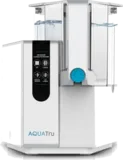
| AquaTru Classic | Countertop RO | $475 | About $130/year in filters | NSF/ANSI 58, and NSF/ANSI 53 for PFOA/PFOS (IAPMO) |
| Waterdrop G3P800 | Under-sink RO | $999 list | About $160/year | NSF/ANSI 58, and NSF/ANSI 53 for PFOA/PFOS only (IAPMO) |
| US Water Systems Pioneer | Whole-house carbon block | $1,669 | $523 cartridge every 100,000 gallons | NSF/ANSI 53 and P473 for PFOA/PFOS only, at 4.51 gpm (IAPMO) |
| Aquasana HealthShield | Whole-house carbon tank | $2,099 | $1,749 tank about every 2 years plus pre/post filters | NSF/ANSI 53 for PFOA, PFOS, PFNA, PFHxS and PFHpA (WQA) |
Over 10 years the gap is large. The AquaTru comes to about $1,773 ($475 plus 10 years at $129.83). The HealthShield comes to about $12,300 ($2,099, plus five replacement tanks at $1,749, plus about $148 a year in pre- and post-filters). The Pioneer lands in between, but a family using 200 gallons a day indoors would need a new cartridge roughly every 16 months, and its certified flow of 4.51 gpm can feel thin in a larger home.
SpringWell sells the same Enpress Pioneer unit as its Lead and Cyst Removal System and advertises 8 gpm. The certified flow rate is 4.51 gpm. No other SpringWell system holds an NSF, IAPMO or WQA listing, including the CF1, whose PFAS claim is uncertified.
When to call a pro
A countertop RO unit needs no plumbing. An under-sink RO needs a drain saddle, a feed valve and an outlet; Waterdrop describes the G3P800 as a DIY job of about 30 minutes.
Whole-house PFAS systems need a plumber. The HealthShield also needs a grounded outlet within 10 feet for its flow monitor, and Aquasana notes that state and local rules may require a licensed installer. If a well test comes back above EPA’s limits, call your state health or environmental agency before buying anything. Connecticut, for example, tells well owners whose results exceed its action levels to contact the state and use bottled water for drinking and cooking in the meantime.
Which products fit
If you want certified PFAS reduction for drinking water at the lowest cost, a countertop or under-sink RO is the next step. The AquaTru needs no installation; the Waterdrop G3P800 is certified but its warranty requires municipal water within set hardness and TDS limits.
Cheapest certified option: AquaTru Classic
Its certification covers PFOA and PFOS, not every PFAS the brand’s marketing mentions. RO’s broad removal of shorter-chain PFAS comes from the membrane itself. Note its feed limits: hardness under 10 grains per gallon, so hard well water needs softening first. Full detail is in our AquaTru Classic review.
Certified whole-house option: Aquasana HealthShield
It is the only whole-house system we track with a PFAS certification covering more than PFOA and PFOS. The catch is the tank: about 165,000 gallons, or roughly two years, at $1,749 each time. Compare it with other options on our best whole house filters for PFAS page, or weigh the two approaches in whole-house filter vs reverse osmosis.
Questions people ask
Does boiling water remove PFAS?
No. The Minnesota and New Jersey health departments both say boiling does not remove PFAS. Boiling drives off water and leaves the PFAS behind, so the concentration goes up slightly.
Does a water softener remove PFAS?
No. A softener uses cation exchange resin to swap calcium and magnesium for sodium. The Minnesota Department of Health says softeners and iron filters are not likely to remove PFAS. PFAS removal uses anion exchange resin, which is a different product.
Is it safe to shower in water that contains PFAS?
The New Jersey Department of Health says exposure from showering, bathing, laundry and dishwashing is not significant. Drinking and cooking water is the main route, which is why a point-of-use filter covers most of the risk.
Does NSF certification mean a filter gets PFAS below EPA's 4 ppt limit?
Not by itself. The NSF/ANSI 53 and 58 pass level for PFOA plus PFOS is 20 ppt combined in the current editions and was 70 ppt under the older P473 protocol. Many certified units do far better, so read the performance data sheet for the actual effluent numbers.
How often do PFAS filters need changing?
On the manufacturer's schedule, or sooner. EPA warns that a filter not replaced on schedule can increase your exposure. As examples, AquaTru's VOC carbon filter is rated for 600 gallons and the US Water Systems Pioneer whole-house cartridge for 100,000 gallons.
Sources
- EPA: Reducing PFAS in your drinking water with a home filter
- EPA: Reducing PFAS in drinking water with treatment technologies
- EPA: PFAS National Primary Drinking Water Regulation
- EPA: Fifth Unregulated Contaminant Monitoring Rule (UCMR 5)
- Minnesota Department of Health: PFAS and home treatment of water
- New Jersey Department of Health: PFAS in drinking water fact sheet (April 2024)
- Penn State Extension: Home water treatment for PFAS
- Connecticut DEEP: Private wells and PFAS
- WC&P: PFOA and PFOS reduction testing under NSF P473 (Rick Andrew, 2016)
- NGWA: NSF standards add PFOA and PFOS reduction claims (2019)
- WaterWorld: NSF certifies first client for NSF/ANSI 53 total PFAS reduction (2023)
- IAPMO R&T listing: AquaTru (NSF/ANSI 53 PFOA/PFOS, NSF/ANSI 58)
- IAPMO R&T listing: Waterdrop G3P800 (NSF/ANSI 53-2022 PFOA/PFOS)
- IAPMO R&T listing: Enpress Pioneer (NSF/ANSI 53 and P473 PFOA/PFOS)
- WQA listing: Aquasana HealthShield (NSF/ANSI 53)
- Aquasana HealthShield performance data sheet
- AquaTru Classic product page
- Waterdrop G3P800 product page
- US Water Systems Pioneer product page