
Specialty media
Key facts
- Installs at
- Whole house or single tap
- Removes
- Arsenic, Nitrate, Fluoride, Uranium, PFAS, Iron, Manganese
- Does not remove
- Bacteria
- Certifications
- NSF/ANSI 53, NSF/ANSI 42, NSF/ANSI/CAN 61 what these mean
- Needs
- a drain and power
- Typical cost
- $1,331 to $2,910 for the whole-house specialty media systems we track, before installation; point-of-use options cost less
- Upkeep
- media replaced or regenerated on a schedule set by your water test; neutralizers refilled every few weeks to months
“Specialty media” covers the single-purpose filter beds and cartridges used when a water test finds something that carbon, softening and ordinary oxidation do not handle: arsenic, nitrate, fluoride, uranium, acidic water, or PFAS where a dedicated resin is used. Each medium targets one or two contaminants, so the lab test decides which one you need.
For arsenic, nitrate or fluoride in drinking water, a certified reverse osmosis unit at the kitchen tap is often simpler and cheaper than a whole-house specialty tank. Consider that first.
How it works
| Medium | Main targets | How it works | Watch for |
|---|---|---|---|
| Adsorptive media, including activated alumina | Arsenic, fluoride, uranium, selenium | A charged media bed pulls ions of the opposite charge out of the water (Minnesota Department of Health) | Media is used up and must be replaced |
| Anion exchange resin | Nitrate, arsenic, uranium, sulfate, PFAS | Resin swaps chloride for the target ions and is regenerated with salt brine | Sulfate competes with nitrate; saturated resin can release nitrate |
| PFAS-selective resin | PFAS | Anion resin chosen to grab and hold PFAS molecules | Costs more than carbon |
| Oxidizing media (greensand, manganese dioxide) | Iron, manganese, hydrogen sulfide | Converts dissolved metals into particles, then filters them | Needs backwashing, and some need regenerating |
| Acid neutralizer (calcite, magnesium oxide) | Low pH, corrosive water | Dissolving mineral raises pH | Adds hardness; must be refilled |
EPA’s list of what each technology removes backs most of this table: adsorptive media for arsenic, fluoride, selenium and uranium, among others; anion exchange for arsenic, chromium-6, nitrate, perchlorate, PFAS, sulfate and uranium. EPA also publishes a design manual on removing fluoride with activated alumina.
What it removes and what it does not
- Arsenic: the Minnesota Department of Health lists adsorptive media and anion exchange alongside RO and oxidation filtration. Arsenic occurs in two forms, and certification claims may cover only pentavalent arsenic (arsenic V); NSF/ANSI 58, for example, has no arsenic III claim. Ask your lab which form you have.
- Nitrate: Penn State describes anion exchange as effective but warns that sulfate interferes, that saturated resin “can actually increase nitrate levels,” and that the high-nitrate brine needs careful disposal.
- Fluoride: activated alumina, per EPA’s design manual, or RO.
- Uranium: anion exchange or adsorptive media, per EPA.
- PFAS: EPA says PFAS-selective anion exchange resin “has shown to have a high capacity for many PFAS” but is “typically more expensive than GAC.”
- Iron and manganese: oxidizing media; the Minnesota Department of Health puts greensand at up to 10 to 15 mg/L of iron.
- Copper and lead from pipes: neutralizers do not remove them, but they reduce the corrosion that dissolves them. Penn State says corrosive water is the main reason about 20% of Pennsylvania’s private water systems have dangerous dissolved lead levels.
None of these media disinfect. For bacteria, add UV or chlorination.
Certifications to look for
- NSF/ANSI 53 for health claims such as arsenic, and PFOA/PFOS. NSF added anion exchange media to its PFOA and PFOS testing in the 2019 edition.
- NSF/ANSI 42 for aesthetic claims such as iron and manganese.
- NSF/ANSI/CAN 61 for media materials. It covers what leaches from the media, not what it removes.
The Minnesota Department of Health advises choosing a system certified by an independent organization such as NSF, UL or WQA, following the maintenance schedule, and testing the treated water periodically. Watch for “tested to” language: the OEM sheet for the cartridge in SpringWell’s PFS-1 describes “internal testing to NSF/ANSI Standard 53” and says its claims are not performance tested by WQA, IAPMO or NSF.
Installation and upkeep
Whole-house tanks that backwash or regenerate need a drain and an outlet; point-of-use cartridges need neither. Upkeep depends on the medium:
- Adsorptive and PFAS-selective media: replaced when capacity runs out, which depends on your contaminant level and water use.
- Anion exchange: salt for regeneration, and safe disposal of the brine.
- Neutralizers: Penn State says refilling ranges from weeks to months, and recommends backwashing unless a sediment filter comes first.
Retest after installation and on a schedule, since media exhaust silently.
Costs
Costs vary more than for any other treatment type. Prices checked September 2026:
| System | Media | Price |
|---|---|---|
| Crystal Quest Metal Removal (1.5 cu ft) | MetalX manganese dioxide-coated media for iron, manganese and H2S | $1,331; media refill $412 |
| SpringWell PFS-1 | PFAS-selective adsorbent cartridge (not certified) | $2,910; cartridge price not listed |
| Under-sink RO, for comparison | Membrane | $300 to $950 installed (HomeGuide) |
Crystal Quest notes its media “may increase hardness” and recommends pairing it with a softener. Browse options in the product finder and start with our well testing guide.
Pros and limits
Pros
- Targets contaminants that general-purpose filters miss.
- Whole-house treatment is possible where drinking-water-only treatment is not enough.
- Neutralizers protect plumbing from corrosion.
Limits
- Each medium does one job; the wrong one does nothing.
- Media exhaust without warning, so regular retesting is essential.
- Anion exchange can release nitrate if it is not regenerated on time.
- Few whole-house specialty systems are certified.
Systems in our database that use specialty media
| System | Grade | Price | Certified to | |
|---|---|---|---|---|
 Aqua-Pure (formerly 3M Aqua-Pure, Solventum) AP904 Aqua-Pure (formerly 3M Aqua-Pure, Solventum) AP904 |
B | $432 | NSF/ANSI 42 | Check price |
 Aquasana SmartFlow Reverse Osmosis (AQ-SFRO2) Aquasana SmartFlow Reverse Osmosis (AQ-SFRO2) |
B | $190 | NSF/ANSI 42, NSF/ANSI 53, NSF/ANSI 58, NSF/ANSI 401, CSA B483.1, NSF/ANSI 372 | Check price |
| Home Master HMF3SdgFeC | B | $550 | None | Check price |
 Aquasana HealthShield WH-HS Aquasana HealthShield WH-HS |
C | $2,099 | NSF/ANSI 53, NSF/ANSI 401, CSA B483.1 | Check price |
 SpringWell PFS-1 SpringWell PFS-1 |
C | $2,910 | None | Check price |
 Crystal Quest Metal Removal Whole House Water Filter (CQE-WH-01195) Crystal Quest Metal Removal Whole House Water Filter (CQE-WH-01195) |
D | $1,331 | None | Check price |
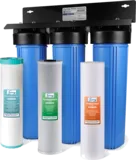 iSpring WGB32BM iSpring WGB32BM |
D | $536 | None | Check price |
Open these in the system finder
Common questions
How do I remove arsenic from well water?
The Minnesota Department of Health lists reverse osmosis, distillation, adsorptive media, anion exchange and oxidation or chlorination followed by filtration. Choose a system certified for arsenic, follow the maintenance schedule and retest the treated water. Softeners and carbon filters alone do not remove it.
Can a water softener remove nitrate?
No. Softeners use cation resin, which EPA lists for hardness, barium and radium. Nitrate needs anion exchange resin, reverse osmosis or distillation. Penn State warns that boiling increases nitrate.
What fixes acidic, corrosive well water?
An acid-neutralizing filter (calcite or magnesium oxide) or soda ash injection. Penn State notes neutralizing filters add hardness and need regular refilling, while soda ash injection does not add hardness.
Does specialty media disinfect water?
No. None of these media kill bacteria. If your well tests positive for coliform bacteria, you need UV or chlorination as well.
Sources
- EPA: Overview of drinking water treatment technologies
- EPA: Design manual, removal of fluoride from drinking water supplies by activated alumina
- EPA: Reducing PFAS in drinking water with treatment technologies
- NGWA: NSF standards add PFOA and PFOS reduction claims (2019)
- Minnesota Department of Health: Arsenic in well water
- Minnesota Department of Health: Iron in well water
- Penn State Extension: Nitrates in drinking water
- Penn State Extension: Corrosive water problems
- CDC: About home water treatment systems
- WC&P: Contaminant reduction testing of POU RO systems under NSF/ANSI 58 (Rick Andrew, 2006)
- UL Solutions: Water filtration products testing and certification (NSF/ANSI 53 scope)
- Crystal Quest Metal Removal whole house filter product page
- Crystal Quest MetalX product data sheet
- SpringWell PFS-1 product page
- Enpress PIONEER PF spec sheet
- HomeGuide: Reverse osmosis system cost