
Catalytic carbon
Key facts
- Installs at
- Whole house or single tap
- Removes
- Chloramine, Chlorine, Hydrogen sulfide
- Does not remove
- Hardness, Nitrate, Bacteria
- Certifications
- NSF/ANSI 42, NSF/ANSI/CAN 61 what these mean
- Needs
- no drain or power
- Typical cost
- $1,160 to $1,400 for entry sizes of the whole-house catalytic carbon systems we track, before installation
- Upkeep
- carbon every 5 to 10 years by maker ratings, plus sediment pre-filters every 2 to 9 months
Catalytic carbon is activated carbon whose surface has been modified so it speeds up chemical reactions instead of only trapping contaminants. That matters for two things ordinary carbon handles poorly: chloramine in city water and hydrogen sulfide in well water.
If your utility disinfects with chlorine rather than chloramine, and you have no sulfur smell, standard activated carbon does the job for less. Your utility’s annual water quality report says which disinfectant it uses; our chloramine vs chlorine guide explains how to check.
How it works
Carbon removes free chlorine quickly. Chloramine, which EPA says utilities use because it lasts longer in the pipes, reacts far more slowly. Robert Potwora’s analysis in Water Conditioning & Purification found monochloramine needs two to four times the contact time of chlorine, and recommends at least 10 minutes of empty bed contact time (EBCT) with ordinary granular carbon. Catalytic carbon cuts that to about 3 minutes.
You can check contact time yourself. EBCT in minutes equals cubic feet of media times 7.48, divided by flow in gallons per minute. US Water Systems’ 10 gpm Matrixx catalytic tank holds 1.5 cubic feet:
- At its full 10 gpm rating: 1.5 × 7.48 ÷ 10 = 1.1 minutes.
- At one 2.5 gpm shower: 1.5 × 7.48 ÷ 2.5 = 4.5 minutes.
For hydrogen sulfide, catalytic carbon helps oxidize the gas. Penn State notes that used alone it needs at least 4.0 mg/L of dissolved oxygen, which is why well systems often add air or hydrogen peroxide first. US Water Systems’ Matrixx InFusion, for example, injects peroxide ahead of a catalytic carbon tank. See chemical injection.
What it removes and what it does not
Catalytic carbon removes:
- Chloramine, given enough contact time.
- Chlorine, taste and odor, as ordinary carbon does.
- Hydrogen sulfide at low levels, or at higher levels when paired with an oxidant.
Makers also list VOCs, pesticides and heavy metals for their catalytic tanks, but none of the whole-house catalytic systems we track is certified for those claims. Performance can also fade over the tank’s life. Aquasana’s data sheet for the Rhino Chloramines shows an 83% average chloramine reduction, falling to 68.7% to 75.5% over the last 400,000 gallons of its 1,000,000-gallon rating.
It does not soften hard water, remove nitrate or disinfect for bacteria. Its PFAS claims, where made, are uncertified.
Certifications to look for
The key listing is NSF/ANSI 42 for chloramine reduction, a separate claim from chlorine. To earn it, a filter must reduce a 3.0 mg/L monochloramine challenge to below 0.5 mg/L across its rated capacity. NSF/ANSI/CAN 61 covers the safety of materials, not performance.
None of the whole-house chloramine filters we track holds the NSF/ANSI 42 chloramine claim. Aquasana’s Rhino Chloramines is “tested to” NSF/ANSI 42 by the maker, and SpringWell’s CF1 claims chloramine removal without a certification. Point-of-use filters certified for chloramine are easier to find in the NSF, IAPMO and WQA listings.
Installation and upkeep
There are two designs:
- Non-backwashing tanks, such as the Rhino Chloramines and SpringWell CF1, need no drain or power. Aquasana recommends a licensed plumber.
- Backwashing tanks, such as the Matrixx, need a drain, an outlet and enough flow to backwash: 4 to 10 gpm depending on size, per US Water Systems, which lists backwashing every 1 to 2 weeks on city water.
Size for contact time, not just pipe size. Choosing one size up gives chloramine more contact at peak flow. Carbon life by maker rating runs from 5 or more years (Matrixx) to 10 years (Rhino Chloramines, CF1), with sediment pre-filters every 2 to 9 months.
Costs
Prices checked September 2026:
| System | Price | Upkeep |
|---|---|---|
| SpringWell CF1 | $1,160 | About $42 a year in sediment filters; $352 media at 10 years |
| US Water Systems Matrixx catalytic carbon | $1,326 (5 gpm) to $1,776 (20 gpm) | Rebed after 5+ years (price not listed) |
| Aquasana Rhino Chloramines | $1,399 | $148 a year in filters; $1,299 tank at 10 years |
HomeGuide puts installation labor at $120 to $600. A backwashing tank may also need a new drain ($300 to $800) or outlet ($150 to $350). If your only goal is drinking water that tastes better, a point-of-use filter certified to NSF/ANSI 42 for chloramine costs a fraction of these. Compare options in the best filters for city water or the product finder.
Pros and limits
Pros
- Handles chloramine at realistic household contact times.
- Also removes chlorine, taste and odor.
- Helps with low-level sulfur odor.
- Non-backwashing tanks need no drain or power.
Limits
- Whole-house systems we track are not certified for chloramine.
- Reduction fades as the carbon ages.
- Hydrogen sulfide needs dissolved oxygen or an added oxidant.
- No effect on hardness, nitrate or bacteria.
Systems in our database that use catalytic carbon
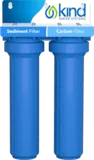
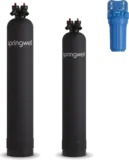

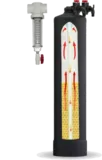

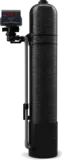
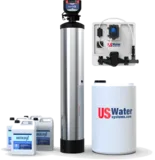
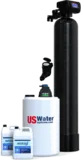
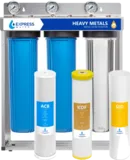

Open these in the system finder
Common questions
Do I need catalytic carbon for chloramine?
For a whole-house filter, usually yes. Ordinary carbon needs at least 10 minutes of contact with chloramine, while catalytic carbon needs about 3, according to Water Conditioning & Purification. Whole-house tanks rarely give ordinary carbon that much time.
Is catalytic carbon the same as activated carbon?
It starts as activated carbon, then its surface is modified so it speeds up chemical reactions as well as adsorbing. That extra catalytic activity is what breaks down chloramine and hydrogen sulfide.
Does catalytic carbon remove PFAS?
Some makers claim it, but none of the whole-house catalytic carbon systems we track is certified for PFAS. For certified PFAS reduction, see our PFAS guide.
Can catalytic carbon fix a rotten egg smell?
At low levels, yes. Penn State notes that catalytic carbon used on its own needs at least 4.0 mg/L of dissolved oxygen in the water, which many wells lack. Stronger odors are treated with air or peroxide injection ahead of the carbon.
Sources
- WC&P: Chlorine and chloramine removal with activated carbon (Robert Potwora, 2009)
- WC&P: Chloramine reduction under NSF/ANSI 42 (Rick Andrew, 2011)
- EPA: Chloramines in drinking water
- CDC: About water disinfection with chlorine and chloramine
- Penn State Extension: Hydrogen sulfide (rotten egg odor) in water wells
- US Water Systems Matrixx catalytic carbon spec sheet
- US Water Systems Matrixx catalytic carbon product page
- US Water Systems Matrixx InFusion product page
- Aquasana Rhino Chloramines product page
- SpringWell CF1 product page
- HomeGuide: Home water filtration system cost (2026)