
KDF (copper-zinc media)
Key facts
- Installs at
- Whole house or single tap
- Removes
- Chlorine
- Does not remove
- PFAS, VOCs, Nitrate, Bacteria
- Certifications
- NSF/ANSI 42, NSF/ANSI 177, NSF/ANSI/CAN 61 what these mean
- Needs
- no drain or power
- Typical cost
- usually included in a carbon system's price; a replacement KDF cartridge for one cartridge system we track is $99.99
- Upkeep
- replaced with the carbon it is packed with, or as a cartridge every 6 to 12 months
KDF is a trade name for granules of high-purity copper and zinc. Its maker says KDF 55 reduces chlorine and water-soluble heavy metals, and KDF 85 reduces iron and hydrogen sulfide.
In home systems KDF is almost always a layer next to activated carbon, not a treatment on its own. Its best-supported role is chlorine reduction, and it is common in shower filters. Most other claims made for it are uncertified at the system level.
How it works
The maker describes KDF as a redox (oxidation-reduction) medium: as water passes over the copper-zinc granules, free chlorine is chemically converted to chloride rather than simply trapped. It says KDF 55 works “even in hot water.”
KDF’s own materials describe it as targeting inorganic contaminants, while activated carbon targets organic ones. That split is the reason KDF is “often used in combination with other filtration systems, such as carbon filters,” in the maker’s words. You will find it:
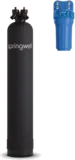
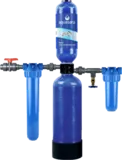
- As the top layer of a whole-house tank, as in Aquasana’s Rhino and SpringWell’s CF1.
- As a separate cartridge, as in Express Water’s WH300SCKS, which pairs KDF with catalytic carbon.
- Inside shower filters.
What it removes and what it does not
- Chlorine: the claim with the most support. The maker says KDF 55 carries an NSF certification to NSF/ANSI 42.
- Iron and hydrogen sulfide: maker claims for KDF 85. None of the whole-house KDF systems we track is certified for either. For real iron or sulfur problems, see air injection oxidation.
- Heavy metals such as lead: a maker claim. SpringWell lists heavy metals for its CF1’s KDF layer without certification. For lead, choose a filter certified to NSF/ANSI 53 for lead.
It does not remove:
- PFAS and VOCs. These are organic chemicals, which is the carbon’s job, not the KDF’s.
- Nitrate. No KDF maker claim covers it.
- Bacteria, in the sense that matters for safety. The maker says KDF “controls” bacteria and algae, and Aquasana describes the KDF in its Rhino as bacteriostatic. That limits growth inside the filter. It is not disinfection of contaminated water.
The maker also claims KDF controls scale. That is not the same as removing hardness.
Certifications to look for
The maker lists NSF certifications for its media: KDF 55 to NSF/ANSI 42, and KDF 85 to NSF/ANSI/CAN 61, the materials safety standard. These cover the raw media, not the finished filter you buy. A brand saying it “uses NSF-certified KDF” has not told you anything certified about its own system.
What to look for instead:
- NSF/ANSI 42 on the finished system, naming chlorine reduction.
- NSF/ANSI 177 for shower filters. It covers free available chlorine only, and NSF notes certified shower filters have not been evaluated in the presence of chloramine.
- NSF/ANSI 53 for any health claim, such as lead.
Check the model number in the NSF, IAPMO or WQA listings.
Installation and upkeep
KDF layers inside a whole-house carbon tank need no drain or power and are replaced along with the carbon. As a cartridge, Express Water replaces its three-filter set, including the KDF stage, every 6 to 12 months or 100,000 gallons. Shower filters attach to the pipe just in front of the showerhead and are replaced on the maker’s schedule.
Costs
KDF is rarely priced on its own. Prices checked September 2026:
| System | Where the KDF is | Price |
|---|---|---|
| Express Water WH300SCKS | KDF and catalytic carbon cartridge | $548 system; $99.99 KDF cartridge; $186.99 three-filter set every 6 to 12 months |
| Aquasana Rhino | Top tank | $999 |
| SpringWell CF1 | Layer above catalytic carbon | $1,160 |
Paying extra for a KDF stage makes sense mainly for chlorine taste or smell, especially in the shower. It is not a substitute for a certified filter if you are treating a health contaminant. Compare systems in the product finder and best filters for city water.
Pros and limits
Pros
- Reduces chlorine, including in hot water.
- Needs no drain, power or chemicals.
- Pairs well with carbon, which handles organic chemicals.
Limits
- Iron, sulfur, metal and bacteria claims are maker claims, not system certifications.
- Does nothing for PFAS, VOCs or nitrate on its own.
- Media certifications are often presented as if they covered the whole filter.
Systems in our database that use kdf (copper-zinc media)
| System | Grade | Price | Certified to | |
|---|---|---|---|---|
 SpringWell CF1 SpringWell CF1 |
B | $1,160 | None | Check price |
 Aquasana Rhino WH-1000 (Max Flow WH-1010) Aquasana Rhino WH-1000 (Max Flow WH-1010) |
B | $999 | None | Check price |
 Kind Water Systems S-500 Kind Water Systems S-500 |
C | $1,471 | None | Check price |
 SpringWell CSF1 SpringWell CSF1 |
C | $2,321 | None | Check price |
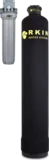 RKIN CS8 / CS9 / CS10 / CS13 RKIN CS8 / CS9 / CS10 / CS13 |
C | $938 | None | Check price |
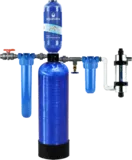 Aquasana Rhino Well Water with UV WH-WELL-UVS (WH-WELL-UV) Aquasana Rhino Well Water with UV WH-WELL-UVS (WH-WELL-UV) |
C | $1,749 | None | Check price |
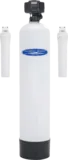 Crystal Quest Metal Removal Whole House Water Filter (CQE-WH-01195) Crystal Quest Metal Removal Whole House Water Filter (CQE-WH-01195) |
D | $1,331 | None | Check price |
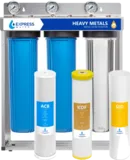 Express Water WH300SCKS Express Water WH300SCKS |
D | $548 | None | Check price |
 Crystal Quest SMART Whole House Water Filter (CQE-WH-01114) Crystal Quest SMART Whole House Water Filter (CQE-WH-01114) |
D | $1,791 | None | Check price |
Open these in the system finder
Common questions
What does KDF stand for?
Express Water expands it as kinetic degradation fluxion. KDF is also the brand of the media's maker, now part of Kymera International. In practice it means granules of high-purity copper and zinc.
Does KDF remove lead?
The maker says KDF 55 reduces water-soluble heavy metals, but the whole-house KDF systems we track are not certified for lead. For lead, EPA's tool looks for a filter certified to NSF/ANSI 53 for lead reduction plus NSF/ANSI 42 Class I particulate reduction.
Does KDF kill bacteria?
The maker says it controls bacteria and algae, which refers to limiting growth inside the filter. That is not disinfection. For bacteria in well water, use UV or chlorination.
Is a filter with KDF better than plain carbon?
Not automatically. KDF adds chlorine reduction and a maker claim for metals, but carbon does the work on organic chemicals. Judge the finished filter by its certified claims, not by the media list.
Sources
- KDF (Kymera International): KDF 55 and KDF 85 process media
- NSF: NSF/ANSI 177 shower filter certification
- NSF: NSF Standards for water treatment systems
- NSF: NSF/ANSI 61 drinking water system components, health effects
- EPA: Consumer tool for identifying filters certified to reduce lead
- Express Water WH300SCKS product page
- SpringWell CF1 product page
- Aquasana Rhino product page