
Chemical injection (chlorine, peroxide and soda ash)
Key facts
- Installs at
- Point of entry (whole house)
- Removes
- Bacteria, Iron, Manganese, Hydrogen sulfide
- Does not remove
- PFAS, Nitrate, Hardness
- Certifications
- NSF/ANSI/CAN 60, NSF/ANSI/CAN 61 what these mean
- Needs
- a drain and power
- Typical cost
- $500 to $1,500 installed for an injector; $2,255 to $2,983 for the peroxide systems we track, which include a filter tank
- Upkeep
- refill chemical as needed; clean the injection fitting every 1 to 6 months; replace catalytic carbon every 3 to 5 years (peroxide systems)
Chemical injection uses a small metering pump to feed a solution into the water line, ahead of a filter or holding tank. It is the step-up treatment for well problems that air injection cannot handle: continuous disinfection for recurring bacteria, iron above about 10 mg/L, strong hydrogen sulfide, and iron or sulfur bacteria.
The same pump design feeds soda ash to raise the pH of acidic, corrosive water. It is the highest-maintenance option on this list, so rule out simpler fixes first.
How it works
Three chemicals cover most home systems:
- Chlorine (sodium hypochlorite) disinfects and oxidizes. Penn State Extension says the goal is about 0.3 to 0.5 mg/L of residual chlorine after the chlorine demand is met, with roughly 30 minutes of contact time. A standard pressure tank is typically not enough, so systems add a larger holding tank, and a carbon filter afterward removes the chlorine taste when high doses are used.
- Hydrogen peroxide oxidizes iron and sulfur and leaves no chlorine taste. US Water Systems’ Matrixx InFusion injects peroxide ahead of a catalytic carbon tank that filters out the particles.
- Soda ash or sodium hydroxide raises pH. Penn State says injection before the pressure tank is simple and inexpensive and, unlike a neutralizing filter, does not increase hardness. It prefers soda ash because sodium hydroxide is extremely caustic.
What it removes and what it does not
- Bacteria: continuous chlorination disinfects the water. Before buying one, Penn State suggests confirming the result and trying shock chlorination; in a Penn State study, about 15% of wells responded to shock chlorination combined with a sanitary well cap.
- Iron: Penn State recommends chlorination followed by filtration above 10 mg/L. US Water Systems rates the Matrixx InFusion for iron up to 20 ppm and the Flexx InFusion up to 10 ppm.
- Hydrogen sulfide: Penn State lists chlorination with filtration above 2 mg/L. The Matrixx InFusion is rated up to 30 ppm, the Flexx up to 15 ppm.
- Manganese: the Matrixx InFusion is rated up to 1 ppm.
- Iron and sulfur bacteria: the Minnesota Department of Health recommends shock chlorination first; continuous injection is the fix when they keep returning.
The Minnesota Department of Health also lists chlorination and filtration among the methods that reduce arsenic. Retest after treatment if arsenic is a concern.
Chemical injection does not remove PFAS, nitrate or hardness.
Certifications to look for
None of the injection systems we track holds a system certification. US Water Systems cites NSF without naming a standard, and we found no system listing.
Two standards still apply:
- NSF/ANSI/CAN 60 covers the health effects of chemicals added to drinking water, including disinfection and oxidation chemicals and pH adjustment chemicals. UL notes most US and Canadian regulators require it for treatment chemicals. Ask whether the chlorine, peroxide or soda ash you are sold is certified to it.
- NSF/ANSI/CAN 61 covers what leaches from materials in contact with drinking water, including treatment devices. It says nothing about performance.
Installation and upkeep
The pump needs power, and the filter after it usually backwashes to a drain. Have a water treatment professional set the dose. Penn State describes chlorine being injected ahead of storage, and soda ash ahead of the pressure tank.
Penn State describes chlorinators as requiring significant maintenance: routine checks, a steady supply of chlorine and safe chemical handling. US Water Systems’ schedule for the Matrixx InFusion is:
- Refill hydrogen peroxide as needed.
- Drain the well pressure tank and clean the injection fitting every 1 to 6 months.
- Replace the pump tube every 1 to 5 years.
- Replace the catalytic carbon every 3 to 5 years.
Costs
HomeGuide puts a chemical injector at $500 to $1,500 installed. Prices checked September 2026:
| System | Rated for | Price | Ongoing |
|---|---|---|---|
| US Water Systems Flexx InFusion | Iron to 10 ppm, H2S to 15 ppm | $2,255 | Peroxide; carbon every 3 to 5 years |
| US Water Systems Matrixx InFusion | Iron to 20 ppm, H2S to 30 ppm | $2,983 | Peroxide ($84.95 for two 2.5-gallon bottles); $499 rebed every 3 to 5 years |
Over 10 years the Matrixx InFusion comes to about $3,980 plus peroxide ($2,983 plus two rebeds). Add a drain line ($300 to $800) or outlet ($150 to $350) if you lack them, per HomeGuide. Compare with air injection oxidation and UV, and see our well water picks or the product finder.
Pros and limits
Pros
- Handles the heaviest iron and sulfur loads home systems see.
- Treats iron and sulfur bacteria that foul other equipment.
- Chlorine leaves a disinfectant residual in the plumbing.
- Soda ash corrects acidic water without adding hardness.
Limits
- Most maintenance of any home treatment: chemicals, pump parts, cleaning.
- Needs power, a drain and usually a professional setup.
- Chlorine needs contact time and often a holding tank plus a carbon filter.
- Does nothing for PFAS, nitrate or hardness.
Systems in our database that use chemical injection (chlorine, peroxide and soda ash)
| System | Grade | Price | Certified to | |
|---|---|---|---|---|
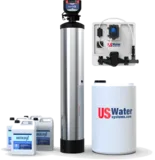 US Water Systems Matrixx InFusion (081-MIF) US Water Systems Matrixx InFusion (081-MIF) |
C | $2,983 | None | Check price |
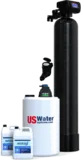 US Water Systems Flexx InFusion (081-FIF) US Water Systems Flexx InFusion (081-FIF) |
D | $2,255 | None | Check price |
Open these in the system finder
Common questions
Chlorine or hydrogen peroxide: which is better?
Chlorine is the standard for continuous disinfection and also oxidizes iron and sulfur. Hydrogen peroxide oxidizes iron and sulfur and leaves no chlorine taste, and US Water Systems markets its peroxide systems for iron and sulfur bacteria. For a well with recurring coliform bacteria, Penn State's guidance covers chlorination and UV as the continuous disinfection options.
Do I need a holding tank for chlorination?
Usually. Penn State says chlorine needs roughly 30 minutes of contact time and that a standard pressure tank is typically not enough, so a larger intermediate holding tank is added.
Is this the same as shock chlorination?
No. Shock chlorination is a one-time, high-strength dose to disinfect the well and plumbing. Chemical injection feeds a small dose continuously. Penn State suggests trying shock chlorination first when bacteria show up.
Will chlorine injection remove PFAS or nitrate?
No. Oxidants do not remove PFAS or nitrate. Use activated carbon or reverse osmosis for PFAS, and reverse osmosis or anion exchange for nitrate.
Sources
- Penn State Extension: Coliform bacteria (continuous chlorination and UV)
- Penn State Extension: Shock chlorination of wells and springs
- Penn State Extension: Corrosive water problems
- Penn State Extension: Iron and manganese in private water systems
- Penn State Extension: Hydrogen sulfide (rotten egg odor) in water wells
- Minnesota Department of Health: Iron bacteria in well water
- Minnesota Department of Health: Arsenic in well water
- UL Solutions: NSF/ANSI/CAN 60 drinking water treatment chemicals
- NSF: NSF/ANSI 61 drinking water system components, health effects
- US Water Systems Matrixx InFusion product page
- US Water Systems Matrixx InFusion spec sheet
- US Water Systems Flexx InFusion product page
- HomeGuide: Home water filtration system cost (2026)