
Arsenic
Key facts
- Type of concern
- Health
- EPA limit
- 10 µg/L (0.010 mg/L) (MCL) In force since January 2006. The health goal (MCLG) is zero.
- Common in
- private wells
- How to test
- A certified lab arsenic test, $38 at Wisconsin's state lab; if the result is high, a speciation test ($150 at Wisconsin) shows how much is arsenic III versus arsenic V, which decides the treatment.
| Treatment | Effectiveness | Look for |
|---|---|---|
| Reverse osmosis | Works well | NSF/ANSI 58 |
| Specialty media | Works well | NSF/ANSI 53 |
| Chemical injection | Partial | - |
| Air injection oxidation | Limited | - |
| Ion exchange softening | Limited | - |
At a glance: Arsenic is a natural element that dissolves from rock into groundwater, and USGS estimates about 2.1 million Americans get drinking water from private wells above EPA’s 10 µg/L limit. Long-term exposure raises the risk of several cancers and other diseases. It has no taste, color or smell, so every well should be tested at least once. If yours is high, a certified reverse osmosis unit or adsorptive media filter at the kitchen tap is the usual fix.
Public water systems must meet the 10 µg/L limit. Private wells are the owner’s responsibility.
What it is and where it comes from
Arsenic occurs naturally in rocks and soil, and small amounts dissolve into groundwater, according to the Minnesota Department of Health. USGS says nearly all arsenic in US groundwater is likely from natural sources. EPA’s health table also lists runoff from orchards as a source.
It is patchy and hard to predict. USGS mapped the highest-risk areas for private wells across much of the West (Washington, Oregon, Nevada, California, Arizona, New Mexico), parts of the Northeast and Midwest (including Maine, New Hampshire, Massachusetts, New Jersey, Michigan, Wisconsin, Ohio, Indiana and Illinois), and some southeastern coastal states. Maps show where risk is higher, but only a test tells you about your own well, which is why MDH advises testing every private well.
Arsenic in groundwater comes in two forms. Arsenic III (trivalent) and arsenic V (pentavalent) behave differently in treatment, and MDH notes both occur in its groundwater.
Health and household effects
Arsenic is a health issue only. It causes no stains, taste or smell.
EPA’s health table lists skin damage, circulatory system problems and increased risk of cancer. MDH adds that long-term exposure to low levels is associated with diabetes, cancers of the bladder, lungs and liver, cardiovascular disease, and effects on children’s development, as well as skin lesions and discoloration. WHO lists arsenic among its 10 chemicals of major public health concern.
MDH notes that even levels below 10 µg/L carry some long-term cancer risk, which is why EPA’s health goal is zero.
Limits and what they mean
| Standard | Level | What it means |
|---|---|---|
| EPA MCL | 10 µg/L | Enforceable for public systems since January 2006 |
| EPA health goal (MCLG) | Zero | No level is considered risk-free |
| WHO guideline | 10 µg/L | Provisional international guideline |
| New Jersey standard | 5 µg/L | Stricter state limit for public systems |
A USGS study of domestic wells found arsenic above the health benchmark in roughly 5 to 7 percent of wells, alongside nitrate and manganese. A result of 6 or 8 µg/L is below EPA’s limit, but given MDH’s note on long-term risk it is worth discussing with your health department if you drink the water every day.
How to test
Use a state-certified lab. Wisconsin’s state lab charges $38 for arsenic. MDH recommends testing every private well at least once, and retesting a new well after six months or more if the first result falls between 5 and 20 µg/L. In New Jersey, the Private Well Testing Act requires arsenic testing when a home with a well is sold.
If the result is high, ask for arsenic speciation ($150 at Wisconsin’s lab), which reports arsenic III and arsenic V separately. That decides whether you need a pre-oxidation step. Our well testing guide covers labs and sampling.
Treatment options
| Method | How well it works | Certification to look for | Cost range |
|---|---|---|---|
| Reverse osmosis, point of use | High for arsenic V | NSF/ANSI 58, arsenic (pentavalent) | $300 to $1,500 |
| Adsorptive media (specialty media), point of use | High for arsenic V | NSF/ANSI 53, arsenic (pentavalent) | $300 to $700, plus $300 to $500 every 6 to 12 months |
| Adsorptive media, whole house | High for arsenic V | NSF/ANSI 53 | $2,400 to $4,500, plus $700 to $900 a year |
| Chlorination as pre-oxidation | Converts arsenic III to V | None | $500 to $2,500 |
| Iron filter or air injection | Low; only with high iron | None | Not an arsenic fix |
| Distillation | High | NSF/ANSI 62 | $300 to $1,200 |
Cost ranges are Minnesota Department of Health estimates based on 2017 and 2018 quotes, low end self-installed and high end professionally installed.
Know which form you have. NSF certifications for arsenic cover arsenic V. MDH says pre-oxidation with chlorination, aeration or ozonation may be needed so treatment removes the type of arsenic in your water, and recommends working with a water treatment professional. MDH adds that sulfate can also affect which treatment works.
Point of use is usually enough. Most homes treat drinking and cooking water only. See whole-house filter vs reverse osmosis for the trade-offs, and use the filter finder to check which RO systems list an arsenic claim, not just an NSF/ANSI 58 certification.
When to call a professional
Call your county or state health department if a result is above 10 µg/L. MDH advises switching water sources or installing treatment when arsenic exceeds 10 µg/L on repeat sampling.
Work with a certified water treatment professional to choose between RO and adsorptive media, because arsenic form, pH, phosphate, sulfate and iron all affect performance. After installation, test the treated water, then retest at least once a year and whenever you change filters or media.
Systems in our database that address arsenic
| System | Evidence | Grade | Price | Certified to | |
|---|---|---|---|---|---|
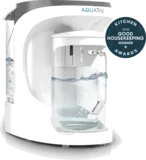 AquaTru Carafe (AT100 series) AquaTru Carafe (AT100 series) |
Certified | B | $375 | NSF/ANSI 42, NSF/ANSI 53, NSF/ANSI 58, NSF/ANSI 401, NSF/ANSI 372 | Check price |
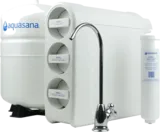 Aquasana SmartFlow Reverse Osmosis (AQ-SFRO2) Aquasana SmartFlow Reverse Osmosis (AQ-SFRO2) |
Certified | B | $190 | NSF/ANSI 42, NSF/ANSI 53, NSF/ANSI 58, NSF/ANSI 401, CSA B483.1, NSF/ANSI 372 | Check price |
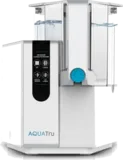 AquaTru Classic (AT2000 series) AquaTru Classic (AT2000 series) |
Certified | B | $475 | NSF/ANSI 42, NSF/ANSI 53, NSF/ANSI 58, NSF/ANSI 401, NSF/ANSI 372 | Check price |
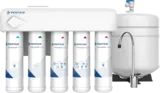 Pentair FreshPoint GRO-575B (161112) Pentair FreshPoint GRO-575B (161112) |
Certified | B | $722 | NSF/ANSI 58, NSF/ANSI 53, NSF/ANSI 42, NSF/ANSI 401, CSA B483.1, NSF/ANSI 53, NSF/ANSI 372 | Check price |
 AquaTru Freestanding Model 1 (ATFS-1-W) AquaTru Freestanding Model 1 (ATFS-1-W) |
Certified | C | $1,699 | NSF/ANSI 42, NSF/ANSI 53, NSF/ANSI 58, NSF/ANSI 401 | Check price |
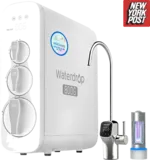 Waterdrop G3P800 (WD-G3P800-W) Waterdrop G3P800 (WD-G3P800-W) |
Lab tested | B | $999 | NSF/ANSI 58, NSF/ANSI 53, NSF/ANSI 42, NSF/ANSI 372 | Check price |
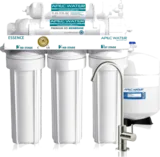 APEC ROES-50 APEC ROES-50 |
Maker claim | B | $231 | NSF/ANSI 58, NSF/ANSI 372 | Check price |
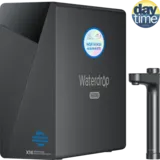 Waterdrop X16 (WD-X16) Waterdrop X16 (WD-X16) |
Maker claim | C | $1,999 | NSF/ANSI 58, NSF/ANSI 42, NSF/ANSI 372 | Check price |
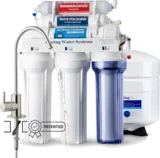 iSpring RCC7AK iSpring RCC7AK |
Maker claim | C | $242 | NSF/ANSI 58 | Check price |
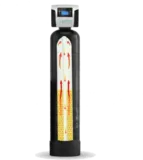 SoftPro Iron Master AIO SoftPro Iron Master AIO |
Maker claim | C | $1,517 | None | Check price |
Open these in the system finder
Common questions
How do I know if my well has arsenic?
Only by testing. Arsenic has no taste, color or smell. MDH advises testing every private well for arsenic at least once, and Wisconsin's state lab charges $38.
Is arsenic in well water natural?
Usually. USGS says nearly all arsenic in US groundwater likely comes from natural sources, dissolving from rocks and minerals. EPA also lists runoff from orchards as a source.
What is the best filter for arsenic?
For drinking water, a reverse osmosis system certified to NSF/ANSI 58 for arsenic, or an adsorptive media filter certified to NSF/ANSI 53. Both certifications cover arsenic V, so if your water has arsenic III it must be oxidized first. A speciation test tells you which you have.
What arsenic level is safe?
EPA's health goal is zero and its enforceable limit is 10 µg/L. MDH notes that even levels below 10 µg/L carry some long-term cancer risk, and New Jersey sets a stricter 5 µg/L standard for public systems.
Sources
- EPA: National primary drinking water regulations (arsenic)
- EPA: Chemical contaminant rules (arsenic rule)
- USGS: Study estimates about 2.1 million people using wells high in arsenic
- Minnesota Department of Health: Arsenic in drinking water
- WHO: Arsenic fact sheet
- New Jersey DEP: Arsenic in private well water
- Minnesota Department of Health: Home water treatment (costs and options)
- Wisconsin Department of Health Services: Treatment devices for private well contaminants
- Wisconsin State Laboratory of Hygiene: Test prices (effective July 1, 2026)
- NSF: Certified drinking water treatment units listings (arsenic pentavalent claims)
- USGS: Quality of water from domestic wells in principal aquifers, 1991-2004