Whole house water filter vs reverse osmosis
We earn a commission if you buy through links on this page. It never changes which systems we recommend. Details.
Short answerIf your worry is what you drink (PFAS, lead, arsenic, nitrate, fluoride), buy a certified RO for the kitchen: about $1,773 to $2,599 over 10 years. Buy a whole-house filter for chlorine or chloramine at every tap or for well iron and sulfur, and buy both when you have one of each problem.
Reverse osmosis is the better tool for the water you drink, and a whole-house filter is the better tool for the water you shower, wash and cook with. A countertop or under-sink RO certified to NSF/ANSI 58 reduces dissolved contaminants none of the whole-house carbon systems here claims to touch, and it costs a fraction of certified whole-house PFAS treatment.
Buy a whole-house (point-of-entry) system when the problem is at every tap: chlorine or chloramine smell in the shower, sediment, or well iron and sulfur. Buy both when you have one problem of each kind.
Well & Tap did not install or test these systems. Specs come from maker data sheets and the IAPMO, WQA and NSF listings, with prices checked September 2026 (how we research).
Which one you need
- PFAS, lead, arsenic, nitrate or fluoride in your drinking water: a certified RO at the kitchen. You may not need a whole-house system at all.
- Chlorine or chloramine taste and smell at every tap: a whole-house carbon filter.
- Well water with iron, manganese or a sulfur smell: whole-house treatment. RO units need that water pre-treated; the AquaTru, for one, wants all three under 0.1 mg/L.
- PFAS, and you want every tap treated anyway: Aquasana HealthShield, the only whole-house system here certified for five PFAS, at about $12,324 over 10 years.
- A whole-house problem plus a drinking-water contaminant: both, whole-house first.
Point of entry vs point of use
A point-of-entry system sits on the main line and treats every gallon that enters the house, so it has to keep up with showers and appliances running at once. The SpringWell CF1 is rated 9 gpm.
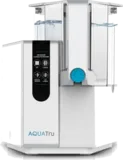
A point-of-use RO treats one faucet or one countertop tank. The AquaTru Classic makes 54 gallons a day at 0.06 gpm; the Waterdrop G3P800 is rated 800 gallons a day. That is plenty for drinking and cooking and nowhere near enough for a house.
RO also sends part of the water away. AquaTru’s data sheet lists 80% recovery, with the reject water collecting in its tap-water tank for you to dump; the G3P800 runs 3:1 pure to drain.
Whole-house RO does exist, but it is commercial-grade equipment. US Water Systems, for one, sells point-of-entry RO under its commercial terms and lists it as non-returnable. None of the systems here is one.
What each one removes
| SpringWell CF1 (whole-house carbon) | Aquasana HealthShield (whole-house) | AquaTru Classic (countertop RO) | Waterdrop G3P800 (under-sink RO) | |
|---|---|---|---|---|
| Treats | every tap | every tap | water you pour in | one faucet |
| Output | 9 gpm | 5.7 gpm | 0.06 gpm, 54 gal/day | 800 gal/day |
| Price (Sept 2026) | $1,160.25 plus $78.74 bypass | $2,099 | $475 | $999 ($759 with checkout code) |
| Chlorine and chloramine | claimed | internal tests only | certified, NSF/ANSI 42 | chlorine certified, NSF/ANSI 42 |
| PFAS | claimed, not certified | certified: PFOA, PFOS, PFNA, PFHxS, PFHpA | certified: PFOA, PFOS | certified: PFOA, PFOS |
| Lead | heavy metals claimed, not certified | no claim | certified, NSF/ANSI 58 | claimed, not on listing |
| Arsenic, nitrate, fluoride | no claim | no claim | certified, NSF/ANSI 58 | fluoride certified; arsenic and nitrate claimed |
| Dissolved solids (TDS) | no | no | certified | certified |
| Certifier | none | WQA | IAPMO | IAPMO |
| Drain / power | no / no | no / yes | no / yes | yes / yes |
| Upkeep | $42.19 a year plus $351.70 media per decade | about $1,022 a year | $129.83 a year | $159.97 a year |
| 10-year cost | $2,012.59 | $12,323.60 | $1,773.30 | $2,598.70 |
AquaTru’s NSF/ANSI 58 listing also covers barium, chromium, copper, radium, selenium, cysts and perchlorate, and its NSF/ANSI 401 listing covers 15 emerging compounds plus microplastics. The G3P800’s NSF/ANSI 58 listing covers TDS, fluoride, cadmium, hexavalent chromium, selenium, barium and radium.
PFAS: the facts that decide it
EPA names three treatment types that work on PFAS: activated carbon, ion exchange and high-pressure membranes such as RO. It calls RO “extremely effective” and notes carbon works well on long-chain PFAS like PFOA and PFOS but less well on short-chain ones like PFBS and PFBA.
When you buy, EPA says to look for NSF/ANSI 53 (filters) or NSF/ANSI 58 (RO). It also notes that current certifications do not yet show a filter will reduce PFAS to the new federal limits.
Certification scope matters. AquaTru and the G3P800 are certified for PFOA and PFOS only; HealthShield for five PFAS. None of them is certified for GenX (HFPO-DA), one of the chemicals in the 2024 rule.
Where the PFAS rule stands, September 2026
EPA’s April 2024 rule set limits of 4 ppt for PFOA and PFOS, 10 ppt for PFHxS, PFNA and GenX, and a hazard index of 1 for mixtures, with compliance by 2029. On May 18, 2026, EPA proposed rescinding all but the PFOA and PFOS limits and letting utilities request two more years for those, to 2031. Comments closed July 20, 2026; until a final rule is published, the 2024 limits stand.
EPA released the final set of UCMR 5 monitoring data in August 2026. Check what your utility reported in the PFAS lookup or by state.
Where you are exposed matters as much as the filter. EPA says “only a small amount of PFAS can get into your body through your skin,” so showering, bathing and washing dishes in water containing PFAS “are unlikely to significantly increase your risk.” For most households, that makes a kitchen RO the right PFAS answer. More in how to remove PFAS from water.
Cost over 10 years
Method: purchase price plus 10 years of scheduled filters, membranes and tanks at September 2026 prices. Installation, electricity and water are not included.
| Setup | Upfront | Upkeep, 10 years | 10-year total |
|---|---|---|---|
| AquaTru Classic | $475 | $1,298.30 (10 x $129.83) | $1,773.30 |
| Waterdrop G3P800 | $999 | $1,599.70 (10 x $159.97) | $2,598.70 |
| SpringWell CF1 | $1,238.99 (incl. bypass) | $773.60 ($421.90 sediment plus $351.70 media) | $2,012.59 |
| SpringWell CF1 plus AquaTru Classic | $1,713.99 | $2,071.90 | $3,785.89 |
| SpringWell Lead & Cyst (PFOA/PFOS certified under Enpress) | $1,554 | $4,239 (10 x $423.90) | $5,793.00 |
| Aquasana HealthShield | $2,099 | $10,224.60 (10 x $147.96 filters plus 5 x $1,749 tanks) | $12,323.60 |
AquaTru’s yearly figure is its $259.65 two-year combo pack divided by two. With Waterdrop’s $240 checkout code, the G3P800 total drops to $2,358.70. HealthShield costs about 7 times the AquaTru over the decade, almost all of it in $1,749 replacement tanks.
Aquasana recommends a licensed plumber for its whole-house systems, while the AquaTru needs only an outlet and the G3P800 a drain saddle and an outlet under the sink. See whole house water filter cost.
When to buy both
City water with chloramine you notice in the shower, plus PFAS or lead in your utility’s results. A CF1 plus an AquaTru comes to $3,785.89 over 10 years, under a third of HealthShield’s $12,323.60, and the RO adds certified lead, nitrate and fluoride reduction HealthShield does not claim.
Well water with iron or sulfur, plus nitrate or arsenic. Treat the whole house first, then add RO at the kitchen. The AquaTru Classic needs hardness under 10 gpg and iron, manganese and sulfide under 0.1 mg/L. Waterdrop’s warranty covers only municipal water, so on a well the AquaTru is the safer pick. Start with how to test well water.
You may need neither. If your utility reports no PFAS and your only complaint is chlorine taste, a whole-house carbon filter is optional and an RO is not needed.
Who should buy which
Best for drinking water: AquaTru Classic
The AquaTru is IAPMO-certified to NSF/ANSI 42, 53, 58 and 401, needs no plumbing, and has the lowest 10-year cost here. Its PFAS certification covers PFOA and PFOS only. Full details in the AquaTru review.
Best under-sink RO: Waterdrop G3P800
Choose the G3P800 if you want filtered water on tap at a dedicated faucet and are on city water. Its $999 list price drops to $759 with a checkout code, and its PFAS certification also covers PFOA and PFOS only.
Best whole-house filter for city water: SpringWell CF1
Buy the CF1 for chlorine or chloramine at every tap, with no drain or power needed. Its PFAS claim is not certified, so pair it with an RO if PFAS is the concern. See the CF1 review.
Certified PFAS at every tap: Aquasana HealthShield
HealthShield is for households that want certified PFAS reduction at every tap and can budget $1,749 for a tank about every 2 years. Compare it with other options in best whole house filter for PFAS and the HealthShield review.
Questions people ask
Is reverse osmosis better than a whole house water filter?
For drinking water, yes: the AquaTru Classic's NSF/ANSI 58 certification covers nitrate, fluoride and arsenic, which none of the whole-house systems here claims to reduce. A whole-house filter is better for shower and laundry water and for well iron and sulfur.
Do I need a whole house filter for PFAS?
Usually not. EPA says showering, bathing and washing dishes in water containing PFAS are unlikely to significantly increase your risk, so a certified point-of-use RO or filter at the kitchen covers the main exposure.
Can I put reverse osmosis on my whole house?
Whole-house RO exists but it is commercial-grade equipment. US Water Systems, for example, sells point-of-entry RO under its commercial terms and lists it as non-returnable. None of the systems compared here is one.
Should I install a whole house filter before an RO system?
On well water, often yes. The AquaTru Classic needs hardness under 10 gpg and iron, manganese and sulfide under 0.1 mg/L, and Waterdrop's warranty only covers municipal water, so iron or sulfur needs treating first.
Which is cheaper over 10 years, RO or a whole house filter?
A countertop AquaTru Classic comes to about $1,773 and a SpringWell CF1 whole-house filter to about $2,013. The only whole-house system certified for five PFAS, Aquasana HealthShield, comes to about $12,324.
Sources
- EPA: reducing PFAS in your drinking water with a home filter
- EPA Science Matters: reducing PFAS in drinking water with treatment technologies
- EPA: meaningful and achievable steps to reduce PFAS risk
- EPA: PFAS National Primary Drinking Water Regulation
- EPA: proposed PFAS rescission rule (May 2026)
- EPA: proposed PFOA and PFOS compliance extension rule
- Water Online: EPA releases final UCMR 5 data
- AquaTru Classic product page
- IAPMO R&T file W-10193 (AquaTru, NSF/ANSI 53)
- IAPMO R&T file W-10194 (AquaTru, NSF/ANSI 58)
- AquaTru Classic two-year filter combo pack
- Waterdrop G3P800 product page
- IAPMO R&T file WC-14805 (Waterdrop G3P800, NSF/ANSI 53)
- IAPMO R&T file WC-13976 (Waterdrop, NSF/ANSI 58)
- Waterdrop G3P800 user manual
- SpringWell CF1 product page
- Aquasana HealthShield product page
- WQA listing: Aquasana HealthShield (NSF/ANSI 53)
- IAPMO R&T file W-9981 (Enpress Pioneer, NSF/ANSI 53)
- US Water Systems return policy (point-of-entry RO terms)