
The best whole house water filters for well water
We earn a commission if you buy through links on this page. It never changes which systems we recommend. Details.
Short answerTest your well before you buy anything. For iron, manganese and sulfur, the SpringWell WS1 is the best fit for most wells, the US Water Systems Matrixx InFusion handles heavy iron and sulfur, and a US Water Systems Pulsar UV goes last in line if the test finds bacteria.
Well water needs a test before it needs a filter, because the right system depends entirely on what is in it. For iron, manganese and sulfur smell, the SpringWell WS1 is the best fit for most wells; for bacteria, a UV unit such as the US Water Systems Pulsar goes last in the line; for hardness, a salt softener; for grit, a sediment filter ahead of everything.
No single tank does all four. This page is organized by problem so you can build the line your test calls for, and skip what it does not.
| Pick | System | Grade | Flow | From | |
|---|---|---|---|---|---|
| Iron, manganese, sulfur | 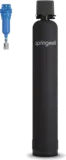 SpringWell WS1 SpringWell WS1 |
C | 12 gpm | $2,231 | Check price |
| Heavy iron and sulfur | 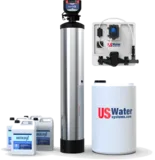 US Water Systems Matrixx InFusion (081-MIF) US Water Systems Matrixx InFusion (081-MIF) |
C | 10 gpm | $2,983 | Check price |
| Light iron, budget | 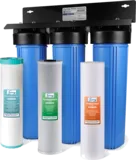 iSpring WGB32BM iSpring WGB32BM |
D | 15 gpm | $536 | Check price |
| Bacteria (UV) | 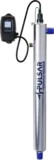 US Water Systems Pulsar UV (405-PUV-200) US Water Systems Pulsar UV (405-PUV-200) |
C | 10 gpm | $995 | Check price |
| Hardness | 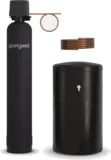 SpringWell SS1 SpringWell SS1 |
C | 11 gpm | $1,607 | Check price |
How we chose
- Rated limits. Each pick lists the maximum iron, manganese and hydrogen sulfide it handles. We matched picks to those numbers, not to “removes iron” marketing.
- Certification reality. None of the iron, sulfur or UV systems here holds an NSF, IAPMO or WQA system certification, and neither UV unit claims NSF/ANSI 55 Class A. We say so on each pick.
- Well-specific needs. Backwash flow your pump must supply, pH ranges, drain and power requirements.
- 10-year cost and terms. Media rebeds, peroxide, UV lamps, and the return policies that apply once a system is plumbed in.
Test first
The EPA does not regulate private wells: “Private well owners are responsible for delivering safe drinking water to their households.” The CDC recommends testing at least once a year for total coliform bacteria, nitrates, total dissolved solids and pH.
For choosing treatment you also need iron, manganese, hardness, hydrogen sulfide and, if you have staining or smell, tannins and turbidity. The EPA’s secondary (nuisance) levels are a useful yardstick: iron above 0.3 mg/L causes orange staining and a metallic taste, manganese above 0.05 mg/L causes black staining, and a rotten-egg smell points to hydrogen sulfide. Our well testing guide covers labs and costs.
Buy to the test, not the symptom
Orange stains can be iron, iron bacteria or both, and the fix differs. Sulfur smell only from the hot water side often points at the water heater, not the well. A lab test costs far less than the wrong $2,500 system.
Iron, manganese and sulfur
These three are the most common reasons well owners buy a whole-house system. All three need to be oxidized (turned from dissolved to solid) and then filtered out. The picks differ in how they oxidize and how much they can handle.
Best for iron and sulfur: SpringWell WS1
The WS1 keeps a pocket of air at the top of the tank. Water passes through it, dissolved iron, manganese and hydrogen sulfide oxidize, and Greensand Fusion media catches the particles. Once a night the tank backwashes to drain and draws in fresh air. There are no chemicals to buy.
SpringWell rates the WS1 for iron up to 7 ppm, hydrogen sulfide up to 8 ppm and manganese up to 1 ppm, at 12 gpm. The WS4 raises that to 20 gpm for $2,677.50 (the linked manual lists 18 gpm). It works across pH 6.5 to 10.
The buying process is the best in this category. A Level 1 plus bacteria water test ($134.25, non-refundable) is a required add-on; SpringWell holds the order until the results are approved and refunds you in full if your water is not compatible. Add the $58.79 bypass valve and the WS1 comes to $2,424.29 before installation.
SpringWell lists no consumables for the WS1 and states a 10+ year media life, but it publishes no replacement media price. Our SpringWell WS1 review has the full breakdown.
Watch out for:
- The nightly backwash runs at about 5 gpm (7 gpm for the WS4). A weak well pump or a small pressure tank may struggle to supply it.
- The tank is under lifetime warranty, but the electronic head carries 5 years. Installed systems cannot be returned for a refund.
Best for heavy iron and sulfur: US Water Systems Matrixx InFusion
When iron or sulfur is beyond the WS1’s limits, you need a stronger oxidizer. The Matrixx InFusion injects hydrogen peroxide with a Stenner pump ahead of a backwashing catalytic carbon tank. US Water Systems rates it for iron up to 20 ppm, hydrogen sulfide up to 30 ppm and manganese up to 1 ppm, and says it also handles iron and sulfur bacteria.
It costs $2,982.95 for 10 gpm and $3,179.16 for 15 gpm. Running costs are real: peroxide refills ($84.95 for two 2.5 gallon bottles, usage varies), a pump tube every 1 to 5 years, and catalytic carbon every 3 to 5 years ($498.95 for the 10 x 54 rebed kit). The tank backwashes about every two days at 5 to 8 gpm.
Warranty is strong: lifetime on the media tank, 10 years on the valve and electronics, 5 years on the Stenner pump. US Water Systems makes the usual “NSF approved components” claim, but there is no system listing.
The cheaper Flexx InFusion ($2,255.36) uses the same idea with half the limits (iron 10 ppm, hydrogen sulfide 15 ppm, manganese 0.5 ppm) and a 5-year warranty. If your numbers fit the SpringWell WS1, it is the simpler buy.
Watch out for:
- A review on the product page reports clogging after about 8 months at around 12 ppm iron, with fouled media not covered under warranty. Very high iron needs regular backwash checks.
- US Water Systems’ restocking fee runs up to 40%, and its one-year money-back guarantee applies to systems specified by its own water specialists.
Best budget for light iron: iSpring WGB32BM
If your iron is modest and you have no sulfur smell, a cartridge system can do the job for $535.99. The WGB32BM runs water through a 5-micron sediment filter, a coconut carbon block and an iron and manganese cartridge (FM25B). iSpring rates it for iron up to 3.0 ppm and manganese up to 1.0 ppm. It needs no drain or power.
The weak point is cartridge life. The FM25B is rated for 50,000 gallons at 3.0 ppm iron, half the life of the other two cartridges, and costs $104.99. At higher iron you will change it often; the full three-filter pack is $159.99 a year at normal levels.
iSpring’s certification claims are “tested to” only: its NSF listing covers reverse osmosis systems, not this one, and the iron cartridge has no test claim at all. The product page lists pH 6 to 11 while the manual lists 6 to 9, so check your pH against the lower number.
Watch out for:
- It does not remove iron bacteria, other bacteria or viruses. iSpring recommends a softener ahead of it if TDS is above 300 ppm.
- 1-year warranty; opened returns lose 15%.
Bacteria
A positive coliform test means something is getting into the well. Fix the source first (cap, casing, grading, then shock chlorination), retest, and use UV as ongoing protection. UV kills or inactivates bacteria, viruses and cysts as water passes the lamp, but only if the water is clear enough for the light to reach them.
Best UV for well water: US Water Systems Pulsar UV
The Pulsar costs $995 for 10 gpm, $1,139 for 15 gpm and $1,195 for 20 gpm, with 1-micron prefilter bundles from $1,079.95. Its controller shows remaining lamp life and alarms if the lamp fails, and the lamp can be changed without shutting off water. For a disinfection device, the alarm is the feature that matters most.
The flow ratings are at a UV dose of 30 mJ/cm2 with 95% UV transmittance. NSF/ANSI 55 Class A, the standard for disinfecting untreated water, uses 40 mJ/cm2, and SpringWell’s BlackComb manual shows its own 15 gpm reactor rated at only 12 gpm at that dose. Size up one step: buy the 15 gpm Pulsar for a home that needs 10 gpm.
The lamp needs replacing every 9,000 hours, about a year ($111.31 for the 10 gpm lamp, $119.25 for the larger sizes). The reactor carries a 10-year warranty, the controller 3 years, and the lamp and sleeve 1 year.
Watch out for:
- No NSF/ANSI 55 certification is claimed. The product page also carries an empty “PFOA/PFOS Removal” heading; UV does nothing for PFAS.
- UV must go after iron, sediment and hardness treatment, or the quartz sleeve fouls and bacteria shelter in the particles.
Hardness
Hard water is common in wells and does not threaten health, but it scales water heaters, fixtures and the quartz sleeve of a UV unit. The USGS classes water above 120 mg/L (about 7 gpg) as hard and above 180 mg/L (about 10.5 gpg) as very hard.
Best for hard well water: SpringWell SS1
For well water, a salt-based softener is usually the right answer. The salt-free conditioners we researched require iron, manganese and hydrogen sulfide at or near zero, and SpringWell’s FutureSoft also needs pH 7.0 or higher, which rules out many wells. The SS1 is a metered ion exchange softener: 32,000 grain, 11 gpm, $1,606.50. The SS4 is 48,000 grain and 13 gpm for $1,785.
If you need both iron and hardness treatment, the SpringWell WSSS1 combo pairs the WS1 and SS1 for $3,123.75, against $3,837.75 bought separately, a saving of $714. The iron filter goes first so the softener resin does not foul.
SpringWell does not claim NSF/ANSI 44 or any other certification for its softeners. Salt use and resin life are not stated either, so budget for salt refills.
Watch out for:
- It needs a drain, an outlet and room for an 18 x 33 inch brine tank. The electronic head is covered 5 years.
- Softened water adds sodium. If anyone in the house is on a low-sodium diet, keep one unsoftened tap for drinking.
For a deeper look at the trade-off, see our salt-free softener picks, which explain when a conditioner is enough.
Sediment
Sand, silt and grit are a pump or well problem as much as a water problem, and they wear out everything downstream. The fix is a sediment filter first in line, and you may not need anything bigger if grit is your only complaint.
We have no standalone sediment pick. The components are cheap and interchangeable, and several picks above include one: the iSpring WGB32BM starts with a 5-micron sediment cartridge, the Pulsar UV is sold with a 1-micron prefilter, and SpringWell sells sediment housings for its UV at $83.23 (10 inch) and $190.39 (20 inch).
Two tips from the spec sheets. UV needs turbidity under 1 NTU (Aquasana’s requirement for its own UV), so a fine prefilter ahead of UV is not optional on a gritty well. And sudden grit after years of clean water can mean a failing pump or well screen, which a filter will hide rather than fix.
Also considered
- SpringWell UV (15 gpm), $1,100.50: a reasonable reactor, but it costs more than the Pulsar, the page’s “lifetime warranty” badge becomes 10 years on the reactor and 1 year on the lamp in the manual, and no lamp-failure alarm is listed.
- Aquasana Rhino Well Water with UV, $1,749: its UV unit is certified to NSF/ANSI 55 Class B, which covers supplemental treatment of water already considered safe, not disinfection of a contaminated well. It has no iron, manganese or hardness treatment, yet its UV needs iron under 0.3 ppm and hardness under 7 gpg. Upkeep is about $444 a year.
- Crystal Quest Metal Removal, from $1,331: the MetalX media data sheet linked from its own page rates a 2.0 cubic foot tank at 4.40 gpm standard service flow, far below the 9 to 13 gpm Crystal Quest quotes. NSF has a public notice about Crystal Quest’s past use of the NSF mark, and the warranty is 1 year.
- US Water Systems Flexx InFusion, $2,255.36: covered above; half the Matrixx limits and a 5-year warranty.
Buying guidance for well water
Build the line in the right order
- Sediment filter
- Iron, manganese and sulfur filter
- Softener
- UV, last
Every UV maker in our research lists water-quality limits ahead of the lamp. SpringWell’s UV needs hardness under 7 gpg, iron under 0.3 ppm and tannins under 0.1 ppm. Put it anywhere but last and it underperforms.
Check your pump and pressure tank
Backwashing filters and softeners draw 2 to 8 gpm to drain during regeneration, on top of household use. Ask your installer to confirm your pump’s output, and see our sizing guide for peak-flow math.
Match pH to the media
The SpringWell WS1 needs pH 6.5 to 10, the Matrixx InFusion 6 to 9, the Flexx InFusion 6.5 to 8.5. Acidic well water below those ranges needs a neutralizer first, or the media will not oxidize iron properly.
PFAS in wells
Iron and UV systems do nothing for PFAS. Private wells are not covered by EPA’s PFAS rule, so the only way to know is a lab test. If PFAS shows up, see our PFAS picks and the EPA data by ZIP code for nearby public systems as a guide to local contamination.
Specific problems
- Orange stains and metallic taste: our iron in well water guide.
- Rotten-egg smell: our sulfur smell guide.
Questions people ask
What is the best whole house filter for well water with iron?
For iron up to 7 ppm, the SpringWell WS1 air-injection filter. Above that, or with iron bacteria, the US Water Systems Matrixx InFusion is rated for iron up to 20 ppm. For iron under 3 ppm on a tight budget, the iSpring WGB32BM cartridge system works but needs frequent filter changes.
Do I need UV if my well tests clean?
Not necessarily. The CDC recommends testing for coliform bacteria at least once a year. If your well tests negative and nothing has changed, UV is optional; if it tests positive, fix the well first (cap, casing, shock chlorination) and add UV as ongoing protection.
In what order should well water treatment go?
Sediment filter first, then the iron and sulfur filter, then the softener, with UV last. UV makers require clear, low-iron, low-hardness water: SpringWell's UV lists iron under 0.3 ppm and hardness under 7 gpg.
Can a salt-free conditioner work on well water?
Only on well water with no iron, manganese or hydrogen sulfide. SpringWell's FutureSoft requires all three at zero, and the US Water Systems GreenWave allows no more than 0.3 mg/L iron. Most wells with those problems need an iron filter and a salt softener instead.
Are any well water filters certified?
None of the iron, sulfur or UV systems on this page holds an NSF, IAPMO or WQA system certification. Neither UV system claims NSF/ANSI 55 Class A. That is normal for this category, so the water test and the seller's return terms matter more.
Sources
- CDC: guidelines for testing well water
- EPA: private drinking water wells
- EPA: secondary drinking water standards (iron, manganese, odor)
- SpringWell WS1 product page
- SpringWell WS1/WS4 manual
- US Water Systems Matrixx InFusion product page
- US Water Systems Matrixx InFusion spec sheet
- US Water Systems return policy
- iSpring WGB32BM product page
- US Water Systems Pulsar UV product page
- US Water Systems Pulsar UV manual
- SpringWell UV product page
- SpringWell BlackComb UV manual (2019)
- SpringWell salt-based softener product page
- SpringWell well filter and salt softener combo
- Aquasana Rhino Well Water with UV product page
- NSF listings, Aquasana NSF/ANSI 55
- Crystal Quest MetalX product data sheet
- USGS hardness classification (Hem, 1985), WRIR 02-4045 table 14