
Ultraviolet (UV) disinfection
Key facts
- Installs at
- Whole house or single tap
- Removes
- Bacteria
- Does not remove
- PFAS, Lead, Nitrate, Arsenic, Iron, Hardness
- Certifications
- NSF/ANSI 55 Class A, NSF/ANSI 55 Class B what these mean
- Needs
- power
- Typical cost
- $350 to $1,500 installed
- Upkeep
- lamp every year; clean the quartz sleeve regularly; sediment pre-filter on its own schedule
A UV system passes water past an ultraviolet lamp that inactivates bacteria, viruses and cysts such as Giardia and Cryptosporidium. It adds no chemicals and removes nothing: lead, PFAS, nitrate, arsenic, iron and hardness all pass straight through.
It is the most common way to disinfect private well water continuously. It only works on clear, pre-treated water, and it needs a lamp change every year.
How it works
Water flows through a stainless steel chamber around a lamp housed in a quartz sleeve. UV-C light damages the genetic material of microorganisms so they cannot reproduce. How well it works depends on the dose, measured in millijoules per square centimeter (mJ/cm2), which falls when flow is high or the water is cloudy.
Flow ratings depend on the dose used to calculate them. SpringWell’s 2019 BlackComb manual, for example, rates its reactor at 15 gpm at 30 mJ/cm2, but 12 gpm at 40 mJ/cm2, the Class A dose. Check which dose a flow rating assumes.
UV also leaves no residual. Penn State Extension notes it “only kills bacteria inside the unit” and does nothing for bacteria that survive or are introduced into the plumbing afterward.
What it removes and what it does not
With pre-filtered water, the CDC says UV treats parasites, bacteria and viruses. It does not remove chemicals.
Penn State adds a limit: UV is not recommended where total coliform bacteria exceed 1,000 colonies per 100 mL or fecal coliform exceed 100 colonies per 100 mL. At that level, find and fix the source first. Shock chlorination is the usual first step.
UV does nothing for PFAS, lead, nitrate, arsenic, iron, hardness or chlorine. If your test shows any of these, you need another treatment in front of the UV, or a point-of-use option such as reverse osmosis for drinking water.
Certifications to look for
The standard is NSF/ANSI 55, and its two classes are very different:
- Class A: delivers at least 40 mJ/cm2 and is intended to inactivate bacteria, viruses, Cryptosporidium and Giardia in contaminated but visually clear water. It must include a UV sensor and alarm as a fail-safe.
- Class B: a lower dose (16 mJ/cm2) for supplemental treatment of disinfected public water or other water already tested acceptable. It is not meant for contaminated water.
Of the UV units we track, only Aquasana’s is certified, to Class B by NSF at 6 gpm. SpringWell’s UV and US Water Systems’ Pulsar claim no NSF/ANSI 55 certification. For a well, a Class A listing is the one to look for; without it, confirm the unit has a sensor and alarm and that the flow rating is quoted at 40 mJ/cm2.
Installation and upkeep
UV goes last in the treatment train, after sediment, iron and softening equipment, because Penn State says the water must be “completely clear and free from any suspended sediment or turbidity.” Makers set specific limits: SpringWell requires iron under 0.3 ppm, hardness under 7 grains per gallon and tannins under 0.1 ppm; Aquasana adds manganese under 0.05 ppm and turbidity under 1 NTU.
It needs a grounded outlet but no drain. Upkeep:
- Lamp: about once a year. Penn State says lamps slowly lose intensity; US Water Systems rates its lamps at 9,000 hours.
- Quartz sleeve: clean regularly, since hardness and iron coat it.
- Electricity: Penn State estimates $2 to $4 a month.
UV cannot reach bacteria already in the plumbing downstream. Penn State suggests shock chlorination as the first step when a well tests positive for bacteria. See chemical injection for continuous chlorination as the alternative to UV, and our well testing guide for retesting.
Costs
HomeGuide puts UV systems at $350 to $1,500 installed and replacement lamps at $20 to $100. Prices checked September 2026:
| System | Flow | Price | Lamp |
|---|---|---|---|
| US Water Systems Pulsar | 10 to 20 gpm | $995 to $1,195 | $111 to $119 a year |
| SpringWell UV | 15 gpm (at 30 mJ/cm2) | $1,101 | $119 a year |
| Aquasana Rhino Well Water with UV | 7 gpm system; UV certified Class B at 6 gpm | $1,749 with carbon tank | $126 a year |
Over 10 years, SpringWell’s unit comes to about $2,290 with lamps. See our well water picks and the product finder.
Pros and limits
Pros
- Inactivates bacteria, viruses and cysts without chemicals.
- No taste, odor or byproducts.
- Low running cost and no drain needed.
Limits
- Removes no chemicals, metals or minerals.
- Needs clear water: sediment, iron, manganese and hardness must be treated first.
- No residual protection in the plumbing.
- Annual lamp replacement, and it stops working if the power fails.
- None of the whole-house UV units we track is Class A certified.
Systems in our database that use ultraviolet (uv) disinfection
| System | Grade | Price | Certified to | |
|---|---|---|---|---|
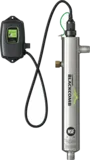 LUMINOR BLACKCOMB 5.1 LB5-101B LUMINOR BLACKCOMB 5.1 LB5-101B |
A | $897 | NSF/ANSI 55 Class B (listed as LB5-10XB, X = plug type, 13 gpm), CSA B483.1 | Check price |
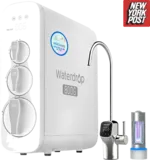 Waterdrop G3P800 (WD-G3P800-W) Waterdrop G3P800 (WD-G3P800-W) |
B | $999 | NSF/ANSI 58, NSF/ANSI 53, NSF/ANSI 42, NSF/ANSI 372 | Check price |
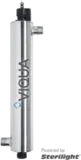 VIQUA VH410 VIQUA VH410 |
B | $880 | NSF/ANSI 55 Class B, listed model VH410-V only (with flow restrictor, 14 gpm); the plain VH410 priced here is not the listed model, CSA B483.1, listed model VH410-V only | Check price |
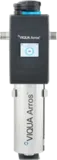 VIQUA Arros 15 VIQUA Arros 15 |
B | $1,046 | NSF/ANSI 55 Class B, listed model Arros 15-V only (with flow restrictor, 9.4 gpm at 16 mJ/cm2 and 70% UVT); the plain Arros 15 priced here is not the listed model, CSA B483.1, listed model Arros 15-V only | Check price |
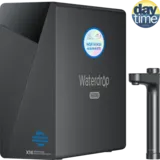 Waterdrop X16 (WD-X16) Waterdrop X16 (WD-X16) |
C | $1,999 | NSF/ANSI 58, NSF/ANSI 42, NSF/ANSI 372 | Check price |
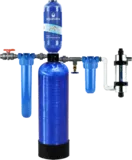 Aquasana Rhino Well Water with UV WH-WELL-UVS (WH-WELL-UV) Aquasana Rhino Well Water with UV WH-WELL-UVS (WH-WELL-UV) |
C | $1,749 | None | Check price |
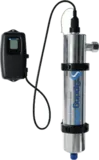 SpringWell SPRW-UV-15gpm SpringWell SPRW-UV-15gpm |
C | $1,101 | None | Check price |
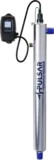 US Water Systems Pulsar UV (405-PUV-200) US Water Systems Pulsar UV (405-PUV-200) |
C | $995 | None | Check price |
Open these in the system finder
Common questions
Should I buy a Class A or Class B UV system?
For a private well or any water that has tested positive for bacteria, Class A. It delivers at least 40 mJ/cm2 and must have a UV sensor and alarm. Class B is only for supplemental treatment of water already considered safe, such as disinfected city water.
Does UV work on well water with iron or hard water?
Only after pre-treatment. Penn State says water must be clear and free of sediment, and hardness can coat the quartz sleeve with scale. SpringWell requires iron under 0.3 ppm and hardness under 7 grains per gallon for its UV unit.
Does UV leave anything in the water?
No. It adds no chemicals and changes no taste. That also means it leaves no residual disinfectant, so Penn State notes it only treats water inside the unit, not bacteria that survive or enter the plumbing afterward.
How often do I change the UV lamp?
About once a year. Penn State says lamps slowly lose intensity, and SpringWell and US Water Systems both list annual replacement (US Water Systems rates its lamps at 9,000 hours).
Sources
- CDC: About home water treatment systems
- Penn State Extension: Coliform bacteria (UV limits, maintenance, running cost)
- Penn State Extension: Shock chlorination of wells and springs
- WC&P: NSF/ANSI 55 Class A versus Class B UV systems (Rick Andrew, 2015)
- NSF: NSF Standards for water treatment systems
- SpringWell UV product page
- SpringWell (BlackComb) UV manual, 2019
- US Water Systems Pulsar UV product page
- US Water Systems Pulsar UV manual
- Aquasana Rhino Well Water with UV product page
- NSF listing: Aquasana UV (NSF/ANSI 55 Class B)
- HomeGuide: Home water filtration system cost (2026)