
Fluoride
Key facts
- Type of concern
- Health and household
- EPA limit
- 4.0 mg/L (MCL) Set in 1986 to prevent bone disease. EPA's non-enforceable secondary standard is 2.0 mg/L, for tooth discoloration. EPA began an expedited review of fluoride in April 2025 and released its toxicity assessment protocol on August 3, 2026.
- Signs
- white spots or streaks on children's teeth (dental fluorosis) at elevated levels
- Common in
- city water and private wells
- How to test
- A certified lab fluoride test, $33 at Wisconsin's state lab; city customers can find the level in the utility's annual water quality report.
| Treatment | Effectiveness | Look for |
|---|---|---|
| Reverse osmosis | Works well | NSF/ANSI 58 |
| Specialty media | Partial | - |
| Activated carbon | Limited | - |
At a glance: Fluoride is a natural mineral that many US utilities also add to water at 0.7 mg/L to prevent tooth decay, following the US Public Health Service recommendation. EPA’s enforceable limit is 4.0 mg/L, with a 2.0 mg/L secondary standard to prevent tooth discoloration, and EPA is reviewing that limit on an expedited schedule. Some private wells have natural fluoride above those levels, so test yours at least once. If you want fluoride out of your drinking water, reverse osmosis certified for fluoride reduction is the practical option; ordinary carbon filters do not remove it.
What it is and where it comes from
Fluoride occurs naturally in rock and dissolves into groundwater. EPA’s health table lists both sources: erosion of natural deposits and a water additive that promotes strong teeth.
On city water, the level usually reflects whether your utility fluoridates. The US Public Health Service has recommended 0.7 mg/L for community water fluoridation since 2015, and the CDC’s guidance still uses that figure. Your Consumer Confidence Report lists the measured level.
On private wells, it depends on local geology. A USGS study of more than 2,000 domestic wells found fluoride above a health benchmark in about 1 to 2 percent of wells. The CDC says less than 1% of the US population has fluoride above 2.0 mg/L from private wells or water systems.
Health and household effects
At high levels, fluoride affects bones and teeth. EPA’s health table lists bone disease (pain and tenderness of the bones) above the 4.0 mg/L limit, and says children may get mottled teeth. The 2.0 mg/L secondary standard exists to help children avoid dental fluorosis, which the CDC says only develops in children under 8, while teeth are forming.
Newer research focuses on the brain. In 2024 the National Toxicology Program concluded, with moderate confidence, that fluoride exposures above 1.5 mg/L in drinking water, the WHO guideline, are consistently associated with lower IQ in children. Most of those studies were done outside the US, and NTP says more research is needed on whether lower exposures affect IQ.
EPA is reassessing its limit in light of this work. It committed in April 2025 to review the new science, released a preliminary assessment plan in January 2026, and on August 3, 2026, published its protocol for a fluoride human health toxicity assessment. EPA says the next full review would otherwise not have been due until 2030. The 4.0 mg/L limit stays in force while the review runs.
Limits and what they mean
| Standard | Level | What it means |
|---|---|---|
| EPA MCL and health goal | 4.0 mg/L | Enforceable limit for public systems, set in 1986; under review |
| EPA secondary standard | 2.0 mg/L | Guideline to prevent tooth discoloration |
| WHO guideline | 1.5 mg/L | Health-based international guideline |
| US Public Health Service recommendation | 0.7 mg/L | Target level for community fluoridation |
The CDC says to contact your public health department if your water has 4.0 mg/L or more. Private wells are not covered by EPA rules, so these numbers are benchmarks for the owner.
How to test
The CDC says the fluoride content of well water can only be determined by lab analysis. Wisconsin’s state lab charges $33. On city water, check your utility’s annual water quality report or call the utility, which can tell you whether it fluoridates and at what level.
If you have young children and a private well, test before they start drinking the water every day, and share the result with your dentist or pediatrician. Our well testing guide covers labs and what else to include.
Treatment options
| Method | How well it works | Certification to look for | Cost range |
|---|---|---|---|
| Reverse osmosis, point of use | High | NSF/ANSI 58, fluoride reduction | $300 to $1,500 |
| Activated alumina (specialty media), point of use | Moderate to high; depends on pH | No NSF/ANSI claim; ask for test data | $300 to $700, plus $300 to $500 every 6 to 12 months |
| Distillation, point of use | High | NSF/ANSI 62 | $300 to $1,200 |
| Standard activated carbon | Low | Not applicable | Not a fluoride fix |
Cost ranges are Minnesota Department of Health estimates based on 2017 and 2018 quotes, low end self-installed and high end professionally installed.
Wisconsin’s health department lists reverse osmosis certified to NSF/ANSI 58 as the device type for fluoride. On NSF’s listings, fluoride is a reduction claim under NSF/ANSI 58 but not under NSF/ANSI 53, so a carbon filter’s NSF/ANSI 53 certification says nothing about fluoride.
You may not need whole-house treatment. Fluoride matters for what you drink, so treat the kitchen tap. If your concern is PFAS or lead as well, a certified RO unit can address several at once; check your system on the PFAS lookup and compare approaches in whole-house filter vs reverse osmosis. The filter finder shows which RO systems list a fluoride claim.
When to call a professional
Call your county or state health department if a well test shows 4.0 mg/L or more, as the CDC advises. If young children drink the water and the result is above EPA’s 2.0 mg/L secondary standard, raise it with your pediatrician or dentist.
Talk to your dentist or pediatrician about fluoride for your children if you remove it from drinking water or your well is naturally low, since fluoride also comes from toothpaste and other sources. A water treatment professional can help if you want whole-house treatment for naturally high well fluoride.
Systems in our database that address fluoride
| System | Evidence | Grade | Price | Certified to | |
|---|---|---|---|---|---|
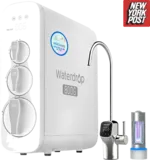 Waterdrop G3P800 (WD-G3P800-W) Waterdrop G3P800 (WD-G3P800-W) |
Certified | B | $999 | NSF/ANSI 58, NSF/ANSI 53, NSF/ANSI 42, NSF/ANSI 372 | Check price |
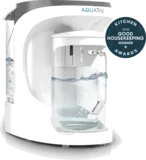 AquaTru Carafe (AT100 series) AquaTru Carafe (AT100 series) |
Certified | B | $375 | NSF/ANSI 42, NSF/ANSI 53, NSF/ANSI 58, NSF/ANSI 401, NSF/ANSI 372 | Check price |
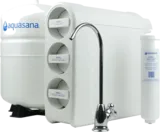 Aquasana SmartFlow Reverse Osmosis (AQ-SFRO2) Aquasana SmartFlow Reverse Osmosis (AQ-SFRO2) |
Certified | B | $190 | NSF/ANSI 42, NSF/ANSI 53, NSF/ANSI 58, NSF/ANSI 401, CSA B483.1, NSF/ANSI 372 | Check price |
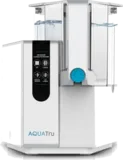 AquaTru Classic (AT2000 series) AquaTru Classic (AT2000 series) |
Certified | B | $475 | NSF/ANSI 42, NSF/ANSI 53, NSF/ANSI 58, NSF/ANSI 401, NSF/ANSI 372 | Check price |
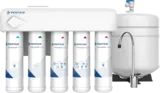 Pentair FreshPoint GRO-575B (161112) Pentair FreshPoint GRO-575B (161112) |
Certified | B | $722 | NSF/ANSI 58, NSF/ANSI 53, NSF/ANSI 42, NSF/ANSI 401, CSA B483.1, NSF/ANSI 53, NSF/ANSI 372 | Check price |
 AquaTru Freestanding Model 1 (ATFS-1-W) AquaTru Freestanding Model 1 (ATFS-1-W) |
Certified | C | $1,699 | NSF/ANSI 42, NSF/ANSI 53, NSF/ANSI 58, NSF/ANSI 401 | Check price |
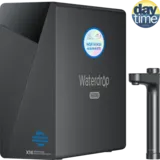 Waterdrop X16 (WD-X16) Waterdrop X16 (WD-X16) |
Lab tested | C | $1,999 | NSF/ANSI 58, NSF/ANSI 42, NSF/ANSI 372 | Check price |
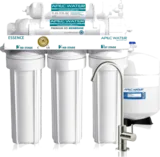 APEC ROES-50 APEC ROES-50 |
Maker claim | B | $231 | NSF/ANSI 58, NSF/ANSI 372 | Check price |
| Home Master TMAFC | Maker claim | B | $330 | None | Check price |
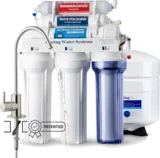 iSpring RCC7AK iSpring RCC7AK |
Maker claim | C | $242 | NSF/ANSI 58 | Check price |
Open these in the system finder
Common questions
Is fluoride in tap water safe?
At the 0.7 mg/L level the US Public Health Service recommends for fluoridation, CDC says it prevents cavities. EPA's enforceable limit is 4.0 mg/L, with a 2.0 mg/L secondary standard to prevent tooth discoloration. EPA is reviewing newer science, including a 2024 NTP report linking levels above 1.5 mg/L with lower IQ in children.
Does a regular water filter remove fluoride?
Usually not. Most carbon filters are not designed for it. Reverse osmosis certified to NSF/ANSI 58 for fluoride reduction, activated alumina, or distillation will reduce it.
Should I test my well for fluoride?
Yes, at least once. The CDC says the fluoride content of well water can only be determined by lab analysis, and some wells have natural fluoride above EPA's limits.
What is dental fluorosis?
Changes in the appearance of tooth enamel, from faint white spots to, at high levels, discoloration. The CDC says it only develops in children under 8, while teeth are forming, which is why EPA's 2.0 mg/L secondary standard exists.
Sources
- EPA: Fluoride in drinking water
- EPA: EPA hits key milestone in expedited review of fluoride under the Safe Drinking Water Act
- EPA: National primary drinking water regulations (fluoride)
- EPA: Secondary drinking water standards
- CDC: Community water fluoridation frequently asked questions
- National Toxicology Program: Fluoride exposure, neurodevelopment and cognition
- WHO: Guidelines for drinking-water quality, 4th edition incorporating the first and second addenda
- USGS: Quality of water from domestic wells in principal aquifers, 1991-2004
- Minnesota Department of Health: Home water treatment (costs and options)
- Wisconsin Department of Health Services: Treatment devices for private well contaminants
- Wisconsin State Laboratory of Hygiene: Test prices (effective July 1, 2026)
- NSF: Certified drinking water treatment units listings (NSF/ANSI 58 fluoride claim)