
Ion exchange water softening
Key facts
- Installs at
- Point of entry (whole house)
- Removes
- Hardness, Iron
- Does not remove
- Bacteria, PFAS, Chlorine, Nitrate, Arsenic
- Certifications
- NSF/ANSI 44, NSF/ANSI/CAN 61 what these mean
- Needs
- a drain and power
- Typical cost
- $1,200 to $3,800 installed
- Upkeep
- salt refills; about $30 to $65 a year for a family of four at 10 grains per gallon in an efficiency-rated softener
A water softener removes hardness, the calcium and magnesium that leave scale, spots and soap scum, by trading it for sodium or potassium on a bed of resin. It is the only common home treatment that makes truly soft water.
It is not a filter. It does not remove chlorine, PFAS, bacteria or lead, and Penn State Extension calls softening “a matter of personal preference not necessity.” Below about 3.5 grains per gallon of hardness you likely do not need one.
How it works
The softener tank holds resin beads loaded with sodium (or potassium) ions. Penn State describes the resin as readily trading those ions for calcium and magnesium as water flows through.
When the resin is full of hardness, the softener regenerates: it flushes the bed with salt brine from a separate tank, then rinses the released hardness to a drain. Penn State puts that at about 50 gallons of water per regeneration.
Softeners start regeneration in one of two ways. Timer models regenerate on a schedule. Demand-initiated models use a meter or sensor and regenerate only when needed, and only they can earn an efficiency rating under NSF/ANSI 44.
The Water Quality Association defines soft water as under 1.0 grain per gallon (17.1 mg/L) of total hardness.
What it removes and what it does not
- Hardness: calcium and magnesium. EPA lists cation exchange as also removing barium, radium and strontium.
- Small amounts of dissolved iron: up to about 2 to 5 mg/L per the Minnesota Department of Health, and below about 5 mg/L when pH is above 6.7 per Penn State. Rusty (oxidized) iron and iron bacteria foul the resin; see iron in well water.
It adds sodium: about 7.5 mg per quart for each grain per gallon removed, according to Penn State.
It does not remove:
- Bacteria, viruses or parasites (CDC).
- PFAS. The Minnesota Department of Health says softeners “are not likely to remove PFAS.”
- Chlorine or other chemicals. HomeGuide notes a softener does not filter water.
- Nitrate and arsenic. These are removed by anion exchange, a different resin, per EPA; the Minnesota Department of Health says conventional softeners cannot remove arsenic. See specialty media.
Certifications to look for
NSF/ANSI 44 is the softener standard. A certified softener has passed tests for hardness reduction, material safety, structural integrity and brine system accuracy. Other points worth checking on the listing:
- Pressure drop: no more than 15 psi at the rated service flow.
- Efficiency rating (optional): at least 3,350 grains of hardness removed per pound of salt. NSF says certification also shows compliance with California’s requirement of 4,000 grains per pound.
- Barium and radium 226/228: separate optional claims.
The softeners we track, including SpringWell’s SS1, list no NSF/ANSI 44 certification. NSF/ANSI/CAN 61 covers materials only.
Installation and upkeep
A softener needs a drain for regeneration and an outlet for the control valve. HomeGuide puts a new drain line at $300 to $800 and a new outlet at $150 to $350. On a well, the softener goes after any iron filter and before UV.
Check local rules. Some communities restrict brine discharge; the Santa Clarita Valley in California banned ion exchange softeners to protect water reuse, as the WateReuse Research Foundation study describes.
Upkeep is mostly salt. A family of four using EPA’s average of 82 gallons per person a day, about 70% of it indoors, runs roughly 230 gallons a day through the softener. At 10 grains per gallon, that family needs roughly 840,000 grains of removal a year. At 3,350 grains per pound, that is about 250 pounds of salt, or six to seven 40-pound bags. At Angi’s $5 to $10 a bag, that is about $30 to $65 a year. Timer models use more.
Costs
HomeGuide puts a salt-based softener at $1,200 to $3,800 installed, a dual-tank softener at $1,700 to $5,000, and salt at $50 to $150 a year. Prices checked September 2026:
| System | Capacity | Price |
|---|---|---|
| SpringWell SS1 | 32,000 grains, 11 gpm | $1,607 |
| SpringWell SS4 | 48,000 grains, 13 gpm | $1,785 |
For comparison, HomeGuide puts salt-free systems at $1,500 to $4,500 installed. Our salt-free vs salt softener guide compares the two, and the product finder lists softeners by capacity.
Pros and limits
Pros
- Produces genuinely soft water: fewer spots, better lather, less scale.
- Also removes barium, radium and a little dissolved iron.
- Proven, widely available technology with a clear certification standard.
Limits
- Needs salt, a drain and power.
- Adds sodium to the water.
- Removes no chlorine, PFAS, nitrate, arsenic or bacteria.
- Brine discharge is restricted in some communities.
Systems in our database that use ion exchange water softening
| System | Grade | Price | Certified to | |
|---|---|---|---|---|
 Rheem Preferred RHS32 Rheem Preferred RHS32 |
B | $489 | NSF/ANSI 44, NSF/ANSI 372, CSA B483.1 | Check price |
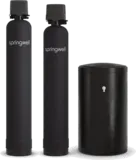 SpringWell WSSS1 SpringWell WSSS1 |
C | $3,124 | None | Check price |
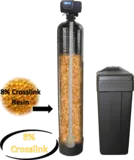 AFWFilters WS48-56SXT (Fleck 5600SXT, 48,000 grain) AFWFilters WS48-56SXT (Fleck 5600SXT, 48,000 grain) |
C | $765 | None | Check price |
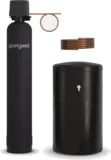 SpringWell SS1 SpringWell SS1 |
C | $1,607 | None | Check price |
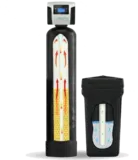 SoftPro Elite HE (city water, upflow) SoftPro Elite HE (city water, upflow) |
C | $1,367 | None | Check price |
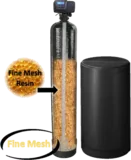 AFWFilters Iron Pro 2 fine mesh softener (Fleck 5600SXT) AFWFilters Iron Pro 2 fine mesh softener (Fleck 5600SXT) |
C | $755 | None | Check price |
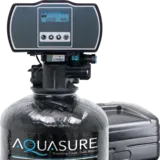 Aquasure Harmony Series (AS-HS32D / AS-HS48D / AS-HS64D) Aquasure Harmony Series (AS-HS32D / AS-HS48D / AS-HS64D) |
D | $540 | None | Check price |
Open these in the system finder
Common questions
Is softened water safe to drink?
Yes for most people. Penn State puts the added sodium at about 7.5 mg per quart for each grain per gallon of hardness removed, so 10 grains per gallon adds about 19 mg per 8-ounce glass. Penn State flags it for people on low-sodium diets; the usual fix is an unsoftened cold tap in the kitchen.
Will a water softener remove iron?
Small amounts of dissolved iron, yes. The Minnesota Department of Health puts the typical limit at 2 to 5 mg/L, and Penn State says it works below about 5 mg/L when pH is above 6.7. Oxidized (rusty) iron and iron bacteria foul the resin.
Does a softener remove chlorine, PFAS or bacteria?
No. A softener exchanges hardness minerals and does not filter out chemicals or germs. The Minnesota Department of Health says softeners are not likely to remove PFAS, and the CDC says softeners do not remove bacteria, viruses or parasites.
Should I get a salt-free conditioner instead?
Only if your goal is less scale rather than soft water. Salt-free conditioners do not remove hardness, so spots and soap scum stay. See our salt-free vs salt comparison.
Sources
- Penn State Extension: Water softening
- EPA: Overview of drinking water treatment technologies
- CDC: About home water treatment systems
- Water Quality Association: Scale deposits
- NSF: NSF/ANSI 44 technical requirements
- WC&P: NSF/ANSI 44 requirements for water softeners
- WC&P: Efficiency of water softeners under NSF/ANSI 44
- Minnesota Department of Health: Iron in well water
- Minnesota Department of Health: PFAS and home treatment of water
- Minnesota Department of Health: Arsenic in well water
- WateReuse Research Foundation: Evaluation of alternatives to domestic ion exchange water softeners (Fox et al., 2014)
- HomeGuide: Water softener cost
- HomeGuide: Home water filtration system cost (2026)
- EPA WaterSense: Statistics and facts (household water use)
- Angi: What is water softener salt
- SpringWell salt-based softener product page