
Hardness
Key facts
- Type of concern
- Household (aesthetic)
- EPA limit
- No federal limit EPA has no standard for hardness. USGS classifies water above 180 mg/L as calcium carbonate (about 10.5 grains per gallon) as very hard.
- Signs
- white scale on faucets, showerheads and kettles; spots and film on glassware; soap and shampoo that lather poorly; scale inside water heaters
- Common in
- private wells and city water
- How to test
- A lab hardness test ($46 at Wisconsin's state lab, or in Penn State's $85 package) or a hardness test strip; city customers can often find it in the utility's annual report. Divide mg/L by 17.1 for grains per gallon.
| Treatment | Effectiveness | Look for |
|---|---|---|
| Ion exchange softening | Works well | NSF/ANSI 44 |
| Salt-free conditioning | Partial | IAPMO/ANSI Z601 |
| Reverse osmosis | Works well | NSF/ANSI 58 |
At a glance: Hardness is dissolved calcium and magnesium. It is not a health risk, and EPA sets no limit, but above about 120 mg/L (7 grains per gallon) most homes notice scale on fixtures, spots on glass and poor lather. A salt-based softener is the only household method that removes hardness. A salt-free conditioner can reduce scale in pipes and water heaters without salt, but it does not make water soft.
If your water is under 60 mg/L, USGS classes it as soft and you do not need either.
What it is and where it comes from
Water picks up calcium and magnesium as it moves through soil and rock. Hardness is reported as mg/L of calcium carbonate, or in grains per gallon (gpg). One grain per gallon equals 17.1 mg/L.
Both well water and city water can be hard. Hardness is not regulated, so city water hardness depends on the source and on whether your utility softens it. Your utility can tell you its typical hardness, and it is often listed in the annual water quality report.
Health and household effects
Penn State Extension is direct about health: calcium and magnesium “have no adverse effects and are, in fact, essential daily nutrients.” WHO does not propose a health-based guideline value for hardness.
The effects are practical. Penn State describes hardness minerals building up on surfaces, possibly plugging pipes and damaging water heaters, and reducing how well soaps and detergents work. In practice that means:
- White scale on faucets, showerheads, kettles and inside water heaters
- Spots and film on dishes and glassware
- More soap and detergent needed for the same lather
- Soap scum on tubs and tile
Softening has one health trade-off. Penn State says swapping hardness for sodium adds 7.5 milligrams of sodium per quart for each grain per gallon removed. At 10 gpg that is 75 mg per quart. Wisconsin’s health department notes this may matter for people on low-sodium diets.
Limits and what they mean
There is no enforceable or secondary federal standard for hardness. These are the classifications used instead:
| Classification (USGS) | mg/L as calcium carbonate | Grains per gallon |
|---|---|---|
| Soft | 0 to 60 | 0 to 3.5 |
| Moderately hard | 61 to 120 | 3.6 to 7.0 |
| Hard | 121 to 180 | 7.1 to 10.5 |
| Very hard | Over 180 | Over 10.5 |
The Water Quality Association defines soft water as under 1 grain per gallon, the target for a properly working salt softener.
How to test
Hardness is one of the few things a test strip measures well enough to act on. For sizing a softener, get a lab number: Wisconsin’s state lab charges $46 for calcium, magnesium and hardness, and Penn State’s $85 package adds iron and manganese, which also affect softener choice. On city water, ask the utility first.
Sizing a softener needs grains per gallon, household water use and your iron level, because softeners also have to handle any dissolved iron. Our well testing guide covers labs and sampling.
Treatment options
| Method | How well it works | Certification to look for | Cost range |
|---|---|---|---|
| Salt-based water softener | High; removes hardness to under 1 gpg | NSF/ANSI 44 | $200 to $3,000, plus $50 to $300 a year for salt |
| Salt-free conditioner (TAC) | Moderate; reduces scale, does not remove hardness | IAPMO/ANSI Z601 or DVGW W 512 | $879 to $1,785 (systems we track) |
| Reverse osmosis, point of use | High at one tap | NSF/ANSI 58 | $300 to $1,500 |
| Magnetic or electronic descalers | Low; about 50% scale reduction in the WateReuse study | None | Not recommended |
Cost ranges are Minnesota Department of Health estimates based on 2017 and 2018 quotes, low end self-installed and high end professionally installed. Figures for systems we track are prices checked September 2026.
Softener. An NSF/ANSI 44 certified softener cannot drop line pressure by more than 15 psi at its rated flow, and an efficiency rating requires at least 3,350 grains removed per pound of salt. Only demand-initiated softeners can earn that rating. A softener needs a drain and power and uses water for each regeneration.
Salt-free conditioner. Template-assisted crystallization (TAC) turns some hardness into tiny crystals that stay in the water, so less scale sticks to heating surfaces. The WateReuse Research Foundation’s study measured over 88% scale reduction in its test rig. The Water Quality Association notes these devices do not reduce calcium or magnesium and are not proven to achieve soft water. Makers typically require iron and manganese to be low, and on chlorinated water some need a carbon filter first.
You may not need either. On moderately hard city water, scale protection for a water heater may be all you want, and salt-free is a reasonable choice. If spotting and soap scum bother you, only salt fixes that. Our salt-free vs salt softener guide compares them in detail, and our salt-free softener picks and the filter finder show the options we track.
When to call a professional
A salt softener needs a drain line, an outlet and a bypass valve, so most installs call for a licensed plumber. Water treatment professionals can size a softener from your test, but ask for the sizing arithmetic in writing.
On a well, call a water treatment professional if your hardness comes with iron above a few mg/L or with low pH, because the order of equipment matters: sediment and iron treatment first, then the softener.
Systems in our database that address hardness

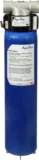
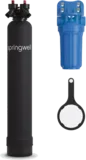
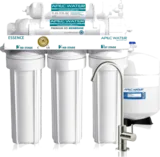
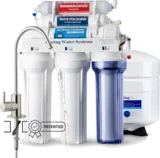
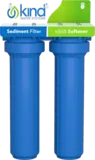
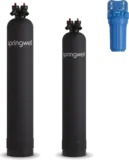
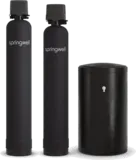
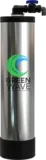
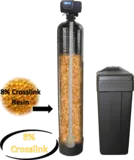
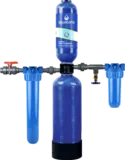
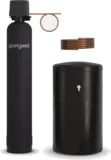
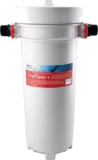
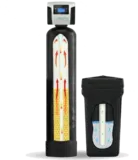
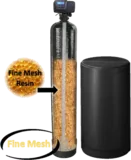
Open these in the system finder
Common questions
Is hard water bad for your health?
No. Penn State Extension says hardness minerals have no adverse health effects and are essential daily nutrients. Hardness is a plumbing, cleaning and appliance issue.
What level of hardness should I treat?
USGS classes 0 to 60 mg/L as soft, 61 to 120 as moderately hard, 121 to 180 as hard and above 180 as very hard. Most people notice scale and spotting in the hard and very hard ranges; below that, treatment is optional.
Does a salt-free softener actually soften water?
No. Salt-free conditioners change how hardness minerals behave so less scale forms on heating surfaces, but the calcium and magnesium stay in the water. The Water Quality Association says these devices are not proven to achieve soft water.
How much sodium does a water softener add?
Penn State says softening adds 7.5 milligrams of sodium per quart for each grain per gallon of hardness removed. If you are on a low-sodium diet, ask your doctor, and consider potassium chloride or leaving the kitchen cold tap unsoftened.
Sources
- USGS: Hardness of water
- Penn State Extension: Water softening
- Water Quality Association: Scale deposits
- WHO: Guidelines for drinking-water quality, 4th edition incorporating the first and second addenda
- Minnesota Department of Health: Home water treatment (costs and options)
- Wisconsin Department of Health Services: Treatment devices for private well contaminants
- Wisconsin State Laboratory of Hygiene: Test prices (effective July 1, 2026)
- Penn State Agricultural Analytical Services Lab: Drinking water test packages
- NSF: Certified drinking water treatment units listings (NSF/ANSI 44 claims)
- Water Conditioning & Purification: NSF/ANSI 44 requirements for water softeners
- Water Conditioning & Purification: Efficiency of water softeners under NSF/ANSI 44
- IAPMO Official magazine: IAPMO publishes IAPMO/ANSI Z601 standard for scale reduction devices
- WateReuse Research Foundation: Evaluation of alternatives to ion exchange water softeners