
Iron
Key facts
- Type of concern
- Household (aesthetic)
- EPA limit
- 0.3 mg/L (SMCL) Non-enforceable secondary standard for rusty color, sediment, metallic taste and reddish or orange staining.
- Signs
- orange, red or brown stains on fixtures, dishes and laundry; metallic taste; clear water that turns rusty after standing; red or brown slime in toilet tanks (iron bacteria)
- Common in
- private wells
- How to test
- A certified lab iron test, $38 at Wisconsin's state lab or in Penn State's $85 package with manganese, hardness and pH; add an iron bacteria test ($72 at Wisconsin) if you see slime.
| Treatment | Effectiveness | Look for |
|---|---|---|
| Air injection oxidation | Works well | - |
| Specialty media | Works well | - |
| Chemical injection | Works well | - |
| Ion exchange softening | Partial | - |
| Sediment filtration | Limited | - |
At a glance: Iron causes the orange, rusty stains common with well water, and it is a nuisance rather than a health hazard. EPA’s secondary standard is 0.3 mg/L, the point where rusty stains and metallic taste usually start. The right fix depends on your iron level and type: a softener can handle a little dissolved iron, an oxidizing filter handles the middle range, and heavy iron or iron bacteria need chlorine or peroxide injection followed by filtration.
If your water only stains occasionally and tests just above 0.3 mg/L, you may not need a dedicated iron filter at all.
What it is and where it comes from
The Minnesota Department of Health says iron gets into well water as water seeps through iron-bearing soil and rock, and from corroding well casing and pipes. Penn State Extension found excessive iron in 17% of Pennsylvania private water supplies sampled.
It shows up in three forms, and the form decides the treatment:
- Dissolved (ferrous) iron. Clear from the tap, turns rusty after standing, because oxygen converts it to particles.
- Oxidized (ferric) iron. Already rusty or cloudy when it leaves the tap.
- Iron bacteria. Microbes that feed on iron and leave red or brown slime, often in toilet tanks.
Corroding iron and steel pipes can add some iron to any supply, but persistent iron problems are mostly a private well issue.
Health and household effects
MDH says iron in well water does not usually present a health risk because the body absorbs iron from water poorly. The indirect concern is bacteria. MDH says iron bacteria are not known to cause disease, but they can create conditions where disease-causing organisms may grow.
The household effects are what you notice:
- Yellow, red or brown stains on dishes, laundry and fixtures (MDH)
- A metallic taste in water, coffee and tea
- Sediment in the water and clogged aerators
- With iron bacteria, a sticky rusty slime and odors MDH describes as swampy, oily or musty, and sometimes a rainbow sheen on the water
Limits and what they mean
| Standard | Level | What it means |
|---|---|---|
| EPA secondary standard | 0.3 mg/L | Guideline for color, taste and staining; not enforced |
| Minnesota Department of Health | Above 0.3 mg/L | Usually considered objectionable |
There is no federal health-based limit for iron. EPA’s secondary standards are guidelines for public water systems, and private wells are not covered by any federal rule. The number still matters for buying equipment, because every iron filter is rated for a maximum iron level.
Manganese often travels with iron and stains black at a much lower level, 0.05 mg/L, so test for both.
How to test
A certified lab test gives you the number you need to size treatment. Wisconsin’s state lab charges $38 for iron and $72 for an iron bacteria test. Penn State’s $85 package adds manganese, hardness, alkalinity, pH and copper, which are the other numbers an iron filter seller will ask for.
For a quick check of the type, fill a clear glass from an untreated cold tap and watch it for a few hours. Clear water that turns rusty and settles points to dissolved iron. Water that is rusty straight away is already oxidized.
Sample raw water before any existing filter or softener. The CDC recommends testing wells for bacteria every year as well, and iron problems are a good reason not to skip it. Our well testing guide covers labs and sampling.
Treatment options
| Method | How well it works | Certification to look for | Cost range |
|---|---|---|---|
| Air injection oxidation with filtration | High for dissolved iron within the maker’s rating | None common; check rated iron limit | $800 to $4,000; $2,231 for the system we track |
| Oxidizing media such as greensand (specialty media) | High, about 3 to 10 mg/L combined iron and manganese (Penn State) | None common | $1,500 to $3,000 |
| Chemical injection (chlorine or peroxide) plus filter | High, including iron bacteria | None common | $500 to $2,500; $2,255 to $2,983 for peroxide systems we track |
| Water softener | Moderate, small amounts of dissolved iron only | NSF/ANSI 44 covers hardness, not iron | $200 to $3,000 |
| Sediment filter | Low, oxidized particles only | NSF/ANSI 42 particulate | About $21 per cartridge (SpringWell 2-pack, $42.19) |
Cost ranges are Minnesota Department of Health estimates based on 2017 and 2018 quotes, low end self-installed and high end professionally installed. Figures for systems we track are prices checked September 2026.
Match the equipment to your numbers. Every iron filter has limits on iron, manganese, hydrogen sulfide and pH, and some sellers will not ship until they see a test. Our iron in well water guide walks through each type in detail, and our well water filter picks list each system’s limits. The filter finder lets you filter by problem.
If iron is paired with a rotten egg smell, see the sulfur smell guide: many systems handle both.
When to call a professional
Call a water treatment professional if your iron is above about 5 mg/L, if you have iron bacteria, or if your pH is low, because those change what you should buy. Backwashing filters also need a drain and an outlet, which may mean a plumber and an electrician.
Call a licensed well contractor if iron bacteria keep returning after shock chlorination. MDH says heavy growth may need physical cleaning of the well and equipment, and that acid or surfactant treatments should only be done by trained professionals.
Systems in our database that address iron

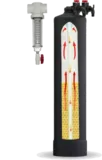
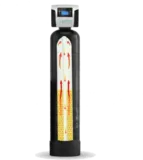
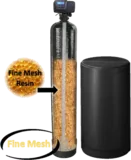
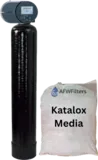
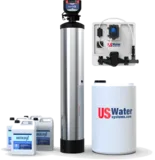

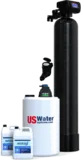
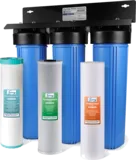
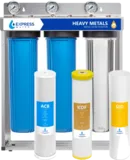

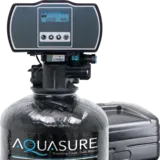
Open these in the system finder
Common questions
Is iron in well water harmful to drink?
Not usually. The Minnesota Department of Health says iron in well water does not usually present a health risk, and EPA regulates it only with a non-enforceable secondary standard of 0.3 mg/L. The indirect concern is that iron can help harmful bacteria grow, so test for bacteria too.
Will a water softener remove iron?
Only small amounts of dissolved iron. MDH puts the typical limit at 2 to 5 mg/L, and Penn State says softening works below about 5 mg/L when pH is above 6.7. Oxidized, rusty iron fouls the resin.
What is the orange slime in my toilet tank?
Usually iron bacteria. MDH says they are not known to cause disease, but they form rusty slime, can cause swampy or oily odors, and make iron problems worse. Shock chlorination of the well is the standard first step.
Why is my water clear from the tap but rusty after it sits?
That is dissolved (ferrous) iron. It is invisible in oxygen-poor groundwater and turns to rust particles once it meets air. Oxidizing filters are built for exactly this.
Sources
- EPA: Secondary drinking water standards
- Minnesota Department of Health: Iron in well water
- Minnesota Department of Health: Iron bacteria in well water
- Penn State Extension: Iron and manganese in private water systems
- Minnesota Department of Health: Home water treatment (costs and options)
- Wisconsin State Laboratory of Hygiene: Test prices (effective July 1, 2026)
- Penn State Agricultural Analytical Services Lab: Drinking water test packages
- CDC: Guidelines for testing well water