Iron in well water: what it is and how to remove it
We earn a commission if you buy through links on this page. It never changes which systems we recommend. Details.
Short answerIron is a nuisance rather than a health hazard, and EPA's secondary standard of 0.3 mg/L marks where staining starts. A softener can handle a few mg/L of dissolved iron, an air-injection or oxidizing-media filter is the standard fix up to about 7 to 10 mg/L, and above that, or with iron bacteria, you need chlorine or hydrogen peroxide injection followed by filtration.
Iron in well water is a staining and taste problem, not usually a health one. EPA’s secondary standard is 0.3 mg/L (the same as 0.3 parts per million), the level where you start to see orange stains, rusty water and a metallic taste.
The right fix depends on two things: which form of iron you have and how much. A softener handles a little dissolved iron, an air-injection or oxidizing filter handles the middle range, and heavy iron or iron bacteria need a chemical oxidant such as chlorine or hydrogen peroxide.
Which kind of iron you have
Fill a clear glass from a cold tap that has not been run through any treatment, and watch it for a few hours.
| What you see | Type | What it means |
|---|---|---|
| Clear at first, turns orange or brown and settles after standing | Ferrous (dissolved, “clear-water”) iron | Iron dissolved in oxygen-poor groundwater that oxidizes when exposed to air |
| Red, orange or yellow straight from the tap | Ferric (oxidized, “red-water”) iron | Iron already in particle form; more common in higher-pH water or where oxygen gets in |
| Yellow or brown that does not settle, sometimes colorless | Organic (tannin-bound) iron | Iron bound to organic matter; harder to remove |
| Rusty, sticky slime in the toilet tank, a rainbow sheen, swampy or oily odors | Iron bacteria | Bacteria feeding on iron; they worsen staining and clog equipment |
These descriptions come from the Minnesota Department of Health and Penn State Extension. Many wells have more than one type at once, which is why a lab test comes first.
How much is too much
| Level | What happens |
|---|---|
| Below 0.3 mg/L | Usually no visible problem |
| 0.3 mg/L and up | Orange or reddish staining, metallic taste, sediment (EPA secondary standard) |
| Above about 10 mg/L | Needs chemical oxidation and filtration, per Penn State |
Manganese often travels with iron and causes black or brown staining at a much lower level: EPA’s secondary standard is 0.05 mg/L. Penn State notes that EPA also has a health advisory for manganese at 0.3 mg/L because of neurological effects, so test for it every time you test for iron.
The Minnesota Department of Health says iron itself poses little direct health risk but “may present some concern if harmful bacteria have entered a well,” since some harmful organisms need iron to grow. That is one more reason to include coliform bacteria in the test.
Test before you choose
Order a lab panel that covers iron, manganese, pH, hardness and coliform bacteria, and add hydrogen sulfide if you smell rotten eggs. Penn State’s lab runs a package with iron, manganese, hardness, alkalinity and bacteria for $85. Our well testing guide lists other labs and prices.
pH matters as much as iron. Penn State says softening works on iron only when pH is above 6.7. SpringWell lists pH 6.5 to 10 for its WS1, and US Water Systems lists pH 6 to 9 for its Matrixx InFusion. If your pH is low, you may need a neutralizer ahead of the iron filter.
Treatment by concentration
| Iron level | Common treatment | How it works | Limits |
|---|---|---|---|
| Under 2 mg/L | Polyphosphate feeder | Keeps iron dissolved so it does not stain | Does not remove iron (Penn State) |
| Up to about 2 to 5 mg/L, dissolved | Water softener | Resin captures dissolved iron along with hardness | Oxidized iron fouls the resin; pH above 6.7 (Penn State, Minnesota DOH) |
| About 3 to 10 mg/L | Oxidizing media (manganese greensand and similar) or air injection | Oxidizes iron into particles, then filters them out | Minnesota DOH puts greensand up to 10 to 15 mg/L |
| Above about 10 mg/L | Chlorine or hydrogen peroxide injection, then filtration | Strong oxidant converts all iron to particles | Needs a pump, solution tank and contact time |
| Organic iron | Chemical oxidation and filtration, or reverse osmosis at the tap | Breaks the organic bond | Harder to treat; get professional advice |
| Iron bacteria | Shock chlorination, then continuous oxidant if it returns | Kills the colony | Often needs repeating |
Softeners
A salt softener removes small amounts of dissolved iron as a side effect of removing hardness. It is the right answer if you have hard water and only a couple of mg/L of clear-water iron. It is the wrong answer for red-water iron or iron bacteria, both of which foul the resin. See salt-free vs salt water softener for sizing.
Air injection and oxidizing media
Air-injection oxidation (AIO) filters keep a pocket of air at the top of the tank. Water passes through it, the iron oxidizes, and the media bed catches the particles. The tank backwashes on a timer to flush them out, so it needs a drain and power.
It covers the 3 to 10 mg/L range Penn State assigns to oxidizing filters, with no chemicals to buy. Manufacturer ratings set the ceiling: SpringWell rates its WS1 for iron up to 7 ppm, hydrogen sulfide up to 8 ppm and manganese up to 1 ppm.
Chlorine or peroxide injection
Above roughly 7 to 10 mg/L, or where iron bacteria keep coming back, a metering pump injects an oxidant ahead of a filter. Penn State recommends chlorination followed by filtration above 10 mg/L. Hydrogen peroxide systems work the same way and leave no chlorine taste; US Water Systems rates its Matrixx InFusion for iron up to 20 ppm, hydrogen sulfide up to 30 ppm, and iron and sulfur bacteria.
The cost is ongoing chemical and upkeep. US Water Systems lists refilling peroxide as needed, draining the pressure tank and cleaning the injection fitting every one to six months, and replacing the catalytic carbon every three to five years.
Cartridge iron filters
Cartridge systems are cheap to buy but only suit low iron. iSpring’s FM25B iron cartridge is rated for 50,000 gallons at 3.0 ppm iron. At about 230 gallons a day of indoor use for a family of four, that is roughly seven months, so budget for extra cartridges on top of the yearly filter pack.
Iron bacteria
The Minnesota Department of Health recommends shock chlorination, with the concentration close to but not above 200 ppm, because stronger doses work less well. Heavy growth may need a contractor to pull and clean the pump and scrub the casing first. You may have to treat more than once. If the slime keeps returning, continuous chlorine or peroxide injection keeps it in check.
What it costs
Prices checked September 2026 on each maker’s store.
| System | Rated for | Price | Running costs |
|---|---|---|---|
| iSpring WGB32BM (cartridges) | Iron up to 3.0 ppm | $536 | $160/year filter pack, plus extra $105 iron cartridges |
| SpringWell SS1 (salt softener) | Hardness plus a little dissolved iron | $1,607 | Salt |
| SpringWell WS1 (air injection) | Iron up to 7 ppm, H2S up to 8 ppm | $2,231, plus a required $134.25 water test | No consumables listed |
| US Water Systems Matrixx InFusion (peroxide) | Iron up to 20 ppm, H2S up to 30 ppm | $2,983 | Peroxide, plus a $499 rebed every 3 to 5 years |
Backwashing systems need a drain and an outlet nearby. HomeGuide puts a new drain line at $300 to $800 and a new outlet at $150 to $350 if you do not have them. Our cost guide has 10-year totals.
None of the iron systems we track holds an NSF, IAPMO or WQA system certification. That is normal for this category, which makes the water test, the maker’s stated limits and the return terms more important than usual.
Put equipment in the right order
If you are treating more than iron, the order is sediment filter, then the iron filter, then the softener, then UV last. UV needs clean water to work: SpringWell’s UV lists iron below 0.3 ppm and hardness below 7 grains per gallon as requirements.
When to call a pro
Call a water treatment professional or well contractor if your test shows iron above about 10 mg/L, iron bacteria, organic iron, low pH, or iron and manganese together at high levels. Also call one if your well yield is low: backwashing filters need steady flow (SpringWell’s manual lists 5 gpm for the WS1), and a weak pump leaves the media dirty. See our sizing guide for how to check.
Which products fit
For most wells with visible iron up to 7 ppm and no iron bacteria, an air-injection filter is the next step. Above that, or when bacteria are involved, step up to peroxide injection.
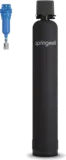
Most wells up to 7 ppm iron: SpringWell WS1
It handles iron, manganese and hydrogen sulfide in one tank with no chemicals, and SpringWell checks your water test before it ships. There is no third-party system certification. More in our SpringWell WS1 review.
Heavy iron or iron bacteria: US Water Systems Matrixx InFusion
Its peroxide injection covers iron up to 20 ppm and targets iron bacteria, at the cost of more upkeep. One owner review on the product page reports clogging after about eight months at around 12 ppm iron, so follow the maintenance schedule closely. US Water Systems charges up to 40% restocking on returns. Compare the two brands in SpringWell vs US Water Systems, or see all our well water picks.
Questions people ask
Is iron in well water harmful to drink?
Not directly. The Minnesota Department of Health says iron itself poses little health risk, and EPA regulates it only as a secondary (taste and staining) standard at 0.3 mg/L. The concern is indirect: some harmful bacteria use iron to grow, so test for bacteria too.
Will a water softener remove iron?
Only small amounts of dissolved (clear-water) iron. Minnesota's health department puts the typical limit at 2 to 5 mg/L, and Penn State says softening works below about 5 mg/L when pH is above 6.7. Oxidized (rusty) iron fouls softener resin.
What is the orange slime in my toilet tank?
Usually iron bacteria. They are not known to cause disease, but they form a rusty, sticky slime, can cause swampy or oily odors and a rainbow sheen, and they make iron problems worse. Shock chlorination of the well is the standard first treatment.
How do I get rid of iron bacteria?
Shock chlorinate the well and plumbing. Minnesota's health department says the chlorine concentration should be close to, but not above, 200 ppm, and you may need to repeat it. Heavy growth may need a contractor to clean the pump and casing first. If it keeps returning, continuous chlorine or peroxide injection is the long-term fix.
What level of iron needs treatment?
Above 0.3 mg/L you will usually see orange staining and taste metal. Below that, most homes do not need iron treatment. Manganese causes black staining at a much lower level, 0.05 mg/L, so test for both.
Sources
- EPA: Secondary drinking water standards
- Penn State Extension: Iron and manganese in private water systems
- Minnesota Department of Health: Iron in well water
- Minnesota Department of Health: Iron bacteria in well water
- CDC: Guidelines for testing well water
- SpringWell WS1 product page
- SpringWell WS1/WS4 manual
- US Water Systems Matrixx InFusion product page
- US Water Systems Matrixx InFusion spec sheet
- iSpring WGB32BM product page
- SpringWell salt-based softener product page
- SpringWell UV product page
- HomeGuide: Home water filtration system cost (drain and outlet add-ons)