
The best salt free water softeners
We earn a commission if you buy through links on this page. It never changes which systems we recommend. Details.
Short answerThe US Water Systems GreenWave is the best salt-free conditioner for most homes: $1,360.95 for 10 gpm, a published media life and rebed price, and a lifetime warranty. But no salt-free system removes hardness, so if you want soft-feeling water, no spots, or you have iron or very hard water, buy a salt softener instead.
The US Water Systems GreenWave is the best salt-free water softener for most homes: $1,360.95 for 10 gpm, a stated 4 to 6 year media life with a $379.95 rebed kit, and a lifetime warranty on the tank and valve. Like every system on this page, it conditions scale; it does not remove calcium and magnesium, so your water tests just as hard afterward.
That distinction decides whether you should buy one at all. If scale in the water heater and on fixtures is your main complaint and your hardness is moderate, a salt-free conditioner is a reasonable, low-maintenance fix. If you want water that feels soft, lathers easily and dries without spots, or you have very hard water or any iron, a salt softener like the SpringWell SS1 is the better answer.
| Pick | System | Grade | Flow | From | |
|---|---|---|---|---|---|
| Best overall salt-free | 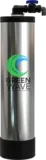 US Water Systems GreenWave 2.0 (385-GW) US Water Systems GreenWave 2.0 (385-GW) |
C | 10 gpm | $1,361 | Check price |
| Best for chlorinated city water | 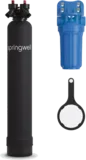 SpringWell FS1 SpringWell FS1 |
B | 12 gpm | $1,785 | Check price |
| Best budget | 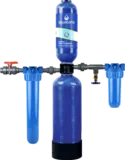 Aquasana Salt-Free Water Conditioner WH-SFWC-S Aquasana Salt-Free Water Conditioner WH-SFWC-S |
C | 7 gpm | $879 | Check price |
| Better answer: salt softener | 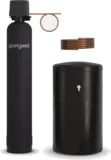 SpringWell SS1 SpringWell SS1 |
C | 11 gpm | $1,607 | Check price |
How we chose
- Honest scope. We judge these systems as scale control, not softening, and treat every scale-reduction percentage as the maker’s claim. None of the conditioners here cites a third-party scale test such as DVGW W 510 or WQA S-803.
- Inlet limits. Salt-free media fouls on iron, manganese, hydrogen sulfide and, for some, chlorine. We compared each system’s published limits because they decide whether it will work in your house.
- Media life and its cost. A published rebed price beats “lasts for years”. We show 10-year cost where the numbers exist.
- Warranty and returns. Lifetime tank warranties are common; what the warranty excludes is not.
What salt-free systems do and do not do
The GreenWave and SpringWell’s FutureSoft use template-assisted crystallization (TAC); Aquasana calls its media Scale Control Media without describing the mechanism. As water passes through the media, dissolved calcium and magnesium form tiny crystals that stay suspended and are less likely to stick to pipes and heating elements. US Water Systems describes GreenWave as converting hardness minerals to “aragonite microcrystals” and states plainly that it “does not remove hardness”.
So a hardness test strip reads the same before and after, soap lathers no better, and spots still dry on glass. SpringWell’s own conditioner page says it “won’t make water feel slick or stop spotting the way salt does”. Credit to SpringWell for saying so. If you expect soft water from a conditioner, you will be disappointed.
What you get is less scale where it costs money: water heaters, tankless heat exchangers, faucet aerators and shower valves. Because nothing is removed, there is no brine, no drain, no electricity and no salt to carry.
The hardness scale
| USGS class | mg/L as calcium carbonate | Grains per gallon (gpg) |
|---|---|---|
| Soft | 0 to 60 | 0 to 3.5 |
| Moderately hard | 61 to 120 | 3.6 to 7 |
| Hard | 121 to 180 | 7.1 to 10.5 |
| Very hard | more than 180 | more than 10.5 |
One grain per gallon is 17.1 mg/L. Your utility can tell you its hardness; on a well, include it in your test.
The picks
Best overall salt-free: US Water Systems GreenWave
GreenWave 2.0 is a single upflow tank of Next Scale Stop TAC media, sized by flow: 10 gpm ($1,360.95), 15 gpm ($1,664.95) and 20 gpm ($1,925.95). No electricity, no drain, no backwash.
It wins on transparency and cost. US Water Systems says the media lasts 4 to 6 years and sells the rebed kit for $379.95 (10 gpm), $620.99 (15 gpm) or $869.95 (20 gpm). Over 10 years the 10 gpm unit comes to $1,740.90 to $2,120.85 depending on whether you rebed once or twice, about $76 a year on US Water’s own estimate. The warranty is lifetime on the tank, valve body and head.
Its spec sheet also publishes strict inlet limits: chlorine no more than 0.05 mg/L, ferrous iron 0.3 mg/L, manganese 0.05 mg/L, copper 1.3 mg/L, pH 6.5 to 8.5. On city water that means a carbon filter goes first. US Water sells a Bodyguard carbon plus GreenWave bundle from $2,179.71, or you can put it after a whole-house carbon filter you already own, such as those in our city water picks.
US Water also asks you to drain the water heater 30 to 60 days after install and again at one year, not to install filters after the GreenWave, and not to use phosphate anti-scalants. Follow that, and the system has little to do day to day.
Watch out for:
- The media warranty is voided by fouling from iron, sulfur or chlorine above 0.01 ppm, so skipping the carbon pre-filter on city water can cost you the warranty.
- Restocking fees run up to 40%, and US Water’s one-year money-back guarantee applies to systems its own specialists specify.
Best for chlorinated city water: SpringWell FS1
The FutureSoft FS1 is the pick if you want a conditioner without adding a carbon filter. SpringWell rates it for free chlorine up to 3 ppm, where the GreenWave allows 0.05 mg/L. It includes a 5-micron sediment pre-filter and runs at 12 gpm; the FS4 is 15 gpm ($1,963.50) and the FS+ 20 gpm ($2,320.50).
SpringWell claims it prevents up to 95% of scale buildup and handles hardness up to 81 gpg. Neither claim cites a test standard, and no SpringWell system is listed at NSF, IAPMO or WQA. The warranty on FutureSoft media is lifetime for the original owner at the original address.
If you want chlorine and chloramine removed as well, the SpringWell CSF1 pairs a CF1 carbon filter with an FS1 for $2,320.50, against $2,945.25 for the two bought separately, a saving of $624.75. The combo’s flow is the lower of the two tanks, 9 gpm. Our SpringWell CF1 review covers the filter half.
The media life is the loose end. The FS page says “5+ year lifespan”; the CSF combo FAQ says the salt-free media “will never need to be replaced”. SpringWell lists no replacement media price, so a 10-year cost cannot be calculated.
Watch out for:
- Iron, manganese, copper, oil and hydrogen sulfide must all be zero, and pH must be 7.0 to 9.5. That rules out most untreated wells.
- It costs $178.50 more than SpringWell’s own 32,000 grain salt softener, and installed systems cannot be returned for a refund.
Best budget: Aquasana Salt-Free Water Conditioner
At $879, Aquasana’s conditioner is the cheapest way in. It is a 46 x 9 inch tank rated 7 gpm (15.3 gpm peak) with a sediment pre-filter and a post-filter, no electricity and no drain. The tank is rated 10 years or 1,000,000 gallons with a matching 10-year warranty.
Aquasana is specific about where it works: hardness below 15 gpg, alkalinity under 250 mg/L, pH below 8.3 and iron under 0.3 ppm. That makes it a fit for moderately hard city water and a poor fit for very hard water.
The pre and post filters are the running cost: $147.96 a year. Over 10 years that is $879 plus $1,479.60, about $2,360, more than the GreenWave despite the lower price. Aquasana’s 90-day guarantee refunds the product price if you return it within 90 days (you pay return shipping, and installation labor is not covered), which is more flexible than the SpringWell or US Water terms.
Watch out for:
- “Independently tested to naturally and safely reduce scale buildup” names no standard or lab. The page also shows an unrelated “78 contaminants” list, and says it pairs with Rhino 600,000 and OptimH2O systems that Aquasana no longer sells.
- 7 gpm rated flow is small for a large household. Aquasana’s “50% off” is permanent; the MSRP is always double.
When a salt softener is the better answer
A salt-based softener swaps calcium and magnesium for sodium, so the hardness is actually removed. Choose one if any of these apply:
- You want soft water, not just less scale. Easier lather, no spots, the slick feel. Salt-free systems do not deliver these.
- Your hardness is above about 15 gpg. Aquasana draws the line there. SpringWell’s 81 gpg claim for FutureSoft is uncertified.
- You have iron, manganese or sulfur. Every conditioner here needs those at or near zero. On a well, see our well water picks.
- Your pH is out of range. FutureSoft needs 7.0 or higher; GreenWave 6.5 to 8.5; Aquasana below 8.3.
- You want proof it is working. A softener’s effect shows on a hardness test strip. A conditioner’s does not.
Better answer: SpringWell SS1
The SS1 is a metered ion exchange softener: 32,000 grain, 11 gpm, $1,606.50, which is less than SpringWell’s own salt-free FS1. The SS4 (48,000 grain, 13 gpm) is $1,785 and the SS+ (80,000 grain, 20 gpm) $2,677.50. A metered head regenerates based on water use rather than a timer.
It needs what a conditioner does not: a drain, an outlet and room for an 18 x 33 inch brine tank. SpringWell does not state salt use or resin life, and it does not claim NSF/ANSI 44 or any other certification.
Watch out for:
- The electronic head is covered 5 years, not lifetime, and installed systems are not refundable.
- In parts of California, local agencies can restrict or ban self-regenerating softeners under state Water Code section 13148. Check before you buy.
Also considered
- SpringWell CSF1 ($2,320.50): a sensible combo if you want carbon filtration and scale control in one order; covered under the FS1 above.
- Crystal Quest SMART with salt-free conditioner ($3,630): about $1,450 more than the GreenWave and Bodyguard bundle, a 1-year warranty, and an NSF public notice about past unauthorized use of the NSF mark.
- Electronic and magnetic descalers: not in our research set, so we make no recommendation.
Buying guidance
Check four numbers first
Hardness, pH, iron and chlorine. If any is outside a system’s inlet limits, it will either underperform or void its warranty. Our salt-free vs salt softener guide explains each limit.
Get the order right
On city water: sediment, then carbon, then the conditioner last. GreenWave’s instructions say not to install filters after it. On a well: iron and sulfur treatment first, and in most cases a salt softener rather than a conditioner.
Flush the water heater
US Water tells GreenWave owners to drain the water heater 30 to 60 days after install and again at one year. It costs nothing and is a sensible habit with any conditioner.
Size to peak flow, not bathrooms alone
A conditioner that is too small lets water through too fast for the media to work. Match rated flow to the fixtures you run at once; the sizing guide shows the math, and the cost guide adds installation.
Compare 10-year cost
| System | Price | Upkeep | 10-year cost |
|---|---|---|---|
| US Water Systems GreenWave (10 gpm) | $1,360.95 | $379.95 rebed every 4 to 6 years | $1,740.90 to $2,120.85 |
| Aquasana Salt-Free Conditioner | $879 | $147.96/yr filters | About $2,360 |
| SpringWell FS1 | $1,785 + $78.74 bypass | Sediment pre-filter; media price not listed | Not calculable from published prices |
| SpringWell SS1 (salt) | $1,606.50 + $58.79 bypass | Salt (amount not stated) | Not calculable from published prices |
Questions people ask
Do salt-free water softeners actually soften water?
No. They are conditioners: the media changes how calcium and magnesium behave so they are less likely to form scale, but the minerals stay in the water. A hardness test reads the same before and after, and SpringWell's own page says its conditioner will not make water feel slick or stop spotting the way salt does.
Are salt-free water softeners certified?
None of the conditioners in our research cites a third-party scale-reduction certification, such as DVGW W 510 or WQA S-803. Aquasana says its conditioner is 'independently tested' without naming a standard. The performance numbers you see are the makers' own.
Can I use a salt-free softener on well water?
Only if your well has essentially no iron, manganese or hydrogen sulfide and its pH is in range. SpringWell's FutureSoft requires all three at zero and pH 7.0 or higher; the GreenWave allows no more than 0.3 mg/L ferrous iron. Most problem wells need an iron filter and a salt softener.
How long does salt-free media last?
US Water Systems says 4 to 6 years for GreenWave media, with a $379.95 rebed kit for the 10 gpm size. Aquasana rates its tank for 10 years or 1,000,000 gallons. SpringWell is inconsistent: its conditioner page says 5+ years, its combo FAQ says the media never needs replacing.
Are salt-based water softeners banned anywhere?
In parts of California, yes. State Water Code section 13148 lets local sewer and water recycling agencies in certain regions restrict or prohibit residential self-regenerating softeners that discharge brine. Check with your local agency before buying one.
What hardness is too high for a salt-free conditioner?
Aquasana says its conditioner works best below 15 gpg. SpringWell claims FutureSoft handles up to 81 gpg, but that claim is uncertified. Above about 15 gpg, a salt softener is the more predictable choice.
Sources
- US Water Systems GreenWave product page
- US Water Systems GreenWave 2.0 spec sheet
- US Water Systems GreenWave 10 gpm rebed kit
- US Water Systems Bodyguard and GreenWave bundle
- US Water Systems return policy
- SpringWell FutureSoft salt-free conditioner product page
- SpringWell FS1/FS4 installation instructions
- SpringWell water filter and salt-free conditioner (CSF) product page
- Aquasana salt-free water conditioner product page
- Aquasana salt-free conditioner installation guide
- Aquasana 90-day guarantee
- SpringWell salt-based softener product page
- USGS hardness classification (Hem, 1985), WRIR 02-4045 table 14
- California Water Code section 13148 (residential water softeners)
- NSF listings search (SpringWell)