
The best whole house water filters for city water
We earn a commission if you buy through links on this page. It never changes which systems we recommend. Details.
Short answerThe SpringWell CF1 is the best whole house filter for most city homes, including those on chloramine: catalytic carbon, 9 gpm and about $1,590 over 10 years. For large homes on chloramine, the backwashing US Water Systems Matrixx Catalytic Carbon sizes up to 20 gpm for less. Neither is certified, so read their claims as the seller's.
The SpringWell CF1 is the best whole house filter for most homes on city water, whether your utility uses chlorine or chloramine. It pairs catalytic carbon with KDF at 9 gpm, needs no drain or power, and costs about $1,590 over 10 years, but it holds no third-party certification.
Chloramine is the harder of the two to remove, and it is common: the EPA says more than one in five Americans drink chloramine-treated water. If that is you, catalytic carbon and generous sizing matter more than the brand name. For bigger homes, the US Water Systems Matrixx Catalytic Carbon offers more flow for the money.
| Pick | System | Grade | Flow | From | |
|---|---|---|---|---|---|
| Best overall for city water | 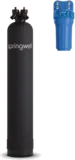 SpringWell CF1 SpringWell CF1 |
B | 9 gpm | $1,160 | Check price |
| Best for chloramine in large homes |  US Water Systems Matrixx Catalytic Carbon (081-MXF-CX) US Water Systems Matrixx Catalytic Carbon (081-MXF-CX) |
C | 5 gpm | $1,326 | Check price |
| Best certified (PFAS and VOCs) | 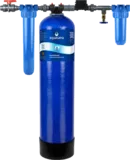 Aquasana HealthShield WH-HS Aquasana HealthShield WH-HS |
C | 5.7 gpm | $2,099 | Check price |
| Best budget (chlorine only) | 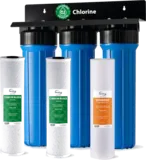 iSpring WGB32B iSpring WGB32B |
D | 15 gpm | $517 | Check price |
| Best certified chloramine reduction (drinking water) | 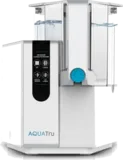 AquaTru Classic (AT2000 series) AquaTru Classic (AT2000 series) |
B | tap only | $475 | Check price |
How we chose
- Chloramine capability. We separated systems with catalytic carbon and a chloramine claim from plain carbon filters that only claim chlorine.
- Certification, stated precisely. No whole-house system in our research is certified for chlorine or chloramine reduction. We say which claims are “tested to”, which are internal, and which have no data at all.
- Flow and size. Carbon needs contact time. We favored systems that scale media volume with flow.
- 10-year cost and terms. System, bypass, filters and media changes at September 2026 prices, plus return policies once a system is installed.
Chlorine vs chloramine
Chlorine dissipates as water moves through pipes; chloramine (chlorine bonded with ammonia) lasts longer, which is why utilities use it. The EPA notes chloramines “provide longer-lasting disinfection as the water moves through pipes to consumers.” That persistence is also what makes it harder to filter.
The makers’ own numbers show it. Aquasana’s data sheet for its catalytic carbon Rhino Chloramines shows 97.4% chlorine reduction but 83% for chloramine, falling to 68.7% to 75.5% over the last 400,000 gallons of its rated million. The Enpress Pioneer spec sheet rates its carbon block for more than 300,000 gallons of chlorine at 15 gpm, but only 150,000 gallons of chloramine at 8 gpm (claims not performance tested by IAPMO or NSF). Half the capacity at about half the flow.
Your utility’s annual Consumer Confidence Report names its disinfectant. Our chloramine vs chlorine guide explains how to check and what it means for filters.
The picks
Best overall for city water: SpringWell CF1
The CF1 is an upflow tank of KDF and catalytic coconut shell carbon, followed by a 5-micron sediment filter. SpringWell claims chlorine and chloramine reduction, and its warranty page includes a “Guarantee of Performance”: the carbon keeps chlorine and chloramine below detection for 6 years or 1 million gallons. That is a written promise from the seller rather than a certification, but no other whole-house carbon tank here offers one.
It is the cheapest to run. SpringWell quotes about $34.95 a year for sediment filters, and the carbon is rated for 1,000,000 gallons. Over 10 years: $1,160.25 for the system, $78.74 for the bypass valve the cart adds, and about $349.50 in filters, roughly $1,590. The product page says the carbon lasts 10 years, but the 2020 manual and the performance guarantee say 6 years; a $351.70 media change at year 6 brings the total to about $1,940.
Sizing is by bathrooms: CF1 at 9 gpm for 1 to 3, CF4 at 12 gpm ($1,294.13) for 4 to 6, and CF+ at 20 gpm ($2,142) for 7 or more. No drain, no power, no backwashing.
If you also want scale control, the SpringWell CSF1 adds a salt-free conditioner tank for $2,320.50; see our salt-free softener picks for what that does and does not do. The SpringWell CF1 review covers installation in detail.
Watch out for:
- The PFAS claim (“removes PFAS, PFOA and PFOS”) has no test data or certification behind it. No SpringWell system is listed at NSF, IAPMO or WQA.
- Installed systems cannot be returned for a refund; unused returns carry a 10% restocking fee and you pay shipping.
Best for chloramine in large homes: US Water Systems Matrixx Catalytic Carbon
The Matrixx is a single backwashing tank of catalytic coconut shell carbon, and it scales the media with the flow: 1.0 cubic foot for 5 gpm ($1,325.50), 1.5 for 10 gpm ($1,415.50), 2.0 for 15 gpm ($1,595.50) and 2.5 for 20 gpm ($1,775.50). The 20 gpm size costs $366.50 less than SpringWell’s 20 gpm CF+.
Backwashing is the other difference. Every one to two weeks on city water, the valve flushes the bed to drain, which stops the carbon packing down and water finding shortcuts through it. The trade-off: you need a drain that can take 4 to 10 gpm during backwash and an outlet for the valve. Power costs under $2 a year.
The warranty is lifetime on the tank and 10 years on the valve and electronics, with registration. US Water Systems says the catalytic carbon typically lasts 5 years or more but does not list a rebed price for this model. It uses “all NSF and FDA approved components”, which is a component claim; there is no system listing.
Skip the 5 gpm base size unless you live alone; two showerheads at the federal 2.5 gpm limit use all of it. The cheaper Matrixx granular carbon version targets chlorine, not chloramine.
Watch out for:
- The one-year money-back guarantee applies to systems specified by US Water’s specialists, restocking fees run up to 40%, and backwashing filters are listed as non-returnable under its commercial policy. Check residential terms before you order.
- It needs a drain and power, which rules out some garage and outdoor installs.
Best certified for PFAS and VOCs: Aquasana HealthShield
If your city’s water reports PFAS or VOCs, the HealthShield is the only whole-house system we found with a WQA certification for them: NSF/ANSI 53 for PFOA, PFOS, PFNA, PFHxS, PFHpA and VOCs, and NSF/ANSI 401 for BPA and ibuprofen.
For chloramine, Aquasana’s data sheet shows 97.49% reduction, better than its Rhino Chloramines, but that figure is an internal test. The data sheet states that WQA did not evaluate chlorine or chloramine reduction.
It is expensive to own. The tank lasts 165,000 gallons or about 2 years and costs $1,749 to replace. Over 10 years, with four replacement tanks and $147.96 a year in pre and post filters, it comes to about $10,575. Check your utility in our PFAS lookup before paying for it, and see our PFAS picks for cheaper certified routes.
Watch out for:
- Rated flow is 5.7 gpm, tight for a large family.
- 2-year warranty, and Aquasana’s “50% off” sale price is its permanent price.
Best budget (chlorine only): iSpring WGB32B
If your utility uses free chlorine, not chloramine, three cartridges on a bracket do a decent job for $516.99. The WGB32B runs water through a 5-micron sediment filter and two coconut shell carbon blocks, claims up to 99% chlorine reduction, and needs no drain or power.
Filters cost $125.99 a year or every 100,000 gallons, so 10 years comes to about $1,650, much the same as the SpringWell CF1. The saving is up front, which suits renters or anyone planning to move.
Watch out for:
- No chloramine claim. iSpring sells a different model for that, and “tested to NSF/ANSI standards” is the only certification language; its NSF listing covers reverse osmosis units, not this system.
- 1-year warranty; opened returns lose 15% to restocking.
Best certified chloramine reduction (drinking water): AquaTru Classic
Here is the odd fact of this category: the only product in our research certified for chloramine reduction is a $475 countertop unit. IAPMO lists the AquaTru Classic under NSF/ANSI 42 for chlorine and chloramine (file W-10188), and under NSF/ANSI 53 and 58 for PFOA, PFOS, lead, nitrate, arsenic and more.
If what bothers you is the taste of chloramine in drinking water and coffee, this solves it for about $130 a year in filters, with no plumbing. If it is skin, hair or the smell in the shower, you need one of the whole-house picks above.
Watch out for:
- It makes 0.75 gallons at a time and you fill it by hand.
- It treats drinking water only.
Also considered
- Aquasana Rhino Chloramines ($1,399): the only whole-house chloramine system with a published data sheet, which is to its credit. But the data sheet itself says “Not certified for contaminant reductions by WQA”, chloramine reduction averages 83% and falls to 68.7% to 75.5% late in the tank’s life, and 10-year cost is about $2,880 with $147.96 a year in filters. Aquasana holds a 1.5 Trustpilot score from 172 reviews.
- Aquasana Rhino ($999): plain carbon and KDF with a chlorine claim only; the data sheet lists nothing else, though the product page shows a “78 contaminants” list.
- Express Water WH300SCKS ($547.99): claims chloramine with a KDF and catalytic carbon cartridge, but has no certification or third-party test claim, costs $186.99 a year in filters, and a product-page review reports a cracked housing flood.
- Crystal Quest SMART ($1,791): ten “stages” in one multimedia tank and two cartridges, a 1-year warranty, and an NSF public notice about past unauthorized use of the NSF mark.
- SpringWell Lead & Cyst Removal System ($1,554): the right pick if lead from old service lines is your concern (IAPMO-certified for lead, cysts and PFOA/PFOS at 4.51 gpm), but its chloramine claims are “not performance tested by IAPMO or NSF”, and its 4.51 gpm certified flow is low for a whole house.
Buying guidance for city water
Know what you are treating
Utilities are required to meet federal drinking water standards. A whole-house filter on city water is mostly about taste, smell and how water feels in the shower. For health contaminants you drink, look at certified point-of-use options first; our whole house vs reverse osmosis comparison sets out the costs.
For chloramine, size up
The data above shows carbon gives up on chloramine sooner than on chlorine. Choose catalytic carbon, and pick the next size up from what your bathroom count suggests if you are near the boundary. Our sizing guide walks through peak flow.
Protect a softener or conditioner
If you add a softener or salt-free conditioner, put the carbon filter first. The US Water Systems GreenWave conditioner allows no more than 0.05 mg/L chlorine at its inlet, and SpringWell’s FutureSoft no more than 3 ppm free chlorine.
Compare 10-year cost
| System | Price | Upkeep | 10-year cost |
|---|---|---|---|
| SpringWell CF1 | $1,160.25 + $78.74 bypass | About $34.95/yr sediment | About $1,590 (about $1,940 with a year-6 media change) |
| iSpring WGB32B | $516.99 | $125.99/yr filters | About $1,650 |
| AquaTru Classic | $475 | $259.65 per two years | About $1,775 |
| Aquasana Rhino Chloramines | $1,399 | $147.96/yr filters | About $2,880 |
| Aquasana HealthShield | $2,099 | $1,749 tank every 2 years + filters | About $10,575 |
| US Water Systems Matrixx Catalytic Carbon (10 gpm) | $1,415.50 | Rebed after 5+ years (price not listed) | Not calculable from published prices |
Questions people ask
What is the best whole house filter for chloramine?
A catalytic carbon system with enough carbon for your flow. The SpringWell CF1 suits most homes and SpringWell guarantees chloramine below detection for 6 years or 1 million gallons. For larger homes, the US Water Systems Matrixx Catalytic Carbon comes in sizes up to 20 gpm. No whole-house system in our research is certified for chloramine reduction.
How do I know if my city uses chloramine or chlorine?
Your utility's annual Consumer Confidence Report names the disinfectant, or you can call the utility. The EPA says more than one in five Americans drink water treated with chloramines.
Does a regular carbon filter remove chloramine?
Poorly. Aquasana's own data for its catalytic carbon Rhino Chloramines shows 83% average chloramine reduction against 97.4% for chlorine, and plain carbon models make no chloramine claim at all. Look for catalytic carbon and a system sized with room to spare.
Do I need a whole house filter on city water?
Utilities are required to meet federal drinking water standards, so a whole-house filter on city water is mostly about taste, smell and skin and hair comfort in the shower. If your concern is a contaminant you drink, such as PFAS or lead, a certified RO at the kitchen sink is cheaper and better certified.
Will a whole house filter remove lead from city water?
Most carbon tanks are not certified for lead. The Enpress Pioneer, sold as the SpringWell Lead & Cyst Removal System, is IAPMO-certified to NSF/ANSI 53 for lead at 4.51 gpm, and the AquaTru Classic countertop RO is certified for lead under NSF/ANSI 58.
Sources
- EPA: chloramines in drinking water
- SpringWell CF1 product page
- SpringWell CF1/CF4 installation instructions (2020)
- NSF drinking water treatment listings search (SpringWell)
- US Water Systems Matrixx Catalytic Carbon product page
- US Water Systems Matrixx Catalytic Carbon spec sheet
- US Water Systems guarantee
- US Water Systems return policy
- Aquasana Rhino Chloramines WH-1011 performance data sheet
- Aquasana HealthShield performance data sheet
- WQA product listing, Aquasana HealthShield (NSF/ANSI 53)
- iSpring WGB32B product page
- IAPMO R&T file W-10188 (AquaTru, NSF/ANSI 42 chlorine and chloramine)
- IAPMO R&T file W-10194 (AquaTru, NSF/ANSI 58)
- IAPMO R&T file W-9981 (Enpress Pioneer, NSF/ANSI 53)
- US Water Systems Pioneer specifications
- Express Water WH300SCKS product page
- NSF public notice: Crystal Quest
- EPA WaterSense: showerheads (federal 2.5 gpm maximum)
- US Water Systems GreenWave spec sheet