SpringWell CF1 review
We earn a commission if you buy through links on this page. It never changes which systems we recommend. Details.
Short answerA low-upkeep chlorine and chloramine filter for city homes with 1 to 3 bathrooms, at about $2,450 over 10 years with a plumber. Do not buy it for PFAS: no SpringWell system holds an NSF, IAPMO or WQA listing.
The SpringWell CF1 is a good fit if you are on city water and want chlorine or chloramine taste and smell gone from every tap without adding a drain line, an outlet or frequent cartridge changes. It is not a PFAS filter you can rely on: SpringWell advertises PFAS, PFOA and PFOS removal, but we found no NSF, IAPMO or WQA listing for any SpringWell system.
Price checked September 2026: $1,160.25 for the CF1 under SpringWell’s 15% sitewide sale (MSRP $1,365). Over 10 years, with a plumber and conservative filter changes, the arithmetic below lands at about $2,450. That is less than the cheaper-looking Aquasana Rhino over the same decade.
This review is research-based. We did not install or use the CF1; the facts below come from SpringWell’s product page, its 2020 installation manual, the three main certification directories and owner reviews on Trustpilot and the BBB. See how we research.
Who it is for
- City water treated with chlorine or chloramine. The CF1 pairs KDF with catalytic carbon, and catalytic carbon is the media type you want for chloramine. If you are not sure which your utility uses, read chloramine vs chlorine.
- Homes with 1 to 3 bathrooms. The CF1 is rated 9 gpm. Bigger homes should look at the CF4 or CF+ (sizes below).
- Owners who want little to maintain. One sediment cartridge every 6 to 9 months, and the carbon itself lasts 6 to 10 years depending on which SpringWell document you read.
- People staying put. The lifetime warranty on the tank, head, valves and fittings covers the registered original owner at the original install location only.
Who should skip it
- You want PFAS reduced. Check your utility in our PFAS lookup. If PFAS shows up, buy something with a PFAS certification, such as the Aquasana HealthShield.
- You are on a private well. The CF1 manual says not to install it on well water without speaking to SpringWell first. Iron, manganese and sulfur need a different system such as the SpringWell WS1.
- Your only concern is drinking water. A certified countertop RO like the AquaTru Classic costs about $1,640 over 10 years and covers far more contaminants at the kitchen tap.
- You want an easy return. The “6-month money-back guarantee” badge excludes installed systems. Unused returns carry a 10% restocking fee, and you pay return shipping.
What is in the tank
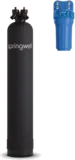
SpringWell lists three stages: KDF (a copper-zinc alloy), catalytic coconut shell carbon, and a 5-micron sediment filter. The carbon tank runs upflow, which SpringWell says increases contact time.
In the 2020 manual the sediment housing sits after the carbon tank, not before it. That placement catches carbon fines and debris leaving the tank. It does not shield the carbon bed from grit, which is rarely a problem on city water.
The CF1 tank is 9 inches wide and 48 inches tall (52 inches with the head). Neither the manual nor the product data we reviewed gives the carbon volume in cubic feet, so you cannot compare contact time directly with a brand like US Water Systems, which publishes 1.5 cubic feet for its 10 gpm Matrixx.
Media life is where SpringWell’s own documents disagree. The current site says 10 years or 1,000,000 gallons. The 2020 manual and the warranty’s “Guarantee of Performance” say 6 years or 1,000,000 gallons. EPA WaterSense puts the average American family at more than 300 gallons a day at home, which is 109,500 gallons a year and 1,000,000 gallons in about 9.1 years.
Certification reality check
We searched NSF’s drinking water treatment listings, the IAPMO R&T directory and WQA’s product directory for SpringWell, “spring well” and Wise Water Solutions on September 27, 2026. None lists a SpringWell finished system.
SpringWell’s About page mentions “certified components,” and its blog mentions “certified KDF media.” Neither names a standard or a certifier. A component certification, if it exists, usually covers material safety (the part does not leach harmful substances). It does not show that the assembled system reduces any contaminant.
The PFAS claim has no certification behind it
The CF1 page says it removes “chlorine, chloramine, PFAS, PFOA and PFOS from city water.” No test report, standard or certifier is cited, and the CF1 is not certified to NSF/ANSI 53 or P473 for PFAS.For contrast, here is what a verified PFAS claim looks like. SpringWell also sells a Lead & Cyst Removal System that is a rebadged Enpress Pioneer. That unit is IAPMO-certified to NSF/ANSI 53 and P473 for PFOA and PFOS only, at 4.51 gpm and 100,000 gallons, listed under Enpress rather than SpringWell. SpringWell advertises it at 8 gpm; the certified flow is 4.51 gpm.
What SpringWell does put in writing for the CF1 is a performance guarantee: the carbon keeps chlorine and chloramine below detection for 6 years or 1,000,000 gallons. That is a contractual promise from the seller, not third-party verification, but it is specific enough to hold them to.
Flow and sizing
| Size | Bathrooms | Flow (SpringWell) | Price (Sept 2026) |
|---|---|---|---|
| CF1 (Core) | 1 to 3 | 9 gpm | $1,160.25 |
| CF4 (Pro) | 4 to 6 | 12 gpm (11 gpm in the 2020 manual) | $1,294.13 |
| CF+ (Max) | 7+ | 20 gpm | $2,142.00 |
All sizes use a 1-inch connection except the CF+ at 1.5 inches. Operating range is 25 to 80 psi and 36 to 120 F.
SpringWell publishes no pressure-drop figure for the CF1. For comparison, Aquasana’s Rhino data sheet lists a 23 psi drop during its NSF/ANSI 42 test. If you are on the edge between CF1 and CF4, the CF4 costs only $133.88 more, which is cheap insurance against low shower pressure with two fixtures running. Our sizing guide walks through peak-flow math.
Installation needs
The CF1 needs no drain and no electricity. You need space for a 52-inch tank plus a wall-mounted sediment housing on the main line, ideally where water enters the house.
The manual adds three steps many buyers miss:
- 48-hour soak. The carbon must soak in water for at least 48 hours before installation, filled through a garden hose.
- Flush both ways. After the soak, flush the tank 3 to 5 minutes in each direction until the water runs clear.
- The head is permanent. Once threaded onto the internal pipe, the head must not be removed, or internal components can separate.
SpringWell auto-adds a bypass valve to the cart for $78.74. The manual strongly recommends a bypass so you can change the sediment filter without shutting off the house. The CF1 is not for water that is microbiologically unsafe.
A handy owner can install it from the manual and video. For the cost math we assume a licensed plumber at $500 for a non-backwashing tank on an accessible main line; your local quote may differ. Our cost guide covers what drives install prices.
Running costs over 10 years
Assumptions: CF1 at the September 2026 price; plumber install at $500; sediment filter every 6 months (the conservative end of SpringWell’s 6 to 9 months), bought in 4-packs at $72.53; one carbon replacement at $351.70, because the manual’s 6-year media life lands inside the decade.
| Item | Arithmetic | Cost |
|---|---|---|
| CF1 system | sale price | $1,160.25 |
| Bypass valve | added to cart | $78.74 |
| Installation | our assumption | $500.00 |
| Sediment filters | 20 changes, less 1 in the box = 19, so 5 four-packs × $72.53 | $362.65 |
| Carbon media | 1 replacement × $351.70 | $351.70 |
| 10-year total | $2,453.34 |
That is about $245 a year. Installed yourself, the total is $1,953.34. If the carbon really lasts 10 years, as the current site says, subtract $351.70.
On the same install assumption, an Aquasana Rhino WH-1000 comes to $2,941.61 over 10 years, because its pre-filter is changed every 2 months. The full breakdown is in our Rhino review.
Owner complaint patterns
Owner feedback on SpringWell is thin outside its own site, so weigh each source for what it is.
- SpringWell’s site shows 4.7 stars from 1,587 reviews on the filter page. These are hosted and moderated by the seller.
- Trustpilot has an unclaimed profile for springwellwater.com, displayed as Wise Water Solutions LLC, with 2 reviews (2.9). The recent one (1 star, November 2025) says a required water test and a two-week wait were not disclosed before the card was charged. That test applies to SpringWell’s well systems, not the CF1.
- BBB lists Springwell Water Filtration Systems (Daytona Beach) as not accredited and not rated, with 21 complaints closed in the last 3 years across all products. The complaint text was not visible to us.
- An installer review by Mid Atlantic Water, a competing dealer, summarizes Trustpilot, Google and BBB feedback. Its main patterns are well systems undersized for the water, slow support during troubleshooting, and “money-back guarantee friction” including restocking deductions.
Across these sources the recurring CF1 complaints are about terms and support, not the tank failing. The main risk is buying, installing, and then finding you cannot return it. Ownership has also changed: Fortune Brands Innovations completed its purchase of SpringWell on February 29, 2024, for about $105 million, which one Trustpilot reviewer cited as a worry.
If you see black specks in the water after installation, the manual’s soak-and-flush step is the first thing to check.
Alternatives
- Lower sticker price: the Aquasana Rhino costs $999 but runs about $490 more over 10 years, has a 23 psi pressure drop on its data sheet, and is likewise uncertified for contaminant reduction.
- Self-cleaning carbon tank: the US Water Systems Matrixx backwashes itself and carries a lifetime tank warranty, but needs a drain and an outlet.
- Certified PFAS reduction: the Aquasana HealthShield is WQA-certified for five PFAS, at roughly $11,000 or more over 10 years.
- Drinking water only: the AquaTru Classic holds IAPMO certifications to NSF/ANSI 42, 53, 58 and 401 for $475.
Questions people ask
Does the SpringWell CF1 remove PFAS?
SpringWell's product page says it removes PFAS, PFOA and PFOS, but it cites no certification or test report, and no SpringWell system appears in the NSF, IAPMO or WQA directories (checked September 27, 2026). Treat the PFAS claim as unverified.
How often do you replace the CF1 carbon?
SpringWell's site says 10 years or 1,000,000 gallons. Its 2020 installation manual and its warranty's performance guarantee say 6 years or 1,000,000 gallons. Replacement media for the CF1 costs $351.70.
Does the CF1 need a drain or electricity?
No. It is a non-backwashing upflow tank plus a sediment housing, so it needs neither a drain line nor an outlet.
Can I install the CF1 on well water?
The CF1 manual says not to install it on well water without first speaking to SpringWell customer service. For iron, manganese or sulfur, look at the SpringWell WS1 or another well system instead.
Can I return the CF1 after it is installed?
Generally no. The 6-month money-back badge applies only to unused, uninstalled systems, with a 10% restocking fee and return shipping paid by you. Installed systems are returnable only if SpringWell deems them defective.
Sources
- SpringWell whole house water filter (CF1/CF4/CF+) product page
- SpringWell CF1/CF4 installation instructions (2020 PDF)
- SpringWell About page ('certified components')
- NSF drinking water treatment unit listings, search for SpringWell
- IAPMO R&T product listing directory
- WQA certified product directory
- IAPMO R&T file W-9981 (Enpress Pioneer, NSF/ANSI 53)
- Trustpilot: springwellwater.com (Wise Water Solutions LLC)
- BBB complaints: Springwell Water Filtration Systems
- Mid Atlantic Water: SpringWell review (competing dealer)
- Business Wire: Fortune Brands acquires SpringWell (Feb 29, 2024)
- EPA WaterSense: how we use water
- Aquasana Rhino WH-1000 performance data sheet