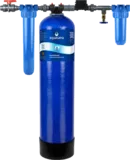
Aquasana HealthShield review
We earn a commission if you buy through links on this page. It never changes which systems we recommend. Details.
Short answerThe only whole-house system in our research with a genuine PFAS certification (WQA, NSF/ANSI 53, five PFAS), so it is the pick if your utility has PFAS and you want it out of every tap. Budget $11,000 to $14,500 over 10 years, because the $1,749 tank lasts 165,000 gallons or about 2 years.
Aquasana HealthShield is the only whole-house system in our research with a genuine PFAS certification: WQA certifies it to NSF/ANSI 53 for PFOA, PFOS, PFNA, PFHxS and PFHpA, plus VOCs. The catch is the tank, which lasts 165,000 gallons or about 2 years and costs $1,749 to replace, putting 10-year ownership at roughly $11,000 to $14,500.
Prices checked September 2026: $2,099 for the HealthShield (WH-HS), or $2,898 bundled with Aquasana’s Max Flow UV. As with every Aquasana system, the MSRP shown ($4,198) is exactly twice the “50% off” price, so treat $2,099 as the real price. Aquasana launched the HealthShield on August 11, 2026, so it has almost no owner history yet.
This review is built from the HealthShield data sheet, warranty and install manual, WQA’s listing and owner reviews of Aquasana. We did not install or use one. See how we research.
Who it is for
- City water with PFAS at or above EPA limits. Look up your utility in our PFAS lookup. UCMR 5 final data, released August 2026, covered 10,313 water systems: 35% had at least one PFAS detected, and 1,165 averaged above an EPA limit at a sampling point, about 55 million people.
- People who want PFAS reduced at every tap, not only at the kitchen sink, and who accept a recurring tank cost of roughly $870 a year.
- Homes with modest peak flow. The rated flow is 5.7 gpm.
The rule is in motion. EPA’s April 2024 rule set 4 ppt for PFOA and PFOS, 10 ppt for PFHxS, PFNA and GenX, and a hazard index of 1 for mixtures, with compliance by 2029. On May 18, 2026 EPA proposed rescinding all but the PFOA and PFOS limits and moving their deadline to 2031; comments closed July 20, 2026. Until that is finalized, the 2024 limits stand.
Who should skip it
- Your utility shows no PFAS detections. Then you are paying about $1,000 a year for protection you may not need. A carbon tank like the SpringWell CF1 handles chlorine for a fraction of that.
- Your concern is drinking and cooking water. A certified countertop RO such as the AquaTru Classic is IAPMO-certified for PFOA and PFOS and costs about $1,640 over 10 years. Our whole-house vs reverse osmosis comparison covers the trade-off.
- Higher-flow homes. At 5.7 gpm, a large home with several showers running will feel it.
- Private wells without disinfection. The data sheet says not to use it on water that is microbiologically unsafe or of unknown quality without disinfection before or after the system. It does nothing for iron, manganese or hardness.
- You need GenX or PFBS covered. Neither is on the certification.
What is in the tank
HealthShield is a single tank, 57 inches tall and 12 inches wide, holding what Aquasana calls a three-layer media blend including granular activated carbon. Aquasana does not publish the full media composition. A 20-inch sediment pre-filter sits in front and a 10-inch post-filter behind, the same cartridges the Rhino uses.
A touchscreen performance indicator on the tank tracks gallons and flow and tells you when the tank is spent. It needs a dedicated, grounded 120V outlet within 10 feet. There is no backwash and no drain line, and a tank bypass valve is included.
Certification reality check
This is where HealthShield earns its price. WQA’s directory lists the WH-HS as a point-of-entry system certified to NSF/ANSI 53 for PFOA, PFOS, PFNA, PFHxS, PFHpA and VOCs (by chloroform surrogate), to NSF/ANSI 401 for bisphenol A and ibuprofen, and to CSA B483.1.
The performance data sheet gives the test conditions:
| Contaminant | Challenge in | Max allowed out | Result |
|---|---|---|---|
| PFOA + PFOS (combined) | 1,500 ppt | 20 ppt | above 99.9%, pass |
| PFHxS | 300 ppt | 20 ppt | above 99.9%, pass |
| PFNA | 50 ppt | 6 ppt | above 99.9%, pass |
| PFHpA | 40 ppt | 20 ppt | above 99.9%, pass |
| VOCs (chloroform surrogate) | 300 ppb | per standard | 99.8%, pass |
| Bisphenol A | 2,000 ng/L | 300 ng/L | 94.7%, pass |
| Ibuprofen | 400 ng/L | 60 ng/L | 94.7%, pass |
Certified to 20 ppt, marketed as below 4 ppt
Aquasana says HealthShield is “WQA tested and certified to NSF/ANSI Standard 53 to remove 99.9% of PFAS to below 4 parts per trillion.” The standard’s pass line for PFOA and PFOS is 20 ppt combined. A 99.9% reduction of a 1,500 ppt challenge does work out to under 4 ppt, but that is Aquasana’s reading of its result, not what the certificate guarantees.Three more precise points:
- Five PFAS, not all PFAS. GenX (HFPO-DA) and PFBS, both in the 2024 EPA rule, are not certified. HealthShield is not certified to NSF P473 or NSF/ANSI 58.
- Chlorine and chloramine are internal claims. The data sheet says “WQA did not evaluate chlorine or chloramine reduction.” Aquasana reports 97.4% and 97.49% from its own testing.
- “61 contaminants” is Aquasana’s headline count. The certified list is the table above plus the individual VOCs covered by the chloroform surrogate test.
The optional Max Flow UV in the bundle is certified to NSF/ANSI 55 Class B, which is for supplemental treatment of water that is already safe, not disinfection.
Flow and sizing
The data sheet rates HealthShield at 5.7 gpm with a 5.4 psi pressure drop, far gentler than the 23 psi on the Rhino WH-1000 data sheet. Operating range is 25 to 100 psi and 40 to 100 F, cold water only.
Capacity is the constraint. Aquasana’s 165,000 gallons over 2 years works out to 82,500 gallons a year, or about 226 gallons a day. EPA WaterSense says the average American family uses more than 300 gallons a day at home. At 300 gallons a day, 165,000 ÷ 300 = 550 days, so the tank lasts about 18 months. Our sizing guide explains how to estimate your use from a water bill.
Installation needs
- Power: a dedicated, grounded 120V outlet within 10 feet for the performance indicator.
- No drain and no backwash.
- Space: a 57-inch tank plus two cartridge housings on the main line.
- Installer: Aquasana recommends a licensed plumber and notes that “State and local regulations may require installation by a licensed plumber or water treatment professional.”
For the cost math we assume $500 for a plumber. Each tank swap uses the bypass valve and may be a DIY job; we have not added labor for swaps.
Running costs over 10 years
Assumptions: $2,099 system; $500 install; pre-filter every 2 months (3-pack $36.99); post-filter every 6 months ($36.99); one set of filters and one tank in the box; replacement tank $1,749. We show two cases: the 2-year time limit, and an average family at 300 gallons a day.
| Item | Arithmetic | 2-year tank life | 300 gallons/day |
|---|---|---|---|
| HealthShield | sale price | $2,099.00 | $2,099.00 |
| Installation | our assumption | $500.00 | $500.00 |
| Replacement tanks | 4 × $1,749 (years 2, 4, 6, 8) / 6 × $1,749 | $6,996.00 | $10,494.00 |
| Pre-filters | 59 changes: 20 three-packs × $36.99 | $739.80 | $739.80 |
| Post-filters | 19 changes × $36.99 | $702.81 | $702.81 |
| 10-year total | $11,037.61 | $14,535.61 |
The heavy-use tank count: 300 × 365 × 10 = 1,095,000 gallons. The first tank covers 165,000, leaving 930,000 gallons, which is 5.6 tanks, so you buy 6.
Not included: pre-filter and post-filter housings, which Aquasana says to replace every 5 years (no price listed), and the UV option ($799 more in the bundle, plus a $146.99 lamp each year). Aquasana’s “penny a gallon” line checks out: $1,749 ÷ 165,000 gallons is $0.0106.
The warranty is 2 years or 165,000 gallons on the tank and 12 months on the installation kit and housings, for the original purchaser. The 90-day guarantee refunds the product price if you return it through Aquasana with an authorization code; you pay return shipping and installation labor is not covered.
Owner complaint patterns
HealthShield went on sale August 11, 2026, about seven weeks before this review. There is no meaningful independent owner record yet. Aquasana’s own product page shows 4.7 out of 5 (the UV bundle page shows 3.2), but those are seller-hosted ratings from a short window.
The company record is the better guide. Aquasana scores 1.5 from 172 reviews on Trustpilot, across all its products. The recurring themes are leaks at filter housings, support that demands lots of documentation before sending parts, auto-ship subscription billing problems, customs fees for Canadian buyers, and warranty claims refused on narrow terms. A Rhino owner wrote in June 2026 that the system kept leaking despite several housing replacements. HealthShield uses the same pre-filter and post-filter cartridges as the Rhino, so housing leaks are the issue to watch.
Alternatives
- Certified for PFOA and PFOS only, lower running cost: the Enpress Pioneer, sold as US Water Systems’ Pioneer ($1,669.09) and SpringWell’s Lead & Cyst Removal System ($1,554). IAPMO certifies it to NSF/ANSI 53 and P473 for PFOA and PFOS only, at 4.51 gpm and 100,000 gallons per cartridge ($523.23 from US Water, $423.90 from SpringWell). SpringWell advertises the unit at 8 gpm; the certified flow is 4.51. Our best PFAS filters compares both routes.
- Drinking water only: the AquaTru Classic, IAPMO-certified to NSF/ANSI 53 for PFOA and PFOS and to NSF/ANSI 58 for dissolved solids, for $475.
- Chlorine only, no PFAS: the Aquasana Rhino or SpringWell CF1, both uncertified for contaminant reduction.
For the full list of methods, see how to remove PFAS from water.
Questions people ask
Is the Aquasana HealthShield really certified for PFAS?
Yes. WQA lists the WH-HS under NSF/ANSI 53 for PFOA, PFOS, PFNA, PFHxS and PFHpA, plus VOCs, and under NSF/ANSI 401 for BPA and ibuprofen. It is the only whole-house system we cover with a PFAS certification for more than PFOA and PFOS.
Does HealthShield reduce PFAS below 4 ppt?
The certification's pass line for PFOA and PFOS is 20 ppt combined, tested against a 1,500 ppt challenge. Aquasana reports above 99.9% reduction, which it presents as below 4 ppt, but the certificate itself confirms 20 ppt or less.
How often do you replace the HealthShield tank?
Every 165,000 gallons or about 2 years, whichever comes first, at $1,749. An average family using 300 gallons a day reaches 165,000 gallons in about 18 months.
Does HealthShield remove GenX?
It is not certified for GenX (HFPO-DA) or PFBS, both of which appear in EPA's 2024 PFAS rule. Its certified PFAS are PFOA, PFOS, PFNA, PFHxS and PFHpA.
Can I use HealthShield on well water?
Only on water that is microbiologically safe or disinfected before or after the system, per its data sheet. It does not treat iron, manganese or hardness, so most wells need other treatment first.
Sources
- Aquasana HealthShield product page
- Aquasana HealthShield + Max Flow UV bundle page
- HealthShield WH-HS performance data sheet
- HealthShield installation manual
- HealthShield warranty
- HealthShield replacement tank WH-HS-R
- Aquasana HealthShield launch announcement
- WQA listing: Aquasana NSF/ANSI 53
- WQA listing: Aquasana NSF/ANSI 401
- Aquasana 90-day guarantee
- Aquasana 20-inch pre-filter 3-pack
- Aquasana post-filter replacement
- Trustpilot: aquasana.com
- EPA WaterSense: how we use water
- IAPMO R&T file W-9981 (Enpress Pioneer, NSF/ANSI 53)
- IAPMO R&T file W-11467 (Enpress Pioneer, NSF P473)
- IAPMO R&T file W-10193 (AquaTru, NSF/ANSI 53)