Aquasana Rhino review
We earn a commission if you buy through links on this page. It never changes which systems we recommend. Details.
Short answerThe cheapest whole-house tank here at $999, and it will take chlorine taste out of city water with no drain or outlet, but it is not certified to reduce anything and its data sheet shows a 23 psi pressure drop. Choose the Rhino Chloramines if your utility uses chloramine, and neither for PFAS.
The Aquasana Rhino is the cheapest whole-house tank system in our research at $999, and it will take chlorine taste and smell out of city water without a drain line or an outlet. It is not certified to reduce any contaminant, its own data sheet shows a 23 psi pressure drop, and despite the “78 contaminants” list on its product page, it is not a PFAS filter.
Prices checked September 2026: $999 for the Rhino WH-1000 (up to 2.5 bathrooms) and $1,399 for the Rhino Max Flow WH-1010 (up to 6 bathrooms). The Rhino Chloramines is $1,399 (WH-1011) or $1,749 (Max Flow WH-1021). Aquasana’s “50% off” banner has run with the MSRP set at exactly twice the sale price on every system and tank checked, so treat the sale price as the real price. Over 10 years with a plumber, the Rhino comes to about $2,940.
Everything here comes from Aquasana’s data sheets, warranty and product pages, the WQA directory and owner reviews. We did not install or use a Rhino. Our method is on how we research.
Who it is for
- City water treated with chlorine, for the standard Rhino, or chloramine, for the Rhino Chloramines. If you do not know which your utility uses, read chloramine vs chlorine.
- Smaller homes with good incoming pressure. The standard Rhino is rated 7 gpm for up to 2.5 bathrooms and 4 people.
- Buyers who want the lowest upfront price and no drain or electricity.
- Buyers who want a real return window. Aquasana’s 90-day guarantee refunds the product price, which is better than terms that exclude installed systems.
Who should skip it
- You want PFAS reduced. Check your utility in our PFAS lookup, then look at the Aquasana HealthShield, the only Aquasana whole-house system with PFAS certification.
- Your pressure is already marginal or you have 3 or more bathrooms on the standard size. A 23 psi drop on the data sheet is a lot.
- You are a large household. At EPA’s average of more than 300 gallons a day, you reach the 1,000,000-gallon rating in about 9.1 years, and the replacement tank ($949) costs almost as much as the whole system.
- You are on a well. Aquasana sells a separate well model, and its UV requires pre-treated water.
- You might move. The warranty covers single-family US residences and is void if the system is moved.
What is in the tanks
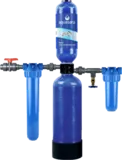
The standard Rhino is an upflow dual-tank system. The bottom tank holds activated carbon for chlorine; the top tank holds copper-zinc KDF, which Aquasana says helps with chlorine and inhibits bacteria and algae growth inside the tank. A 20-inch sediment pre-filter sits in front and a 10-inch post-filter behind. The Rhino is 46 inches tall and 9 inches wide; the Max Flow is 57 by 11 inches.
The pre-filter is changed every 2 months, which is the most frequent cartridge change of any tank system we cover. The optional Low Maintenance pre-filter stretches that to 6 months at a higher price.
Rhino Chloramines
The Rhino Chloramines swaps the carbon and KDF for 100% catalytic carbon in both tanks, with the same pre-filter and post-filter. WH-1011 is 57 by 11 inches; the Max Flow WH-1021 is 63 by 11 inches, rated 10 gpm with a 12 gpm peak. It costs $400 more than the standard Rhino, and its replacement tank is $1,299 rather than $949.
Certification reality check
The Rhino data sheet says it plainly: “Not certified for contaminant reductions by WQA.” What WQA does certify is the tank’s materials: NSF/ANSI/CAN 61 (materials safety only), CSA B483.1 (materials and structural integrity) and NSF/ANSI/CAN 372 (lead content). Those tell you the tank is safe to hold drinking water. They say nothing about what it removes.
Chlorine reduction is “tested to” NSF/ANSI 42, not certified. The data table shows free chlorine not detected through 480,000 gallons, then reduction slipping to 97.7% at 540,000 gallons, 91.9% at 960,000 gallons and 92.8% at the rated 1,000,000. The overall result is above 97.4%.
For the Rhino Chloramines, the WH-1011 data sheet (also tested to, not certified) shows chloramine reduction of 99.7% at 20,000 gallons, 80.7% at 400,000, and between 68.7% and 75.5% across the last 400,000 gallons. The 83% headline is an average over the tank’s life.
The '78 contaminants' list is not for this filter
The Rhino, Rhino Max Flow and Rhino Chloramines pages show a “78 contaminants” list, including lead, cysts, PFOA and PFOS, copied from Aquasana’s Claryum drinking-water filters. The Rhino data sheet says “All contaminants reduced by this filter are listed” and lists only chlorine.Two more inconsistencies. Aquasana’s Certified Products page says the Rhino Max Flow is “Independently tested and certified to NSF/ANSI Standard 42,” but WQA lists no NSF/ANSI 42 certification for the WH-1000 or WH-1010. And the Max Flow data sheet, rated at 14 gpm, reproduces the identical chlorine data table printed for the 7 gpm WH-1000.
The optional UV add-on is NSF-certified to NSF/ANSI 55 Class B, which covers supplemental treatment of water that is already safe, not disinfection of contaminated water.
Flow and sizing
| Model | Rated flow | Bathrooms | Data sheet pressure drop | Price (Sept 2026) |
|---|---|---|---|---|
| Rhino WH-1000 | 7 gpm | up to 2.5 | 23 psi | $999 |
| Rhino Max Flow WH-1010 | 14 gpm | up to 6 | not reviewed | $1,399 |
| Rhino Chloramines WH-1011 | 7 gpm | up to 2.5 | 12.7 psi | $1,399 |
| Chloramines Max Flow WH-1021 | 10 gpm | up to 6 | not reviewed | $1,749 |
The WH-1000 data sheet lists a 23 psi pressure drop in its NSF/ANSI 42 test, which ran at 60 psi dynamic pressure. That leaves roughly 37 psi downstream at the test’s full flow, before the pre-filter clogs. Aquasana’s own HealthShield data sheet, by contrast, lists 5.4 psi at 5.7 gpm.
Operating range is 20 to 100 psi and 40 to 90 F, on 3/4-inch or 1-inch main lines. If you have more than 2.5 bathrooms, go to the Max Flow. Our sizing guide has the peak-flow method.
Installation needs
The Rhino needs no electricity, drain line or backflushing. The kit includes Schedule 80 PVC fittings, a drain valve, a shut-off valve and the pre-filter and post-filter housings. Aquasana “strongly recommend[s] using a licensed plumber.”
Plan space for the tank height (46 inches for the Rhino, 57 to 63 inches for the larger models) plus two cartridge housings, and for opening the pre-filter housing six times a year. A shut-off valve on each side of the housings makes those changes easier.
For the cost math we assume a plumber at $500 for a non-backwashing tank on an accessible main line.
Running costs over 10 years
Assumptions: $500 install; pre-filter every 2 months (3-pack $36.99, so two packs a year); post-filter every 6 months ($36.99 each); one set of filters comes in the box. The tank is rated 10 years or 1,000,000 gallons, so we show it both lasting the decade and needing one replacement.
| Item | Arithmetic | Rhino WH-1000 | Rhino Chloramines WH-1011 |
|---|---|---|---|
| System | sale price | $999.00 | $1,399.00 |
| Installation | our assumption | $500.00 | $500.00 |
| Pre-filters | 60 changes, less 1 in the box = 59, so 20 three-packs × $36.99 | $739.80 | $739.80 |
| Post-filters | 20 changes, less 1 in the box = 19 × $36.99 | $702.81 | $702.81 |
| 10-year total, tank lasts | $2,941.61 | $3,341.61 | |
| Replacement tank | WH-1000R $949; WH-1011R $1,299 | $949.00 | $1,299.00 |
| 10-year total, heavy use | $3,890.61 | $4,640.61 |
Heavy use means an average family: EPA WaterSense says more than 300 gallons a day, so 300 × 365 = 109,500 gallons a year and 1,000,000 gallons in about 9.1 years.
The free Low Maintenance pre-filter in the current promotion cuts housing openings to twice a year, but replacements cost $73.99 each, so the pre-filter line roughly doubles to about $1,406 over 10 years.
The warranty covers the tank for 10 years or 1,000,000 gallons, prorated to remaining life, and the installation kit and housings for 12 months. It excludes failures from iron or sediment buildup and clogging from not replacing the pre-filter.
Owner complaint patterns
- Trustpilot: Aquasana scores 1.5 from 172 reviews. That covers every Aquasana product, including under-sink and countertop filters. The recurring themes are leaks at filter housings, dismissive support that asks for lots of documentation before sending parts, auto-ship subscription billing, customs fees for Canadian buyers, and warranty claims refused on narrow terms. A Rhino owner wrote on June 23, 2026 that the system “keeps leaking” despite repeated tightening and several housing replacements, and was giving up on it.
- Retail reviews: Home Depot’s Rhino reviews include owners reporting a noticeable pressure drop with two fixtures running, which matches the 23 psi figure on the data sheet.
- Aquasana’s own site shows the Rhino at 5 out of 5 and the Max Flow at 3.7; the Chloramines models show 4 and 4.5. These are seller-hosted ratings.
The pattern is housings and service rather than the carbon itself. If you buy, keep the pre-filter schedule (the warranty depends on it) and lubricate housing O-rings at each change.
Alternatives
- Lower 10-year cost, no 2-month pre-filter: the SpringWell CF1 at $1,160.25 comes to about $2,453 over 10 years. It is also uncertified. See SpringWell vs Aquasana.
- Self-cleaning chloramine tank: the US Water Systems Matrixx backwashes itself but needs a drain and outlet.
- Certified PFAS reduction: the Aquasana HealthShield, at about $11,000 or more over 10 years.
- Drinking water only: the AquaTru Classic at $475, with IAPMO certifications to NSF/ANSI 42, 53, 58 and 401.
Questions people ask
Is the Aquasana Rhino NSF certified?
Not for contaminant reduction. Its performance data sheet says 'Not certified for contaminant reductions by WQA.' The tank is WQA-certified only for materials safety (NSF/ANSI/CAN 61), structural integrity (CSA B483.1) and lead content (NSF/ANSI/CAN 372). Chlorine reduction is tested to NSF/ANSI 42, not certified.
Does the Rhino remove PFAS?
Nothing supports that. The product page shows a '78 contaminants' list including PFOA and PFOS, but the Rhino data sheet says all contaminants reduced by the filter are listed, and it lists only chlorine. Aquasana's PFAS-certified whole-house system is the HealthShield.
What is the difference between the Rhino and the Rhino Chloramines?
The standard Rhino uses activated carbon plus copper-zinc KDF and is tested for chlorine. The Rhino Chloramines uses catalytic carbon in both tanks and is tested for chloramine too, averaging 83% over its rated life. It costs $400 more.
Is Aquasana's 50% off sale real?
Treat the sale price as the real price. On every Aquasana system and replacement tank checked in September 2026, the MSRP shown was exactly twice the sale price.
How often do you change the Rhino pre-filter?
Every 2 months for the standard 20-inch sediment pre-filter (a 3-pack is $36.99), plus the post-filter every 6 months ($36.99). The optional Low Maintenance pre-filter lasts 6 months but costs $73.99.
What happened to the Aquasana EQ-1000 and EQ-600?
Both are discontinued. Aquasana still sells replacement tanks for them (EQ-1000R $949, EQ-600R $713.90). There is no 'Rhino PFAS' model.
Sources
- Aquasana Rhino product page
- Aquasana Rhino Max Flow product page
- Aquasana Rhino Chloramines product page
- Rhino WH-1000 performance data sheet
- Rhino Max Flow WH-1010 performance data sheet
- Rhino Chloramines WH-1011 performance data sheet
- Rhino WH-1000 warranty
- Rhino WH-1000 installation manual
- Aquasana 90-day guarantee
- Aquasana Certified Products page
- WQA listing: Aquasana (NSF/ANSI/CAN 61)
- Rhino replacement tank WH-1000R
- Rhino Chloramines replacement tank WH-1011R
- Aquasana 20-inch pre-filter 3-pack
- Aquasana post-filter replacement
- Trustpilot: aquasana.com
- Home Depot customer reviews: Aquasana Rhino WH-1000
- EPA WaterSense: how we use water