iSpring vs SpringWell
We earn a commission if you buy through links on this page. It never changes which systems we recommend. Details.
Short answerOn city water, the iSpring WGB32B and SpringWell CF1 cost about the same over 10 years ($1,777 to $2,157 vs $2,013), so pick iSpring for the lowest upfront price and SpringWell if you have chloramine or want less upkeep. On wells, the iSpring WGB32BM suits light iron up to 3 ppm; above that, or with a sulfur smell, the SpringWell WS1 wins.
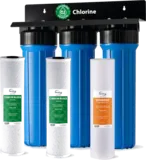
The iSpring WGB32B costs $516.99 against $1,238.99 for a SpringWell CF1 with its bypass valve, but over 10 years the gap nearly closes: $1,776.89 to $2,156.79 for the iSpring, depending on how often you change the sediment filter, against $2,012.59 for the CF1. So the real choice is upkeep and water chemistry, not price.
iSpring’s carbon blocks make no chloramine claim, and its iron model stops at 3 ppm iron. SpringWell’s tanks cover chloramine (CF1) and iron to 7 ppm plus sulfur (WS1), with a lifetime tank warranty against iSpring’s 1 year.
Well & Tap did not install or test these systems. The numbers below come from the iSpring and SpringWell manuals, product pages and NSF listings, with prices checked September 2026 (how we research).
Which one wins for you
- Tight budget, chlorinated city water, DIY install: iSpring WGB32B.
- Chloramine in your city water: SpringWell CF1. The WGB32B does not claim chloramine reduction.
- Well with light iron (up to 3 ppm) and manganese, no sulfur smell: iSpring WGB32BM.
- Well with iron above 3 ppm or a rotten-egg smell: SpringWell WS1.
- Moving within a few years: iSpring. SpringWell’s warranty stays with the original owner at the original address, so its long-term value leaves with the house.
Spec comparison
| iSpring WGB32B | iSpring WGB32BM | SpringWell CF1 | SpringWell WS1 | |
|---|---|---|---|---|
| Type | 3 cartridges | 3 cartridges | carbon tank plus post-filter | backwashing oxidation tank |
| Price (Sept 2026) | $516.99 | $535.99 | $1,160.25 plus $78.74 bypass | $2,231.25 plus $134.25 test and $58.79 bypass |
| Water type | city | well, light iron | city | well |
| Rated flow | 3-15 gpm (15 gpm peak) | 15 gpm | 9 gpm service | 12 gpm |
| Published pressure drop | none | none | none | none |
| Media | 5-micron sediment, 2 carbon blocks | sediment, carbon block, iron and manganese cartridge | KDF, catalytic carbon, 5-micron sediment | air injection, Greensand Fusion |
| Iron / sulfide limits | not rated | iron 3 ppm, manganese 1 ppm; no sulfide rating | not for wells without checking | iron 7, sulfide 8, manganese 1 ppm |
| Chloramine | no claim | no claim | claimed | not applicable |
| Change interval | carbon 100,000 gal or 12 months; sediment 6-12 months | 12 months; iron cartridge 50,000 gal at 3 ppm | sediment 6-9 months; media 10 years (site) | 10+ year media (as stated) |
| Certification | “tested to” NSF/ANSI; not certified | same | none found | none found |
| Drain / power | no / no | no / no | no / no | yes / yes |
| Warranty | 1 year | 1 year | lifetime on tank, valves, heads | lifetime tank; 5 years head |
| Returns | 30 days; 15% fee if opened | 30 days; 15% fee if opened | uninstalled only; 10% fee | uninstalled only; 10% fee |
Differences that matter
Upfront vs 10-year cost
The CF1 costs $722 more on day one ($1,238.99 vs $516.99). It then saves $83.80 a year on filters ($125.99 iSpring pack vs $42.19 SpringWell sediment 2-pack), which would take about 8.6 years to recover ($722 / $83.80).
The CF1’s media replacement ($351.70) keeps the iSpring ahead at 10 years, by $235.70, if you change its sediment filter once a year. Change it every 6 months, as iSpring allows, and the CF1 becomes cheaper by $144.20.
On wells, the WGB32BM’s cost depends on your iron. Its $159.99 annual pack includes one iron cartridge rated 50,000 gallons at 3 ppm. At that iron level and 100,000 gallons a year, you need a second $104.99 iron cartridge each year, and the 10-year cost passes the WS1’s.
Flow and pressure drop
On paper the iSpring flows more: its manual rates the WGB series at 3 to 15 gpm with a 15 gpm peak, against 9 gpm service for the CF1 (12 for the CF4, 20 for the CF+). Neither maker publishes a pressure-drop figure at a given flow, so there is no like-for-like psi comparison.
What differs is where the drop builds. In the iSpring, all three cartridges are fine barriers that restrict flow more as they load; the manual says that when “the pressure is slowing, it may be time to change the filter cartridge.” On the CF1, the only straining element is the single 5-micron cartridge after the tank, so that is the part to watch.
Measure it yourself
iSpring’s manual suggests fitting a pressure gauge on either side of the filter. The same works for any whole-house system: the gap between the two readings with a tap running is your pressure drop, and a growing gap tells you when to change cartridges.
iSpring’s manual also warns that heavy flow in the first 72 hours can cause a temporary carbon blockage. Avoid filling tubs or running multi-head showers until it clears.
Capacity at real household use
EPA’s WaterSense program puts average family use at more than 300 gallons a day. If all of it passes the filter, the iSpring carbon blocks reach their 100,000-gallon rating in about 11 months, so plan on at least annual changes. The CF1’s media is rated 1,000,000 gallons.
Water chemistry each can handle
The WGB32B targets chlorine (up to 99%, per iSpring), sediment, taste and odor, and makes no chloramine claim; iSpring sells a separate WGB32B-KSNC for that. It does not reduce hardness, TDS or fluoride, and iSpring says it is not for bacteria or viruses. See chloramine vs chlorine.
The WGB32BM handles iron up to 3 ppm and manganese up to 1 ppm. iSpring recommends a softener ahead of it if TDS is above 300 ppm, and points to a different model for heavy hydrogen sulfide.
The WS1 handles iron to 7 ppm, sulfide to 8 ppm and manganese to 1 ppm, at pH 6.5 to 10, and SpringWell requires a water test before shipping. Read iron in well water and sulfur smell in well water before choosing.
Certification: neither is certified
iSpring says its carbon blocks are “tested by a third-party to meet NSF/ANSI standards.” NSF’s listing for iSpring covers only its NSF/ANSI 58 reverse osmosis systems; no WGB32B-series system or cartridge appears. The sediment cartridge’s web address even says “nsf-certified”, while its page only claims third-party testing.
SpringWell has no listing at NSF, IAPMO or WQA. The CF1 claims PFAS reduction without a cited standard. If PFAS is your concern, neither system here is the answer; see how to remove PFAS from water.
Installation and upkeep
The iSpring hangs on a wall bracket with 1-inch connections, needs no drain or power, and is designed for DIY install from the manual. It is for indoor use only, at 25 to 80 psi. Each change means opening three housings.
The CF1 is a 48-inch tank (52 inches with head) with a 1-inch connection and no drain or power; its carbon must soak 48 hours before install. The WS1 needs a drain and an outlet for its nightly backwash.
Warranty and returns
iSpring’s warranty is 1 year. Extended cover costs $310.19, $516.99 or $775.49 for 3, 5 or 10 years, so a WGB32B with 10-year cover ($1,292.48) costs more up front than the CF1 with its bypass.
SpringWell covers tanks, valves and housings for life, and electronic heads (the WS1’s) for 5 years. Returns favor iSpring: 30 days, full refund if unopened, 15% fee if opened. SpringWell takes back only uninstalled systems, minus 10%.
Owner feedback is lopsided: iSpring’s Trustpilot page shows 4.9 from 1,888 reviews; SpringWell’s shows 2.9 from 2.
Price over 10 years
Method: purchase price plus 10 years of cartridges, plus one media replacement where it falls due, at September 2026 prices. iSpring’s 15% fall code (valid to October 7, 2026), installation and electricity are not included.
| System | Upfront | Cartridges, 10 years | Media | 10-year total |
|---|---|---|---|---|
| iSpring WGB32B, sediment yearly | $516.99 | $1,259.90 (10 x $125.99) | none | $1,776.89 |
| iSpring WGB32B, sediment every 6 months | $516.99 | $1,639.80 (adds 10 x $37.99) | none | $2,156.79 |
| SpringWell CF1 | $1,238.99 | $421.90 (10 x $42.19) | $351.70 | $2,012.59 |
| iSpring WGB32BM, light iron | $535.99 | $1,599.90 (10 x $159.99) | none | $2,135.89 |
| iSpring WGB32BM, 3 ppm iron at 100,000 gal/yr | $535.99 | $2,649.80 (adds 10 x $104.99) | none | $3,185.79 |
| SpringWell WS1 | $2,424.29 (incl. test, bypass) | none listed | not priced | $2,424.29 plus media |
For more on what drives these numbers, see whole house water filter cost.
Who should buy which
Best on a budget: iSpring WGB32B
Buy it for chlorinated city water if you are comfortable changing cartridges once or twice a year and want to spend about $517 now. Skip it if your utility uses chloramine.
Best for light iron: iSpring WGB32BM
It suits wells with iron up to 3 ppm and no sulfur smell. At 3 ppm its iron cartridge is rated for 50,000 gallons, half the carbon block’s rating, so test first and plan on changing that cartridge more often than the rest. Compare options in best whole house filter for well water.
Best for chloramine and low upkeep: SpringWell CF1
Buy the CF1 if you have chloramine, plan to stay put, and want one small cartridge change instead of three. Full details in the CF1 review.
Best for iron and sulfur: SpringWell WS1
The WS1 is the pick once iron passes 3 ppm or you smell sulfur, up to its 7 ppm and 8 ppm limits. It needs a drain and an outlet.
Questions people ask
Is a cartridge whole house filter as good as a tank system?
For chlorine and sediment on city water, a 3-stage cartridge system like the iSpring WGB32B covers the basics for less money up front. Tank systems hold more media, need fewer changes, and in SpringWell's case add chloramine and well-water options the cartridges do not claim.
Does the iSpring WGB32B reduce water pressure?
iSpring publishes no pressure-drop figure. Its manual says pressure slowing over time is the sign to change cartridges, and suggests fitting pressure gauges on either side of the housings to watch it.
Is the iSpring WGB32B NSF certified?
No. iSpring says its cartridges are tested by a third party to meet NSF/ANSI standards, but NSF's listing for iSpring covers only its reverse osmosis systems, not the WGB32B series or its cartridges.
How often do iSpring whole house filters need changing?
iSpring rates the carbon blocks for 100,000 gallons or 12 months and the sediment filter for 6-12 months. The WGB32BM's iron cartridge is rated 50,000 gallons at 3 ppm iron, so iron-heavy water uses it up faster.
Can I use the SpringWell CF1 on well water?
SpringWell's CF1 manual says not to install it on well water without speaking to customer service first. For iron, manganese or sulfur, SpringWell's well system is the WS1.
Sources
- iSpring WGB32B product page
- iSpring WGB32BM product page
- iSpring F3WGB32B replacement filter pack
- iSpring F3WGB32BM replacement filter pack
- iSpring WCB/WGB series user manual
- iSpring return policy
- iSpring extended warranty options
- iSpring NSF certified collections page
- NSF drinking water treatment listings: iSpring
- SpringWell CF1 product page
- SpringWell CF1/CF4 installation manual (2020)
- SpringWell WS1 product page
- NSF drinking water treatment listings: SpringWell search
- EPA WaterSense: how we use water
- Trustpilot: iSpring